Loops and Lures
I had this idea of a person who keeps getting sidetracked on his way to fishing. It feels like a sitcom with the entrance and ending are the same. He packs up his fishing gear and leaves his house but gets lured towards something else. I don’t really write much prose anymore and I initially envisioned it being filmed as a short while being next to flash fiction. I’ve been shallowly dabbling in AI and thought this would be a fun “newspaper” project. I think AI is pretty dumb but can be hilarious in its vanity. It’s nuance and lack of brevity leaves it clueless. I like the idea of AI being fed with a prompt that’s entries have to deal with the short sightedness of AI and it’s reach. I know most fans hate AI but I want to be up front with its use in this material and my thought on it.
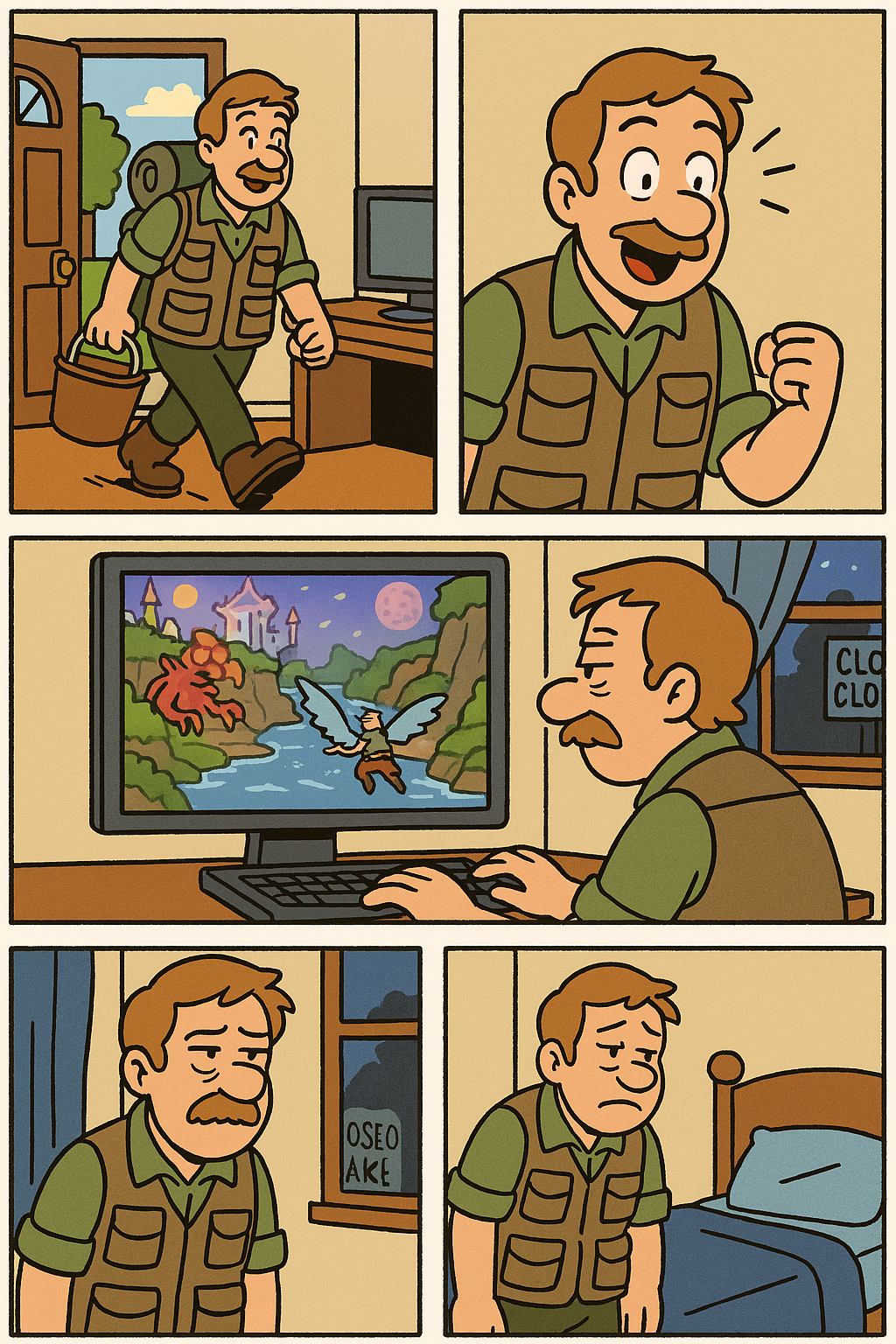
He woke up electric with purpose, already zipped into his fishing vest like a man born inside a tackle box. The thermos was filled, the lures were sorted by color and emotional resonance, and the lake—oh, the lake—waited only a short drive away. He stepped toward the door with the solemn determination of a sitcom dad about to seize his one day off.
Then he saw the glow.
His computer monitor pulsed like a tiny artificial sun, and a memory hit him with the force of a laugh track: the new expansion for his favorite MMORPG had dropped at midnight.
He froze. Blinked. Took one hesitant step toward the door… then three confident ones toward the desk.
Moments later he was logged in, vibrating with excitement. The game world loaded with a shudder, like it had been assembled by interns who were told “just make it weird.” The intro quests were a maze of obtuse instructions and NPCs who spoke in riddles about taxes, cosmic debt, and the nature of trout. His character clipped through a wall, then through the floor, then somehow through the concept of linear time.
But he was smiling. This was home.
He summoned his flying mount—a giant, vaguely disgruntled heron—and soared over shimmering rivers and impossible waterfalls that looped back into themselves. The water physics were wrong in a way that felt right. He drifted down into a quiet canyon where pixelated reeds swayed in a wind that didn’t exist.
Perfect spot.
He set up his in‑game folding chair, cast his digital line, and let the day dissolve. Hours passed in a warm, hypnotic blur of ambient music, inventory management, and the gentle plunk of imaginary fish biting imaginary hooks.
When he finally leaned back and rubbed his eyes, the real world snapped into focus like a bad transition effect. His fishing vest was still on. His boots were still tied. His thermos sat untouched. He squinted out the window, pupils protesting after a full day staring into neon fantasy.
The lake—his actual lake—was closed. The sun had set without him.
He stood, joints stiff, spirit deflated, and trudged toward his bedroom. Still in full fishing gear, he collapsed onto the bed with the weary dignity of a man who had technically fished all day… just not in the dimension he intended.
As sleep crept in, he muttered a single, defeated truth:
“Tomorrow. For real this time.”
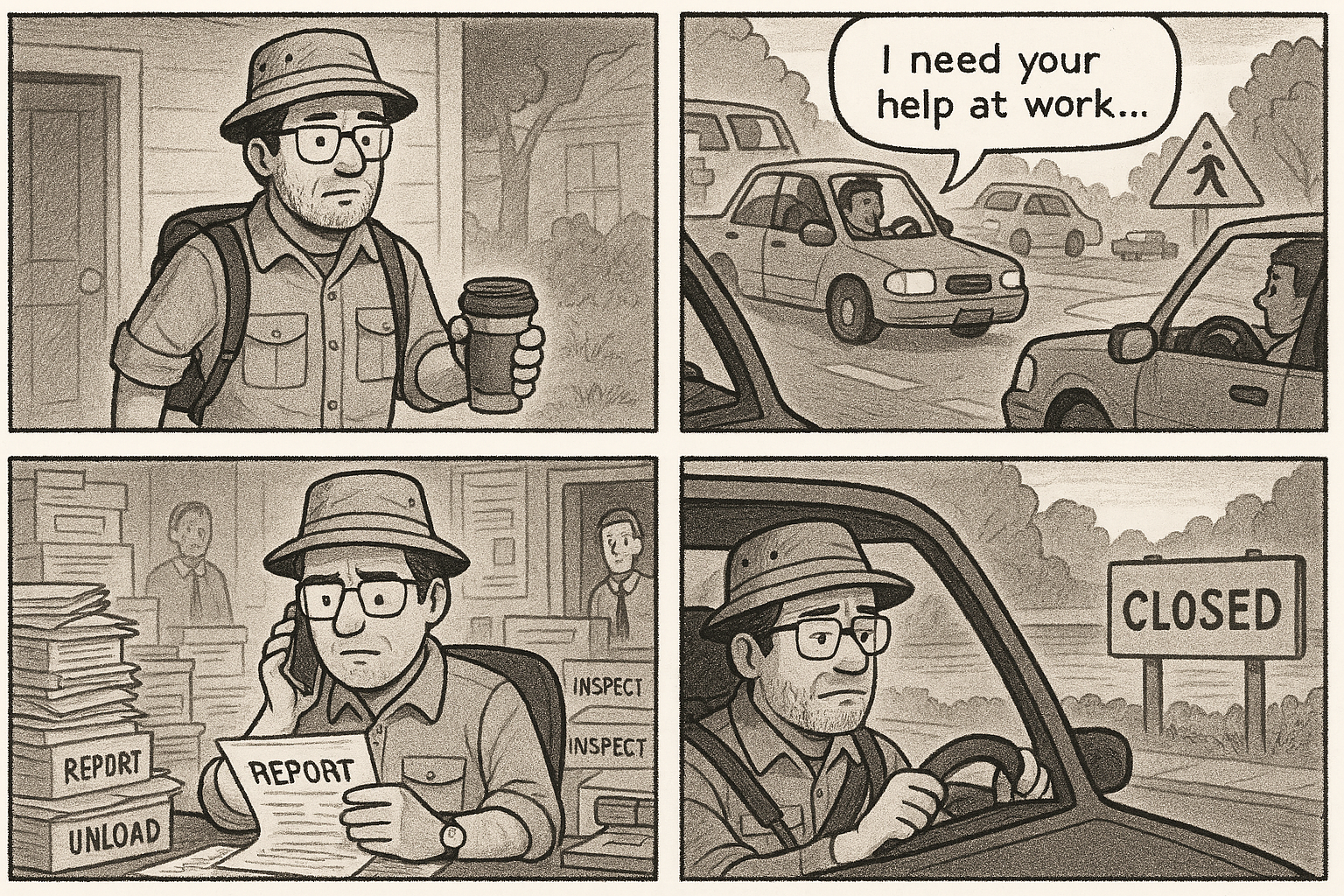
He woke up electric with purpose, the kind of purpose only a man with a packed tackle box and a thermos of gas‑station coffee can feel. The sun wasn’t even up yet, but he was—boots on, cooler loaded, fishing hat angled like a promise. Today, finally, he would get to the lake.
He made it ten minutes down the road before his phone buzzed. A coworker. Of course.
“Hey, uh… weird question,” the coworker said, voice trembling like he was calling from inside a wind tunnel. “Do you know where the Form of Forms is? The one that explains how to request the form that explains how to request forms?”
The man blinked. “What?”
“It’s urgent,” the coworker whispered. “Management says the whole workflow collapses without it.”
Traffic around him slowed to a crawl, as if the town itself overheard the conversation and decided to lean in. A minivan drifted sideways across two lanes like a sleepwalker. A cyclist pedaled backward. A billboard for a dentist now read: WE SEE YOU.
He drove past the lake—so close he could almost smell the water—but the coworker’s panic clung to him like static. He sighed, turned the wheel, and headed toward work.
The office felt wrong the moment he stepped inside. Too bright. Too quiet. A stack of documents waited on his desk, each labeled with titles that contradicted the others. Inventory Forecast for Items We Don’t Sell. Safety Protocols for Imaginary Hazards. Employee Roles for People Who Don’t Exist.
He generated document after document, each one more nonsensical than the last. Every time he finished, someone would appear behind him—sometimes a coworker, sometimes someone he’d never seen before—asking for another. “We need a report on the report about the report,” one said, eyes wide and unblinking.
Then the trucks arrived.
Three of them. All at once. Engines rumbling like beasts that had wandered off the wrong set.
The new service team had vanished—apparently for “spiritual recalibration”—so he was handed a clipboard and told to unload everything himself. The products inside were equally baffling: boxes labeled FRAGILE: DO NOT OPEN stacked beside boxes labeled URGENT: OPEN IMMEDIATELY that contained nothing but packing peanuts and a single laminated smiley face.
He was the funnel of knowledge, they said. The cog that kept the machine turning. The analyst who translated chaos into spreadsheets. But each task drained him, like someone was siphoning off his daylight one minute at a time.
By the time he escaped the building, the sky was bruised purple. He drove toward the lake anyway, clinging to the faint hope that maybe—just maybe—it would still be open.
It wasn’t.
The gate was locked. The sign read CLOSED in letters that seemed larger than usual, as if the universe wanted to make sure he didn’t miss the message.
He sat there for a moment, hands on the wheel, feeling the weight of the day settle into his bones. Then he turned the car around and headed home, tired, defeated, and already knowing tomorrow would probably start the same way.
But for one brief moment, as he passed the dark water, he imagined a ripple—like the lake was waving at him, apologetic.
It didn’t help much.
But it helped a little.
“The Lake Is Closed for Reasons We Cannot Disclose”
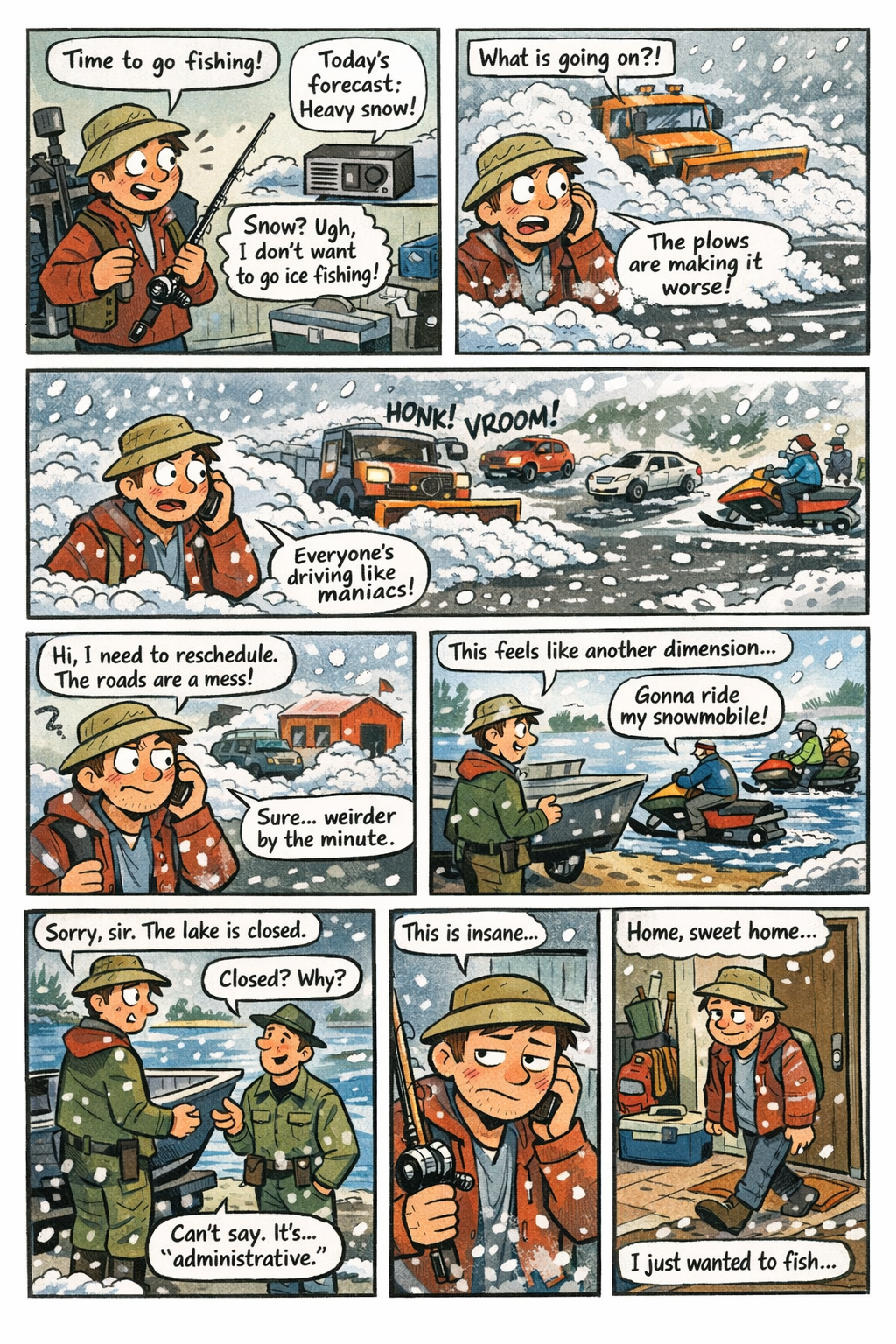
He woke up before dawn, humming with that rare, electric optimism reserved for fishing days. His tackle box was packed, his thermos was full, and his soul—usually a lukewarm soup of work emails and mild regret—felt almost hot.
But the weather report on the radio was muttering about snow. Not a blizzard, not a storm—just snow, said in a tone that implied the meteorologist had seen something in the clouds he wasn’t allowed to talk about.
He eyed his ice‑fishing gear in the corner. The auger glared at him like an ex who knew he’d moved on.
“No,” he said aloud. “Today is a regular fishing day. Sun hat. Boat. Water. Sanity.”
He stepped outside and immediately felt like he’d wandered into a rejected Twilight Zone pilot. Snowflakes drifted lazily from a sky that looked bored. The snowplow trundling down his street was somehow depositing more snow than it was removing, leaving behind a fluffy white berm tall enough to qualify as a national monument.
Traffic was bumper‑to‑bumper, but drivers were peeling off the road, bouncing across medians and lawns like they were in a demolition derby for people who had somewhere to be but no idea how to get there.
His phone buzzed.
BROKER: Running late? Roads are bad.
He sighed and rescheduled the meeting, blaming “ice,” though the ice seemed to be forming only in places that made no meteorological sense—like the tops of stop signs and the inside of his left shoe.
By the time he reached the lake, the world had fully committed to its surreal bit. The lake shimmered, perfectly liquid, but people were unloading snowmobiles anyway, revving them enthusiastically as if preparing for a race across a frozen tundra that did not exist.
One man in a neon snowsuit waved at him.
“Perfect day for it!” the man shouted.
“For what?” he asked.
The man winked. “Exactly.”
He backed his boat toward the ramp, trying to ignore the creeping sensation that the lake was watching him. Just as he was about to launch, a park ranger jogged over, clipboard in hand, expression apologetic in a bureaucratic, cosmic sort of way.
“Sorry, sir. Lake’s closing.”
“Because of the snow?”
“Oh no,” the ranger said, chuckling nervously. “Not snow. Something else. Something… administrative.”
He flipped a page on his clipboard and whispered, “We’re not supposed to elaborate.”
And that was that.
He drove home through the sideways‑logic snowfall, past the plow that continued to create geological features, past the drivers who had given up on roads entirely, past the feeling that the universe was gently but firmly nudging him away from the water.
He arrived home tired, cold, and defeated—still packed, still ready, still wanting.
Somewhere in the distance, a snowmobile revved triumphantly on bare pavement.
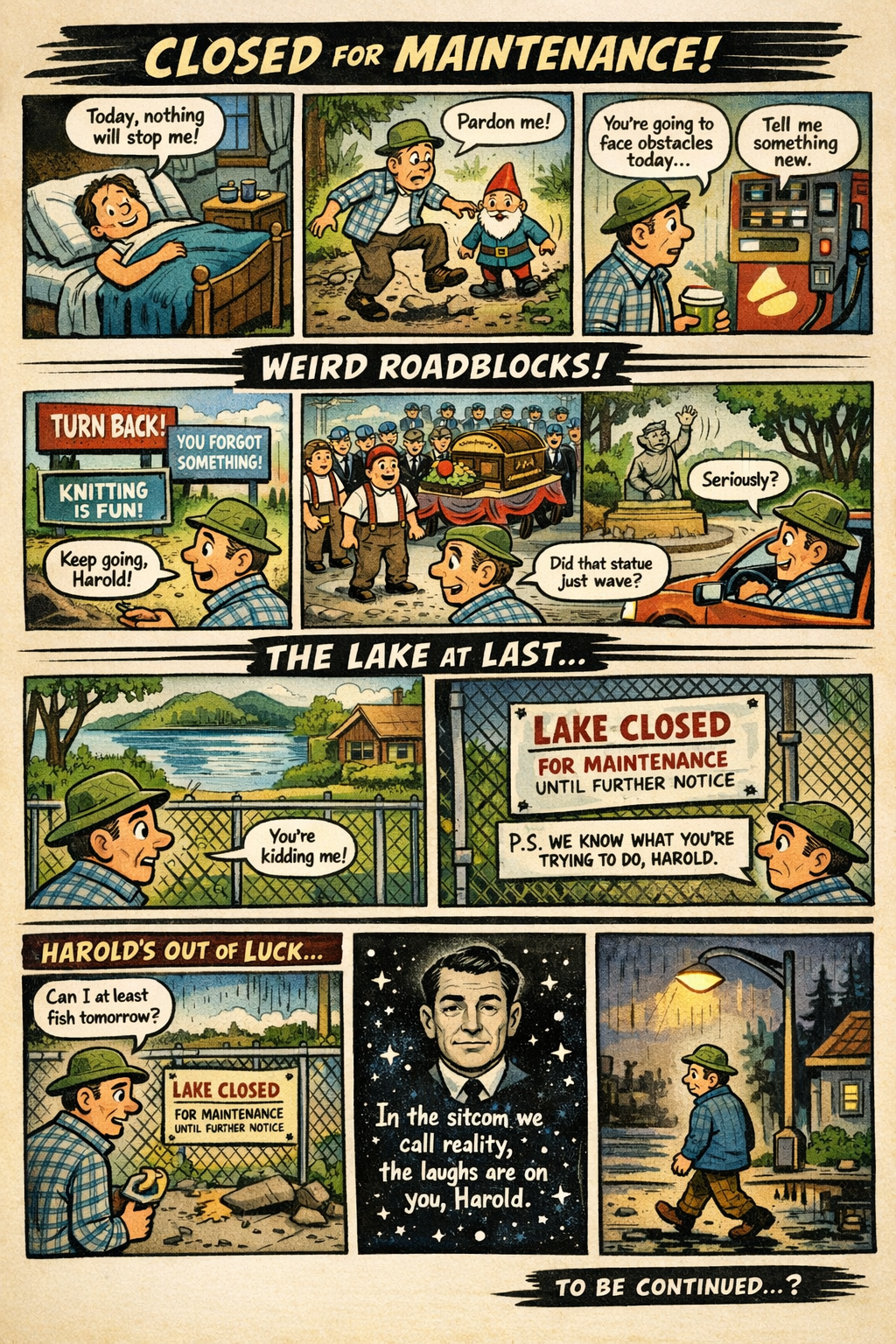
🎣 “Closed for Maintenance” — A Flash Fiction
Harold Bimms woke up at 4:44 a.m., which felt significant in a way he didn’t appreciate. His fishing pole leaned against the wall like a loyal dog. His tackle box clicked open on its own, as if eager. Even his thermos seemed to wink at him.
“Today,” Harold declared to no one, “nothing will stop me.”
The universe, hearing this, cracked its knuckles.
Act I: The Morning of Mildly Impossible Tasks
Harold stepped outside and immediately tripped over a garden gnome he didn’t own. The gnome apologized in a tiny baritone voice, then shuffled away into the neighbor’s bushes.
At the gas station, the pump insisted on telling him his horoscope before dispensing fuel.
“You will encounter obstacles,” it droned.
“I always do,” Harold muttered.
“Ah,” said the pump, “a Pisces.”
Inside, the cashier rang up Harold’s coffee three times, each total different, each receipt printed in a language that looked like cursive static. When Harold asked for clarification, the cashier simply said, “Corporate.”
Act II: The Day of Escalating Shenanigans
On the highway, every billboard changed as he passed:
“TURN BACK.”
“YOU FORGOT SOMETHING.”
“HAVE YOU CONSIDERED KNITTING?”
Harold ignored them. Fishermen do not fear cryptic signage.
Then came the detours. First a construction crew repairing a road that didn’t exist yesterday. Then a parade of identical twins celebrating “National Twin Awareness Day.” Then a slow‑moving funeral procession for a goldfish named Emperor Bubbles III.
By noon, Harold had circled the same roundabout so many times he began waving to the statue in the center. The statue waved back once.
Just once.
Act III: The Lake at Last
As the sun dipped low, Harold finally reached Lake Tranquility, the shimmering jewel of his dreams.
Except today it shimmered behind a chain‑link fence.
A sign hung crookedly:
LAKE CLOSED FOR MAINTENANCE UNTIL FURTHER NOTICE (WE APOLOGIZE FOR THE INCONVENIENCE)
Below it, in smaller letters:
P.S. WE KNOW WHAT YOU'RE TRYING TO DO, HAROLD.
Harold pressed his face to the fence. The lake rippled sympathetically, as if shrugging. A fish leapt once, did a little flip, and splashed back down with a sound suspiciously like laughter.
Act IV: The Twilight Zone Button
Defeated, Harold trudged back to his car. The sky flickered like a dying fluorescent bulb. A narrator’s voice—smooth, omniscient, and slightly judgmental—whispered from nowhere:
“Harold Bimms, a man who wanted only to fish. But in the cosmic sitcom we call existence, desire is bait, and fate… is the one holding the rod.”
Harold sighed.
“Can I at least go tomorrow?”
The narrator paused.
“…We’ll see.”
And the streetlight above him blinked out.
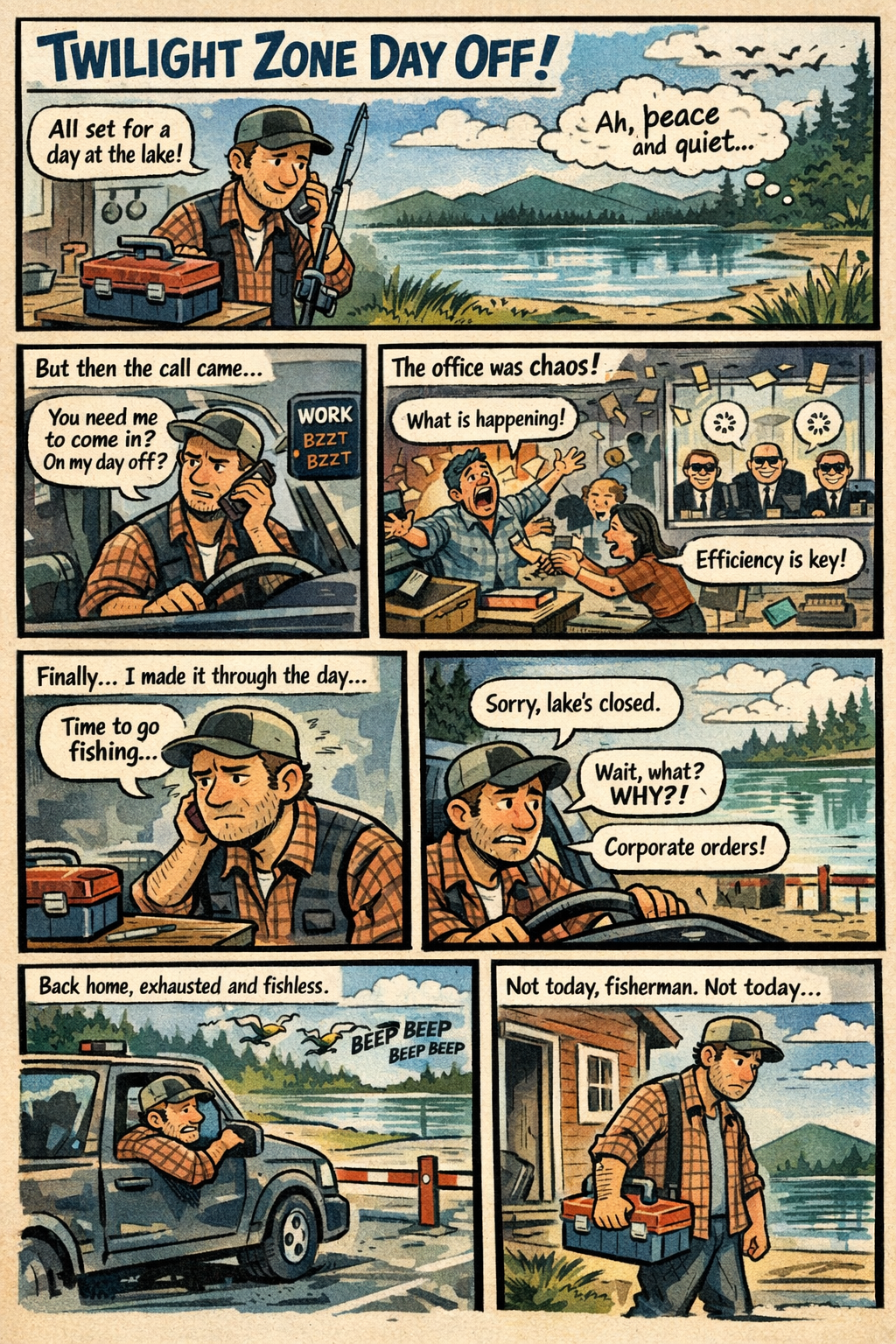
He woke before dawn, humming. The tackle box clicked shut with a satisfying finality, the kind of sound that promised a simple day: lake water, quiet air, maybe a trout with a sense of humor.
But the moment he stepped outside, the world felt… off. The sky had that wrong shade of blue, like someone had adjusted the saturation slider too far. Birds chirped in a rhythm suspiciously close to Morse code. He ignored it. Fishermen don’t fear omens.
Halfway to the lake, his phone buzzed.
WORK flashed across the screen like a threat.
He let it ring once. Twice. Then, with the sigh of a man who already knew the punchline, he answered.
“Hey, uh… we need you,” said his manager, voice trembling like a man calling from inside a collapsing circus tent. “Corporate wants us leaner. More efficient. Everyone’s scrambling. Can you come in? Just for a bit?”
The fisherman stared at the road. The lake shimmered in the distance like a mirage.
“Fine,” he muttered, turning the wheel as if dragged by invisible strings.
Work looked like someone had shaken the building and all the people inside were still vibrating. Papers flew. Phones rang. Nobody answered them. A forklift beeped in the distance for no discernible reason.
All the people who used to care—the ones who knew how things worked, the ones who could fix a jammed printer with a single sigh—were gone. Fired, laid off, or evaporated into the ether. In their place stood frantic newcomers clutching clipboards like flotation devices.
Meanwhile, the corporate executives sat in a glass room above it all, smiling too widely, staring at screens that displayed nothing but spinning loading icons. They nodded at the icons as if receiving divine prophecy.
Two worlds. One building.
He moved through the chaos like a reluctant ghost: answering questions, fixing mistakes, doing three jobs at once while meetings spawned like hydras around him. Every time he solved a problem, two more sprouted. Efficiency, apparently, meant everyone running faster while accomplishing less.
Hours passed. Time bent. The clocks disagreed with each other.
Finally—finally—he escaped.
He drove straight to the lake, exhaustion clinging to him like wet clothes. The sun was low but not gone. He could still salvage this. He could still cast a line, breathe, exist.
But at the entrance, a small office light flicked on. A ranger leaned out the window.
“Sorry, sir. Lake’s closed.”
“For what reason?”
The ranger shrugged. “Corporate said so.”
“Corporate… for the lake?”
Another shrug. “Something about efficiency.”
He sat there, hands on the wheel, staring at the darkening water he wasn’t allowed to touch. The universe had delivered the punchline with perfect comedic timing.
He turned the car around and drove home, tired, defeated, and still carrying the untouched tackle box that had clicked shut with such misplaced optimism that morning.
The birds were still chirping Morse code when he pulled into his driveway. He didn’t bother decoding it. He already knew the message.
It said:
Not today, fisherman. Not today.
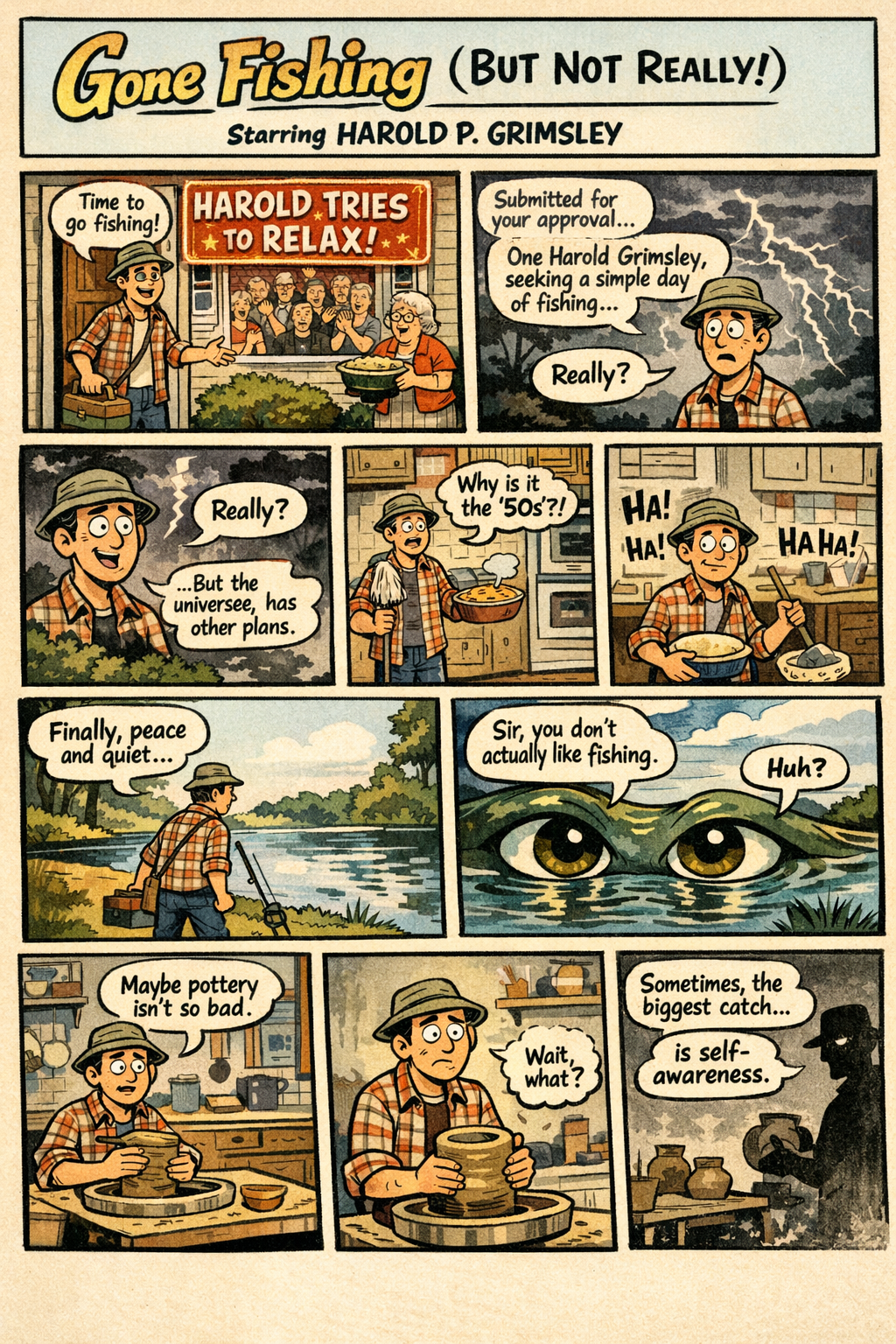
🎣 “Gone Fishing (But Not Really)” — Flash Fiction
Harold P. Grimsley had one dream: to go fishing.
Not a grand dream. Not a heroic dream. Just a man, a pole, and a lake that smelled faintly of algae and broken promises.
But every time he grabbed his tackle box, reality… shifted.
On Monday, he opened his front door and found a live studio audience applauding wildly. A neon sign blinked “HAROLD TRIES TO RELAX!” above his porch. His neighbor, Mrs. Dalloway, popped out from behind a hedge with a casserole and a catchphrase she’d never used before: “Looks like someone’s angling for trouble!” Cue laugh track.
Harold shut the door.
On Tuesday, he tried sneaking out the back. The sky turned sepia. A narrator with a voice like polished mahogany intoned, “Submitted for your approval: one Harold Grimsley, a man who wants nothing more than a quiet day of fishing… but who is about to discover that the universe has other plans.”
Harold looked up. “Seriously?”
Thunder rumbled ominously, which felt rude.
By Wednesday, he was determined. He tiptoed through his living room—only to find it had transformed into a 1950s kitchen set. His fishing rod was now a mop. His tackle box was a pie. A laugh track cackled as he screamed into a decorative throw pillow.
He marched outside anyway.
And there, finally, was the lake.
Still. Quiet. Perfect.
Still. Quiet. Perfect.
He exhaled, stepped forward… and the lake blinked. Literally blinked. Two enormous eyes opened in the water and regarded him with mild curiosity.
“Sir,” the lake said, in a voice that sounded suspiciously like his high school gym teacher, “you don’t actually like fishing.”
Harold froze. “I… what?”
“You like the idea of liking fishing. Big difference.”
The studio audience “awww’d” sympathetically.
Harold lowered his rod. “So what do I do?”
The lake shrugged—an impressive feat for a body of water. “Try something else. Maybe pottery.”
The world snapped back to normal. No laugh track. No narrator. Just Harold, standing alone with a fishing pole he suddenly realized he had no idea how to use.
He went home. Googled pottery classes. Signed up for one.
And somewhere, in a dimension just slightly to the left of this one, a narrator whispered:
“Sometimes, the biggest catch… is self‑awareness.”
The Vanishing Act
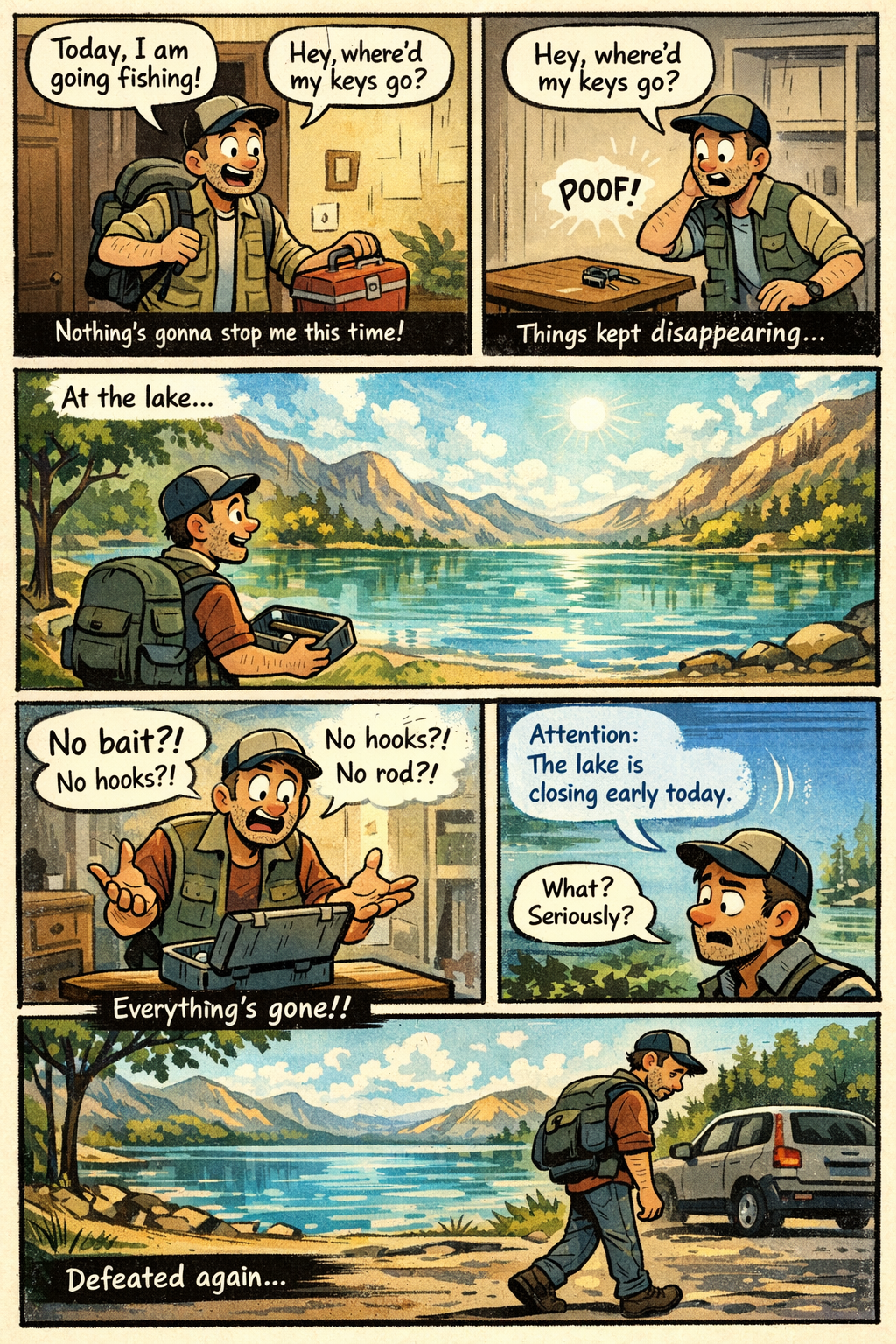
He woke before his alarm, bright‑eyed, backpack zipped, tackle box neatly squared away like a man who refused to be thwarted by the universe for the fifth weekend in a row. Today, he told himself, he would fish. He said it out loud, too, just to make it official.
But the universe heard him.
He stepped into the hallway and noticed the first disappearance: his keys. Gone. Not misplaced—gone, like they’d been erased from the script. He turned around to retrace his steps, and there they were, sitting politely on the counter as if they’d been there all along, judging him.
He shrugged it off. Sitcom laugh track. Cue theme music.
On the drive to the lake, things kept blinking out of existence. His water bottle vanished when he looked left. His sunglasses disappeared when he looked right. His entire passenger seat briefly flickered into a void of static before reassembling itself when he blinked twice. It was as if the world only existed when he faced it directly—like a cosmic stagehand was cutting corners.
By the time he reached his favorite fishing spot, the world had stabilized. The lake shimmered like nirvana—hyper‑detailed, impossibly serene, every ripple rendered with divine precision. It was the kind of lake that made monks weep and poets retire.
He exhaled. Finally.
He reached into his tackle box for bait.
Gone.
He checked again.
Still gone.
He turned around to see if it had reappeared behind him.
It had not.
He sighed and reached for his hooks.
Also gone.
He checked for lures.
Gone.
He checked for his entire fishing rod.
Gone.
He stared at the empty space in his hands where the rod should have been, as if the universe had simply decided he didn’t need props for this episode.
He tried walking in a circle, switching directions, spinning like a confused NPC hoping the items would respawn. Nothing. The lake remained perfect. He remained empty‑handed.
Then a voice—disembodied, bored, vaguely municipal—echoed across the water:
“Attention visitors: due to… uh… unforeseen circumstances, the lake will be closing early today.”
He looked around. No ranger. No speaker. Just the voice, drifting like a shrug.
He stood there in the golden, impossible light of the lake that refused to let him fish, feeling the laugh track fade into a melancholy hum.
He trudged back to his car, defeated, tired, and carrying absolutely nothing because everything had vanished.
Another day, another episode, another fishing trip that never happened.
And somewhere, in the cosmic writer’s room, someone said:
“Same time next week?”
🎣 “The Day the Lake Forgot Him”
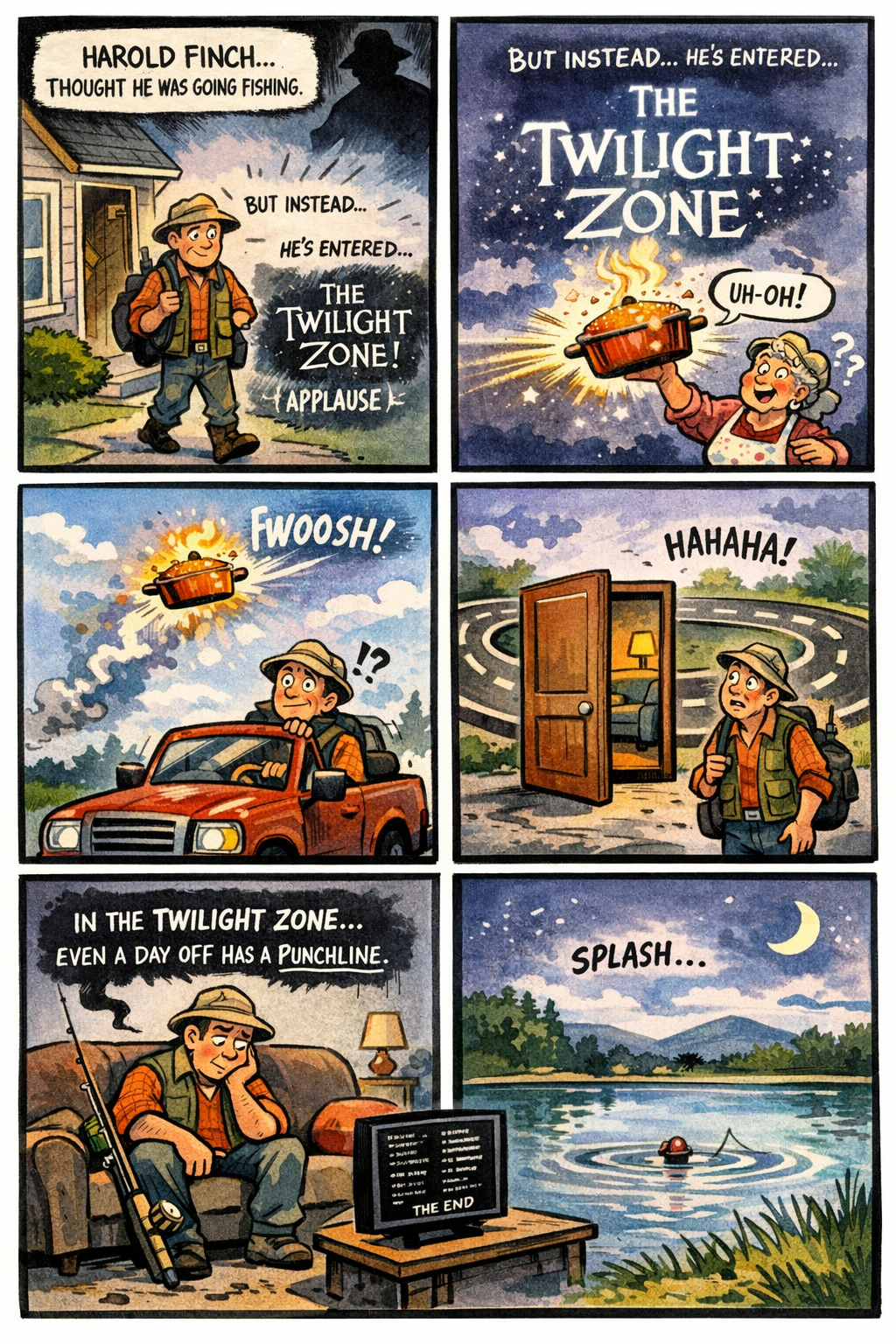
Harold Finch woke before his alarm, which should’ve been the first warning. No mortal man wakes up eager at 5:12 a.m. unless the universe is winding up for a punchline. But Harold didn’t question it. Today was fishing day. His gear was packed, his thermos was full, and his heart was light as a sitcom theme song.
He stepped outside—and the world applauded.
Actual applause. A laugh track, too. Somewhere above the clouds, an invisible studio audience was warming up. Harold froze on his porch as a disembodied voice boomed:
“Harold Finch… thought he was going fishing.”
A dramatic pause.
A spooky chord.
A cymbal crash.
“But today… he’s entered… The Twilight Zone.”
Harold sighed. “Not again.”
He marched toward his truck, determined not to let narration derail his plans. But the moment he touched the door handle, his neighbor Mrs. Dalloway burst out of her house holding a casserole the size of a small asteroid.
“Oh Harold, thank goodness you’re here!” she cried. “I need you to taste-test my new recipe. It’s for the Neighborhood Casserole-Off!”
A trumpet played a goofy “wah-wah-waaaah.”
Harold’s eye twitched. “I’m… going fishing.”
The audience laughed.
But Mrs. Dalloway’s casserole began to vibrate. The lid rattled. A low hum filled the air. Harold stepped back as the casserole rose from her hands, glowing like a UFO with cheddar-based propulsion.
“Oh dear,” she whispered. “It’s happening again.”
The casserole shot into the sky, leaving a trail of steam and oregano. The laugh track roared. Harold checked his watch. 5:27 a.m. Still time to fish.
He sprinted to his truck. The engine started. Victory. He pulled out of the driveway—only to find the road looping back into itself like a Möbius strip. Every turn brought him back to his own mailbox.
A sign materialized on the curb:
“YOU ARE HERE.”
Another sign popped up beneath it:
“YOU ARE STILL HERE.”
Harold groaned. “Come on.”
A narrator whispered:
“In the Twilight Zone… all roads lead home.”
Harold parked, got out, and walked. Maybe the lake was reachable on foot. But the sidewalk stretched on endlessly, repeating the same three houses like a background in a low-budget cartoon. Mrs. Dalloway waved from each one, holding a different casserole each time.
Hours passed. The sun looped in the sky like a skipping record. A laugh track erupted whenever Harold tripped, sighed, or expressed even mild frustration. At one point, a door appeared in the middle of the street labeled “EXIT.” He opened it and found… his living room.
By sunset, Harold stumbled back inside, exhausted, smelling faintly of oregano and cosmic irony. He dropped his fishing pole on the floor.
The narrator returned, smug as ever:
“Harold Finch wanted a simple day at the lake. But sometimes, the universe has other plans. Plans involving casseroles, looping roads, and laugh tracks that mock the human condition. And so Harold ends his day not with a fish… but with a lesson.”
A beat.
A spooky chord.
“In the Twilight Zone… even a day off has a punchline.”
Harold collapsed onto the couch.
The audience applauded.
The credits rolled.
And somewhere, far away, the lake waited—quiet, serene, and utterly unreachable.
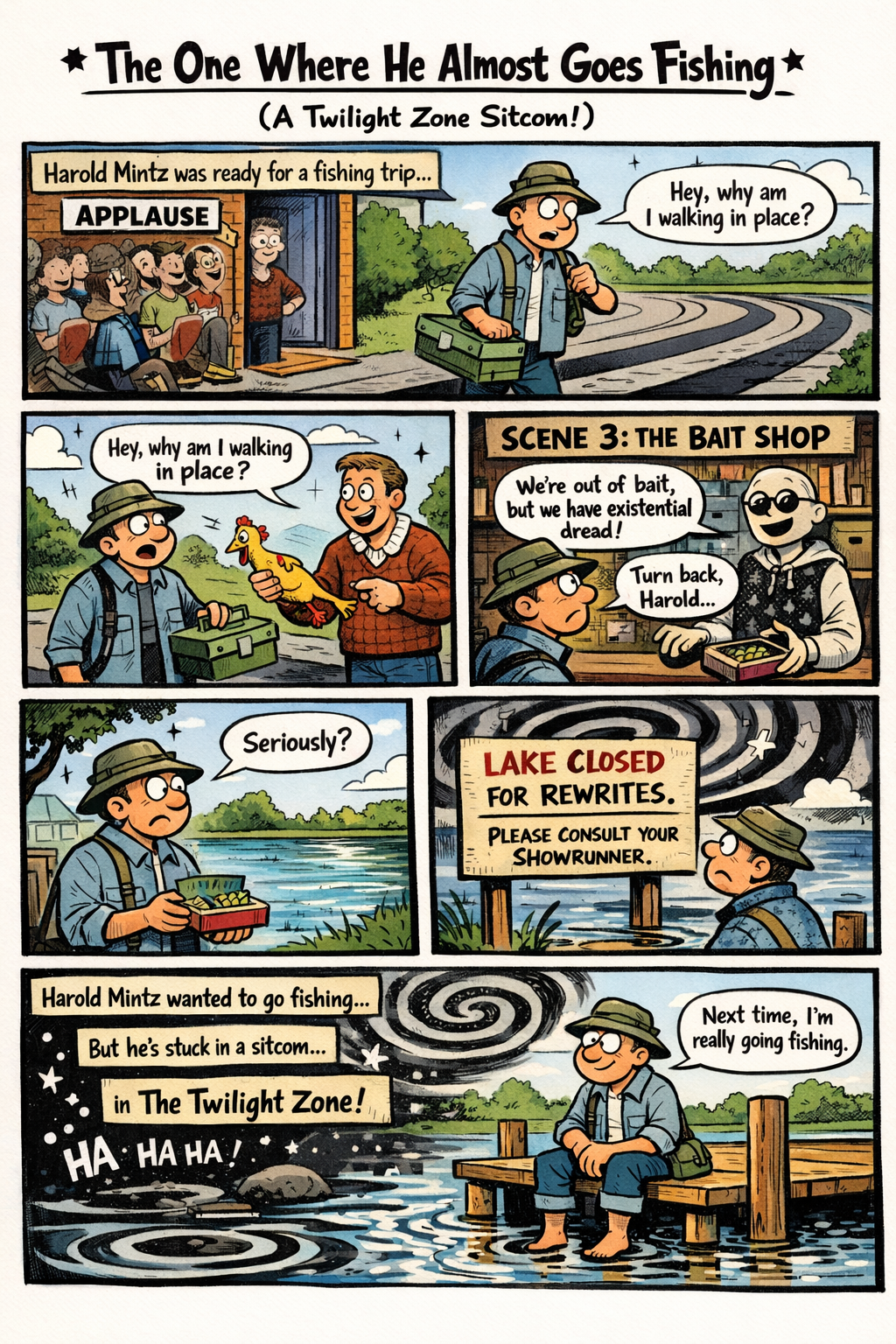
🎣 “The One Where He Almost Goes Fishing”
(A sitcom that accidentally wandered into The Twilight Zone)
Harold Mintz woke up with the serene certainty of a man destined—destined—to go fishing. The sun glowed just right. The birds chirped in a suspiciously on‑beat harmony. Even his alarm clock winked at him, as if to say, Buddy, today’s your day.
He whistled his way to the front door, tackle box in hand, only to find a studio audience applauding. He froze. The applause sign above his hallway flickered, then went dark.
“Odd,” he muttered, stepping outside.
The sidewalk had been replaced with a perfectly looping conveyor belt. Each time Harold took a step, he ended up exactly where he started. A laugh track erupted. A disembodied voice chimed in:
“Harold Mintz thought he was heading to the lake.
But today, he’s wading into… The Twilight Zone.”
Harold sighed. “Not again.”
A neighbor he’d never seen before—tall, smiling too wide, wearing a sweater that radiated 1950s optimism—leaned over the fence.
“Going fishing, Harold? Oh, you won’t need that where you’re going.”
He handed Harold a rubber chicken.
Cue laugh track.
Harold tried to walk away, but the conveyor belt finally released him—only to deposit him in front of a door labeled SCENE 3: THE BAIT SHOP.
Inside, the shopkeeper was a mannequin with googly eyes glued on. It rotated its head 360 degrees and chirped, “We’re out of bait, but we do have existential dread on sale!”
Harold grabbed a pack of worms anyway. They whispered, “Turn back.”
He didn’t.
He marched onward, through a hallway that shouldn’t exist, past a family eating dinner in a kitchen that definitely wasn’t his, through a laugh track that was starting to sound tired of itself.
Finally—finally—he reached the lake.
It shimmered like a TV screen paused mid‑commercial. A sign hung from a single nail:
LAKE CLOSED FOR REWRITES.
PLEASE CONSULT YOUR SHOWRUNNER.
Harold stared at it. The wind sighed sympathetically.
Then the narrator returned:
“Harold Mintz wanted a quiet day of fishing.
But sometimes the universe has other plans—
especially when the universe is a sitcom with a broken script.”
Harold sat on the dock anyway, dangling his feet over the glitching water.
“Fine,” he said. “But next episode, I’m going fishing.”
The laugh track agreed. The universe did not.
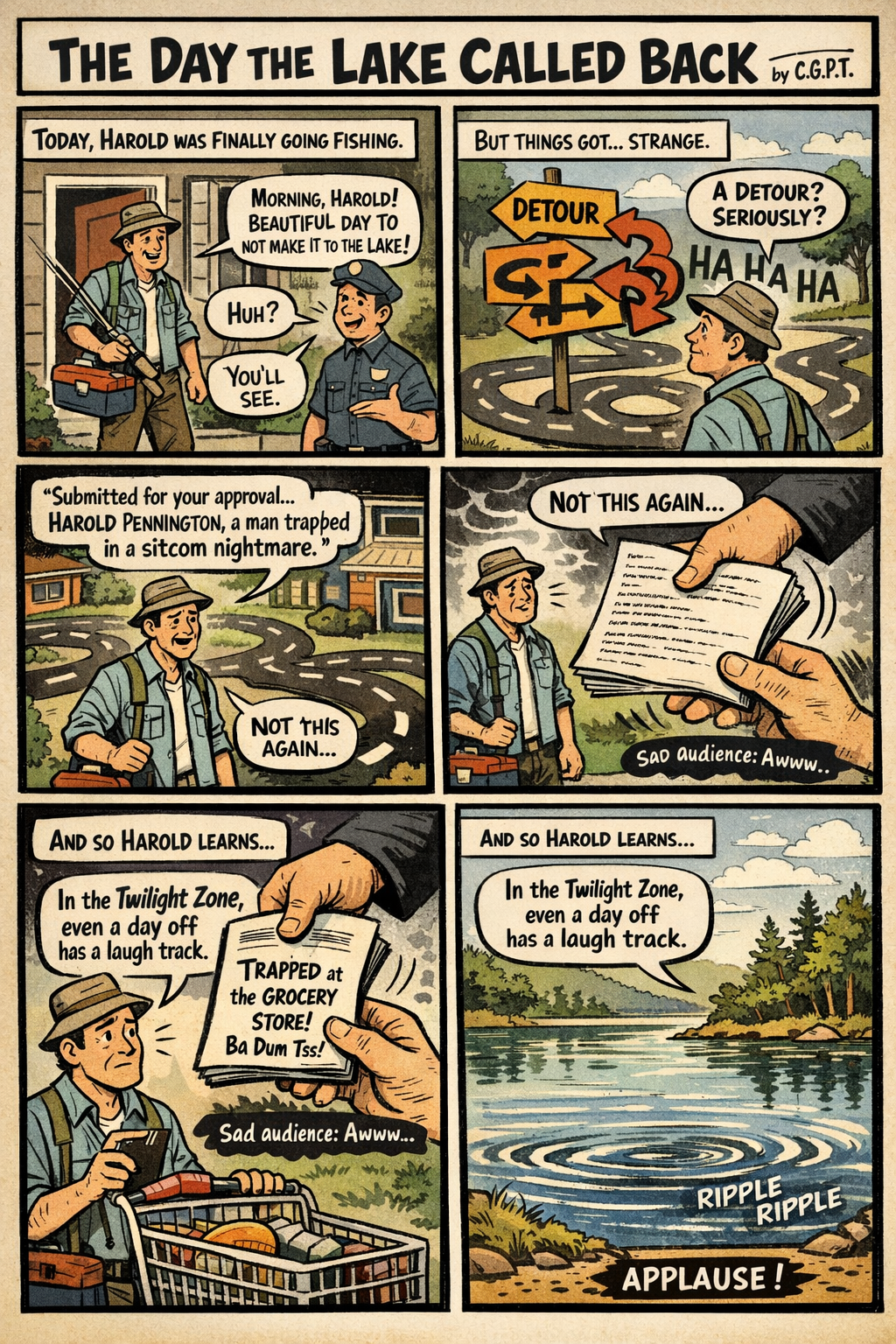
“The Day the Lake Called Back”
Harold woke up with the kind of optimism usually reserved for lottery winners and golden retrievers. Today—finally—he was going fishing. No errands, no chores, no unexpected visits from neighbors wanting to borrow hedge trimmers. Just him, his tackle box, and the quiet shimmer of Lake Merriweather.
He stepped outside, locked the door, and immediately noticed the mailman standing perfectly still on the sidewalk, staring at him with a sitcom‑freeze‑frame smile.
“Morning, Harold,” the mailman said, still not blinking. “Beautiful day to not make it to the lake.”
Harold blinked. “I’m… sorry?”
The mailman winked like a man who had been instructed to wink by someone who had never winked before. “You’ll see.”
Harold decided that was a problem for Future Harold and kept walking.
At the end of the block, he found a detour sign that hadn’t been there yesterday. It pointed left, then right, then somehow back at itself like a snake eating its own tail. A laugh track echoed faintly in the distance.
He ignored it.
But the world didn’t.
Every street he turned down looped him back to his own driveway. Every time he tried to call a rideshare, the app insisted he was already at his destination. A bus pulled up beside him with the marquee LAKE MERRIWEATHER EXPRESS, but when the doors opened, the interior was just an infinite hallway of identical bus interiors stretching into the void.
A narrator’s voice drifted from nowhere and everywhere at once:
“Submitted for your approval: Harold J. Pennington, a man whose only desire is a quiet day of fishing. But in the neighborhood known as the Twilight Zone, even the simplest plans are subject to cosmic reruns.”
Harold groaned. “Not again.”
A studio audience “awww’d” sympathetically.
He tried one last time—one heroic, determined step toward the horizon. The sky flickered like a dying fluorescent bulb. A giant hand descended from above holding a script.
Harold’s name was highlighted.
“Looks like you’re in the B‑plot today,” the hand said in a bored producer’s voice. “Fishing episode got bumped.”
Harold sighed, defeated. “Fine. What’s the B‑plot?”
The hand flipped the page. “You get trapped in an existential loop at the grocery store.”
A rimshot played.
Harold trudged toward the nearest supermarket as the narrator wrapped things up:
“And so Harold Pennington learns that in the Twilight Zone, even a day off has a laugh track. And the fish? Well… they’ll have to wait for the season finale.”
The audience applauded. The credits rolled. Harold pushed a shopping cart that squeaked in perfect comedic timing.
And somewhere, far away, the lake rippled—like it was laughing too.
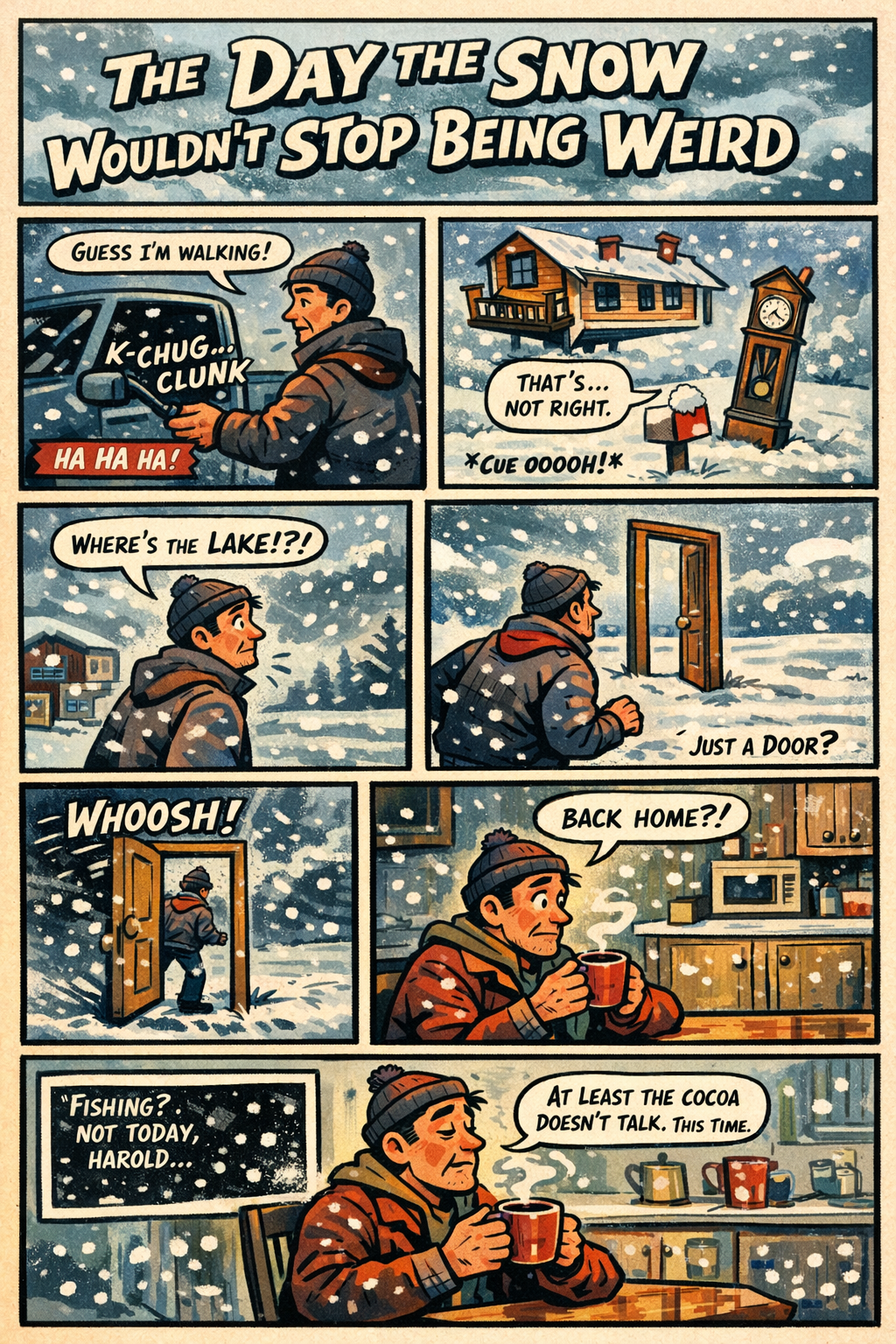
❄️ “The Day the Snow Wouldn’t Stop Being Weird”
By the time Harold stepped outside with his fishing pole, the snow was already falling sideways. Not blowing—falling. Perfectly horizontal, like it had somewhere urgent to be. He squinted at it, shrugged, and marched toward his truck, humming the theme song of a sitcom he couldn’t quite place.
He turned the key. The engine made a noise like a confused goose and refused to start.
Laugh track.
Harold sighed, got out, and decided he’d walk to the lake. It was only a mile. Maybe two. Maybe three. The snow rearranged itself every time he blinked, so distances felt optional.
Halfway down the road, he noticed the houses were… wrong. Mrs. Delaney’s porch swing was on the roof. The Johnsons’ mailbox was now a grandfather clock. A snowman waved at him with too many arms.
Cue canned audience “ooooh.”
Harold trudged on, determined. Today, he would fish. He would. He deserved it. He’d packed sandwiches. He’d packed optimism. He’d even packed the lucky lure shaped like a disgruntled trout.
When he reached the lake, he stopped.
The lake was gone.
Not frozen. Not thawed.
Gone.
In its place was a perfectly flat field of snow, stretching out like a blank page. A single wooden doorframe stood in the center, unattached to anything, gently swaying in the wind.
Harold approached it. The doorframe hummed. A studio audience murmured with anticipation.
He stepped through.
Instantly he was back in his kitchen, dripping snow onto the linoleum. His fishing pole leaned against the counter, already dry. His sandwiches were unwrapped and half-eaten, though he didn’t remember eating them.
A narrator’s voice drifted from nowhere and everywhere:
“Harold Jensen, a man who wanted nothing more than a quiet day of fishing. But in the snowy cul-de-sac between desire and destiny, he discovered that some days simply refuse to cooperate. Especially in… the Twilight Zone.”
Harold sighed, hung up his coat, and made himself a cup of cocoa.
He didn’t get to fish.
But at least the cocoa didn’t talk.
This time.
The Sidetracked Fisherman (Season 1, Episode… Unknown)
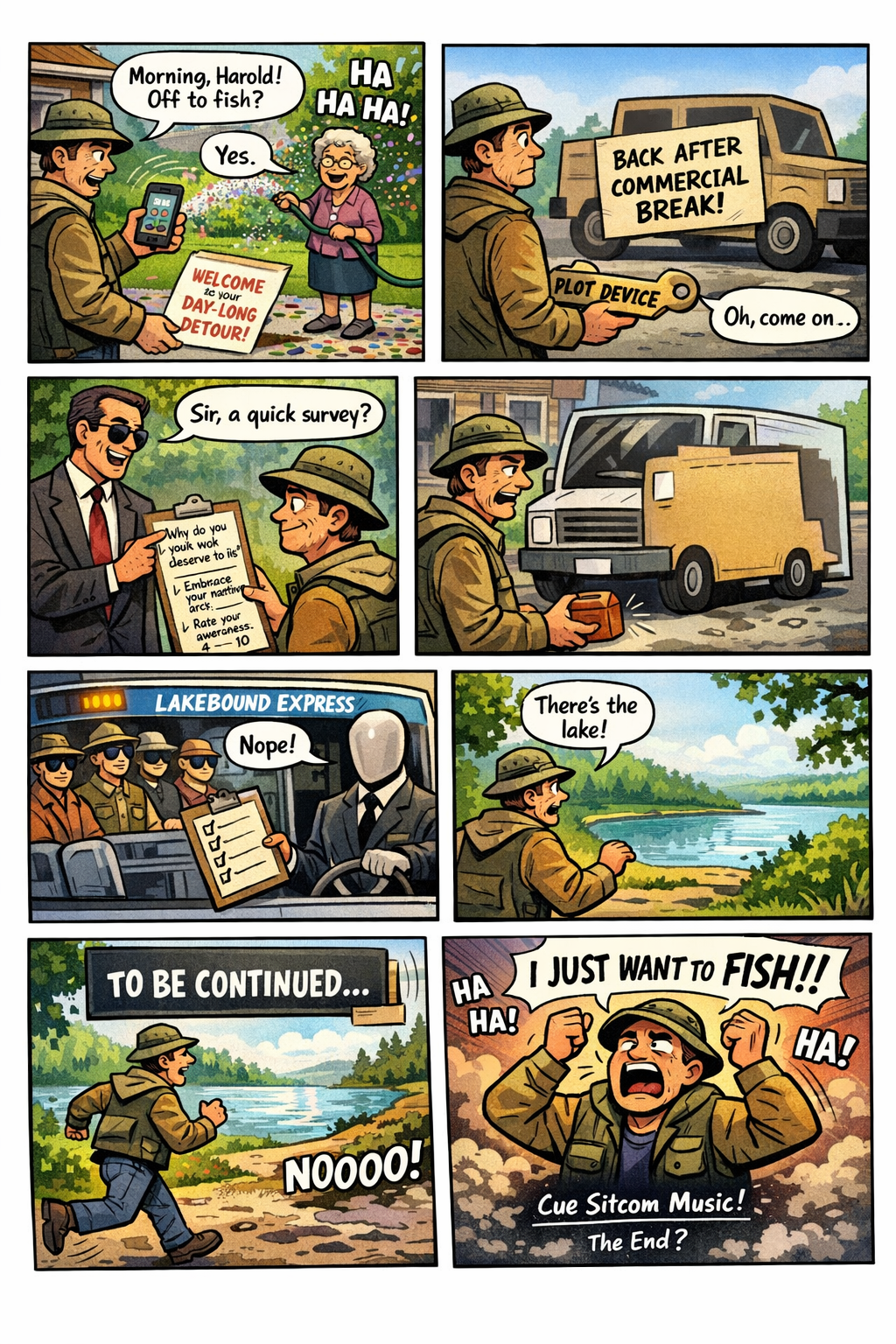
Harold wakes up with the serene conviction that today—finally—he will go fishing. The lake is calling. Not metaphorically. Literally. His phone keeps buzzing with a caller ID that reads LAKE. He ignores it. He’s not falling for another prank from the guys at work.
He grabs his tackle box, steps outside, and immediately slips on a pamphlet that wasn’t there a second ago:
“WELCOME TO YOUR DAY-LONG DETOUR! PLEASE ENJOY RESPONSIBLY.”
A laugh track plays from nowhere. Harold looks around. No audience. Just his neighbor, Mrs. Pennington, watering her lawn with a hose that sprays confetti instead of water.
“Morning, Harold! Off to fish?” she chirps.
“Yes,” he says, stepping carefully around the confetti puddles.
“Oh good! You’ll need this.” She hands him a single car key labeled PLOT DEVICE. Before he can ask, she winks and walks back inside. The door closes. Applause.
Harold shrugs and heads to his truck—only to find it missing. In its place is a cardboard cutout of his truck with a sticky note:
“BACK AFTER COMMERCIAL BREAK.”
He sighs and starts walking.
Halfway down the street, a man in a suit stops him. “Sir, do you have a moment to answer a brief survey about your destiny?” The man’s tie spins like a propeller.
“No,” Harold says.
“Excellent!” the man replies, handing him a clipboard anyway. The questions include:
Why do you think you deserve to fish?
Have you considered embracing your narrative arc?
On a scale of 1–10, how aware are you that you’re in an episode?
Harold drops the clipboard and keeps walking.
The sky flickers like a dying fluorescent bulb. A narrator’s voice booms overhead:
“Harold Jensen, a simple man with a simple dream. But dreams, like fishing lines, often get tangled… in the Twilight Zone.”
Harold groans. “Not again.”
He reaches the bus stop. A bus labeled LAKEBOUND EXPRESS pulls up. Finally. He steps on.
Inside, every passenger is wearing fishing gear but staring blankly ahead, unmoving, like mannequins. The driver turns around—he has no face, just a smooth surface like a polished stone.
“Exact change only,” the driver says, despite having no mouth.
Harold backs off the bus.
The bus drives away, revealing the lake shimmering just beyond it. He can see it. He can smell it. He can practically hear the fish mocking him.
He sprints toward the water.
Just as he reaches the shore, a studio audience gasps. A giant sign drops from the sky with a thud:
“TO BE CONTINUED…”
Harold screams into the void, “I JUST WANT TO FISH!”
Cue upbeat sitcom outro music.
Fade to static.