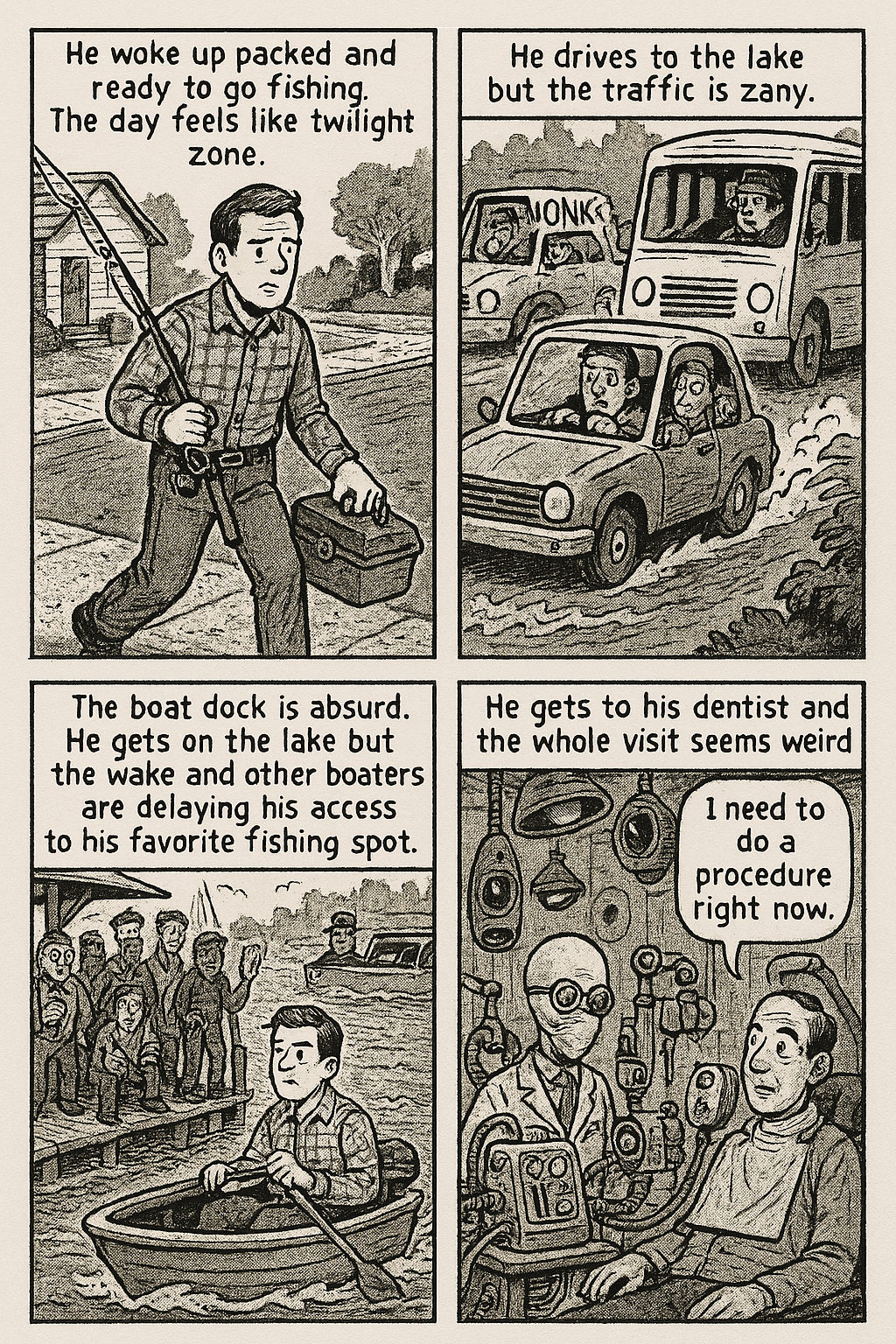
Loops and Lures
I had this idea of a person who keeps getting sidetracked on his way to fishing. It feels like a sitcom with the entrance and ending are the same. He packs up his fishing gear and leaves his house but gets lured towards something else. I don’t really write much prose anymore and I initially envisioned it being filmed as a short while being next to flash fiction. I’ve been shallowly dabbling in AI and thought this would be a fun “newspaper” project. I think AI is pretty dumb but can be hilarious in its vanity. It’s nuance and lack of brevity leaves it clueless. I like the idea of AI being fed with a prompt that’s entries have to deal with the short sightedness of AI and it’s reach. I know most fans hate AI but I want to be up front with its use in this material and my thought on it.
The morning had that canned‑laughter glow to it—the kind of sunshine that practically winked at you. Marty took it as a sign. Today, finally, he would go fishing. No errands, no chores, no “quick favors.” Just him, his tackle box, and the quiet lake waiting like a promise.
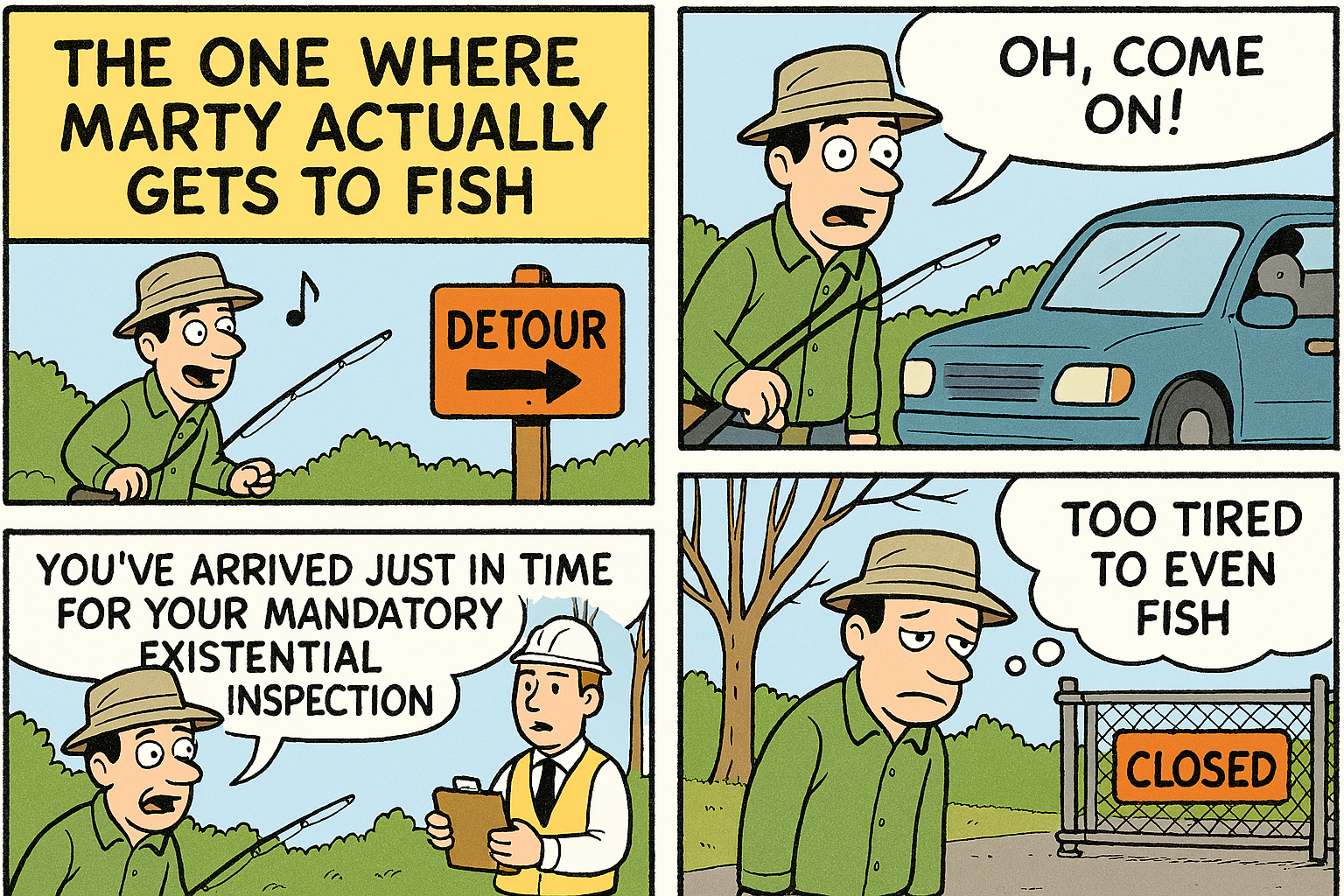
He whistled as he drove, windows down, thermos full, the whole thing feeling like the cold open of a sitcom episode titled The One Where Marty Actually Gets to Fish.
Then he saw it.
A detour sign.
Bright orange.
Pointing away from the lake.
He frowned. The road had never had a detour before. In fact, he’d driven it every weekend for years. But the sign blinked—literally blinked—like an eye winking at him. And when he tried to ignore it, the arrow rotated on its own, swiveling to follow him.
That was… new.
Marty sighed, turned the wheel, and followed the sign down a narrow road he didn’t recognize. The trees leaned in too close, like they were eavesdropping. The radio fuzzed into static, then into a voice that sounded suspiciously like his high school guidance counselor saying, “Recalculating your life choices…”
He pulled into a clearing where a lone man in a reflective vest waved him down. The vest was normal. The man’s three identical shadows were not.
“Sir,” the man said, “you’ve arrived just in time for your mandatory existential inspection.”
“My what?”
The man handed him a clipboard. The questions were… odd.
Have you ever felt watched by inanimate objects?
Do you believe time is a hallway or a circle?
If given the chance, would you apologize to your eighth‑grade self?
Marty tried to leave, but every path out of the clearing looped him right back to the man with the clipboard. After the fifth attempt, he gave up and filled out the form. Then came the “processing phase,” which involved sitting in a lawn chair while the man hummed a single note for forty‑five minutes.
By the time Marty was released—“You’re cleared for continued existence, pending review”—he felt wrung out like a dish towel. His arms ached. His brain buzzed. His soul needed a nap.
He drove back toward the lake, desperate for even ten minutes of peace on the water.
But as he passed the entrance, the gate clanged shut. A sign flipped from OPEN to CLOSED with the theatrical flourish of a stage magician.
Marty slowed, stared, and let his forehead fall against the steering wheel.
The laugh track in his head finally kicked in.
He drove home in silence, exhausted, defeated, and smelling faintly of existential paperwork. The lake would have to wait for another episode.
The man should have known the day was too perfect.
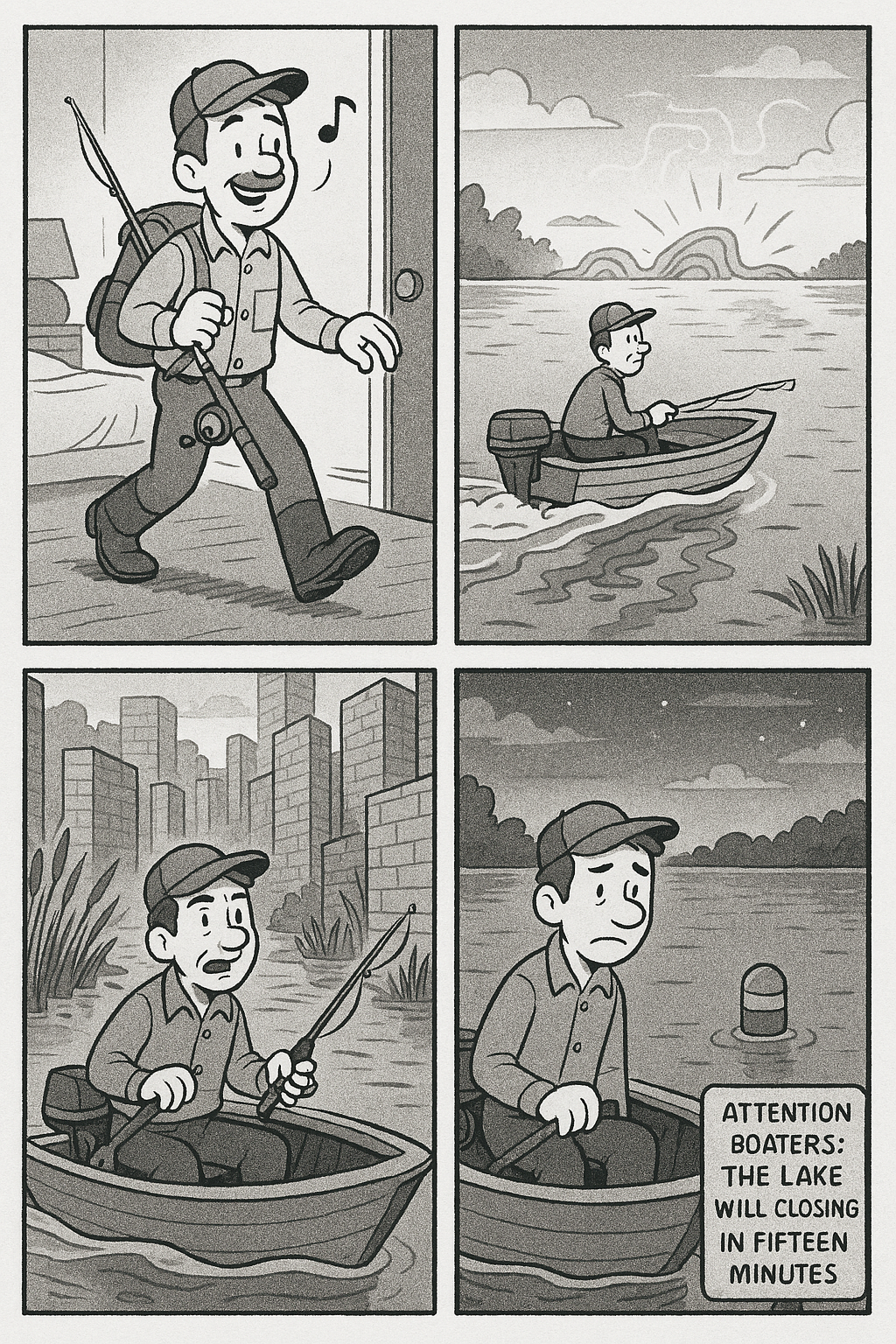
He woke before his alarm, humming the theme song of some forgotten ’90s sitcom, the kind with canned laughter and a dad who always wore the same sweater. His tackle box was already packed. His thermos was already full. His boat key practically leapt into his hand like it wanted this as badly as he did.
By the time he pushed off from the dock, the lake was a sheet of glass catching the first blush of sunrise. It should’ve been peaceful. It should’ve been the start of the kind of day he’d brag about for years.
Instead, he saw… it.
A shimmer on the water. A shape that wasn’t a shape. A mirage that wobbled like heat on asphalt, except the air was cool and still. It hovered just far enough away to be intriguing, just close enough to feel personal.
He squinted. The thing squinted back. Or maybe it waved. Or maybe it rotated. Hard to tell.
He steered toward it.
The lake stretched, warped, rearranged itself. One moment he was gliding past the familiar cove; the next he was drifting through a corridor of reeds that hadn’t existed yesterday. The sun rose, then stalled, then seemed to rewind a few degrees like someone was fiddling with the cosmic remote.
He followed the mirage deeper.
It led him through a labyrinth of déjà vu—turning left into places he’d never been, turning right into memories he didn’t remember having. A loon laughed overhead, except it sounded suspiciously like a studio audience reacting to a punchline he hadn’t delivered.
Hours passed. Or minutes. Or days. Time felt like a suggestion.
Finally, the shimmering thing slowed. Stopped. Solidified.
He braced himself for revelation.
It was… a buoy.
A regular, sun-faded, bobbing buoy. The kind he’d passed a thousand times. The kind that didn’t shimmer or beckon or warp reality. The kind that absolutely did not justify an entire day of cosmic detours.
He stared at it.
It bobbed, indifferent.
Behind him, the sky dimmed. The lake’s loudspeaker crackled to life with its nightly announcement: “Attention boaters: the lake will be closing in fifteen minutes.”
He sighed. Deeply. Existentially. The kind of sigh that belonged in a season finale.
He turned the boat around, the buoy gently tapping the hull like a condescending pat on the back.
By the time he reached the dock, the sun was gone, the day was over, and whatever he’d been chasing—mirage, mystery, metaphor—had left him with nothing but an empty cooler and a bone-deep exhaustion.
He trudged to his truck, defeated and tired, wondering if next weekend would be normal.
But somewhere out on the lake, something shimmered again.
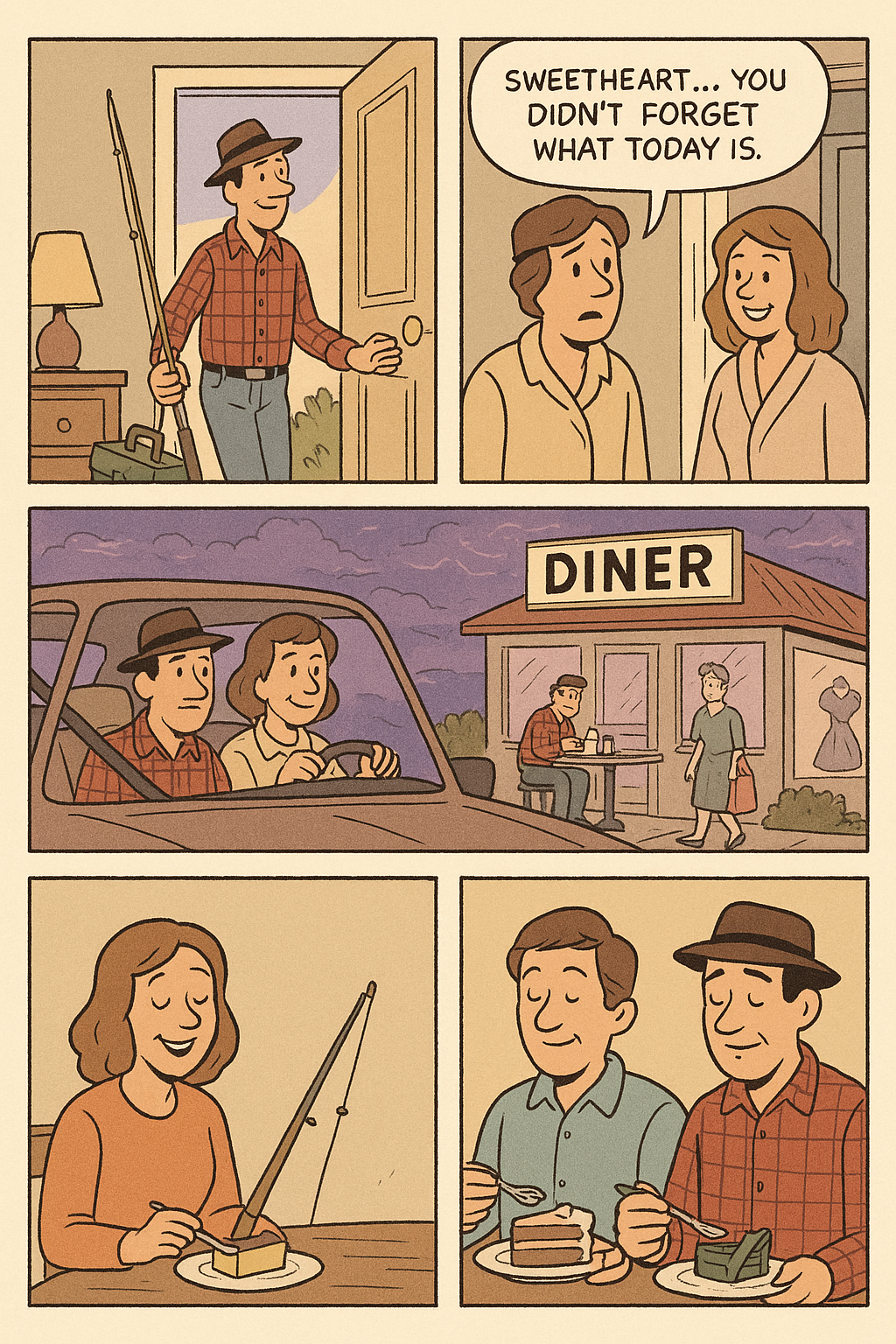
The man woke up electric with purpose, the kind of purpose only a perfectly planned fishing morning can give. His tacklebox gleamed. His thermos steamed. His fishing rod practically hummed like a tuning fork for serenity. He tip‑toed toward the door, already imagining the lake mist curling around his ankles.
Then his wife, still in her robe, called out with a brightness that froze him mid‑stride.
“Sweetheart… you didn’t forget what today is.”
He turned. She smiled. A birthday smile. A smile that said you absolutely forgot.
The fishing rod drooped in his hand like it, too, knew the day was lost.
He set it down gently, as if apologizing to it. “Of course I didn’t forget,” he said, voice cracking like a teenager caught sneaking in past curfew. “I’ve got… plans.”
Five minutes later they were in his car, and the world outside the windshield had shifted into something slightly off‑kilter. The sky was too lavender. The stoplights blinked in unfamiliar patterns. Every radio station played songs he half‑remembered from dreams.
They drove anyway.
At a diner, the waitress insisted they’d been there yesterday, though neither remembered it. The pancakes were shaped like geometric symbols he couldn’t name. His wife loved them.
At a boutique, every mannequin had the same face as his high school gym teacher. His wife bought a scarf that shimmered like static on an old TV.
At a park, the ducks waddled in perfect formation, like they were rehearsing for a parade no one had announced. His wife fed them crackers and laughed like a kid.
Everywhere they went, the world felt one degree to the left of normal—pleasant, eerie, and strangely cooperative. A Twilight Zone birthday tour curated by fate itself. And she was glowing. Radiant. Happy in a way that made the bizarre feel like the right kind of bizarre.
By the time they pulled back into the driveway, the sun was setting in colors he didn’t have names for.
Inside, she cut a slice of birthday cake and handed him one. They sat together at the table, her humming softly, him watching her enjoy her day.
His eyes drifted to the corner, where his tacklebox and fishing rod waited like loyal pets.
He took a bite of cake.
Maybe tomorrow, he thought.
And the fishing rod, if it could think, probably thought the same.
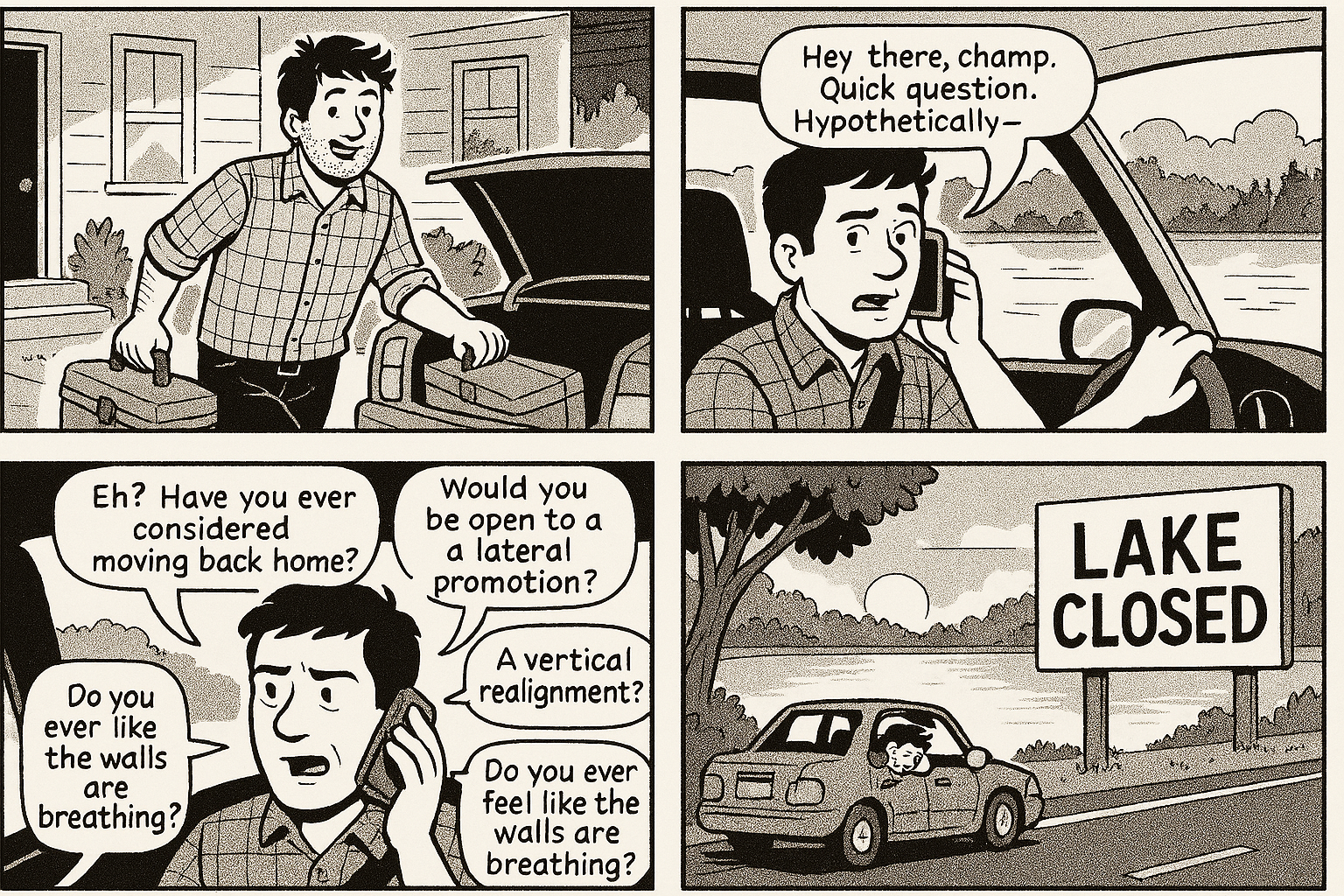
The day began with that crisp, impossible optimism that only a man with a packed tackle box and a thermos of lukewarm coffee can feel. He woke before his alarm, humming some half-remembered sitcom theme song, and stepped into his car with the buoyant certainty that today—finally—he would make it to the lake.
He was halfway down the highway, the water just beginning to glint through the trees, when his phone rang.
His boss’s boss.
He stared at the screen. “That’s… unusual,” he muttered, answering with the cautious cheer of a man who still believed in weekends.
“Hey there, champ,” the voice boomed, too warm, too rehearsed. “Quick question. Hypothetically—hypothetically—how would you feel about moving back home?”
“Home?” he repeated. “Like… my childhood home?”
A pause. “Or a version of it. One optimized for productivity.”
Before he could respond, another call beeped in. Then another. And another. Senior leadership. Executive leadership. People he’d only seen in company newsletters, smiling with the vague menace of people who used the phrase “synergy” unironically.
Each call spiraled into stranger territory.
One VP asked if he’d ever considered becoming “a regional ambassador of morale.”
Another wanted to know if he’d be open to “a lateral promotion into a vertical realignment.”
Someone who might have been the CFO whispered, “Do you ever feel like the office walls are… breathing?”
And then—because the universe enjoys a punchline—the President called.
Not his company president.
The President.
“Son,” the voice said, grave and echoing, “we’re all counting on you to stay exactly where you are. Don’t go anywhere. Especially not lakes.”
He blinked. “Sir, I’m just trying to go fishing.”
“That’s what they all say,” the President sighed, and hung up.
When the last call finally ended, the world snapped back into focus. The sun had dipped low. The lake shimmered beside him, serene and unreachable. He realized he’d been driving in circles around it—loop after loop—while the voices of authority layered over each other like a bureaucratic chant.
A sign ahead flickered: LAKE CLOSED.
He pulled over, forehead resting on the steering wheel, the day’s absurdity settling into his bones like damp air.
He turned the car around and headed home, tackle box unopened, thermos untouched, sitcom theme song long forgotten.
Defeated. Tired.
And already dreading tomorrow’s calls.
Flash Fiction: The Off‑Ramp That Never Was
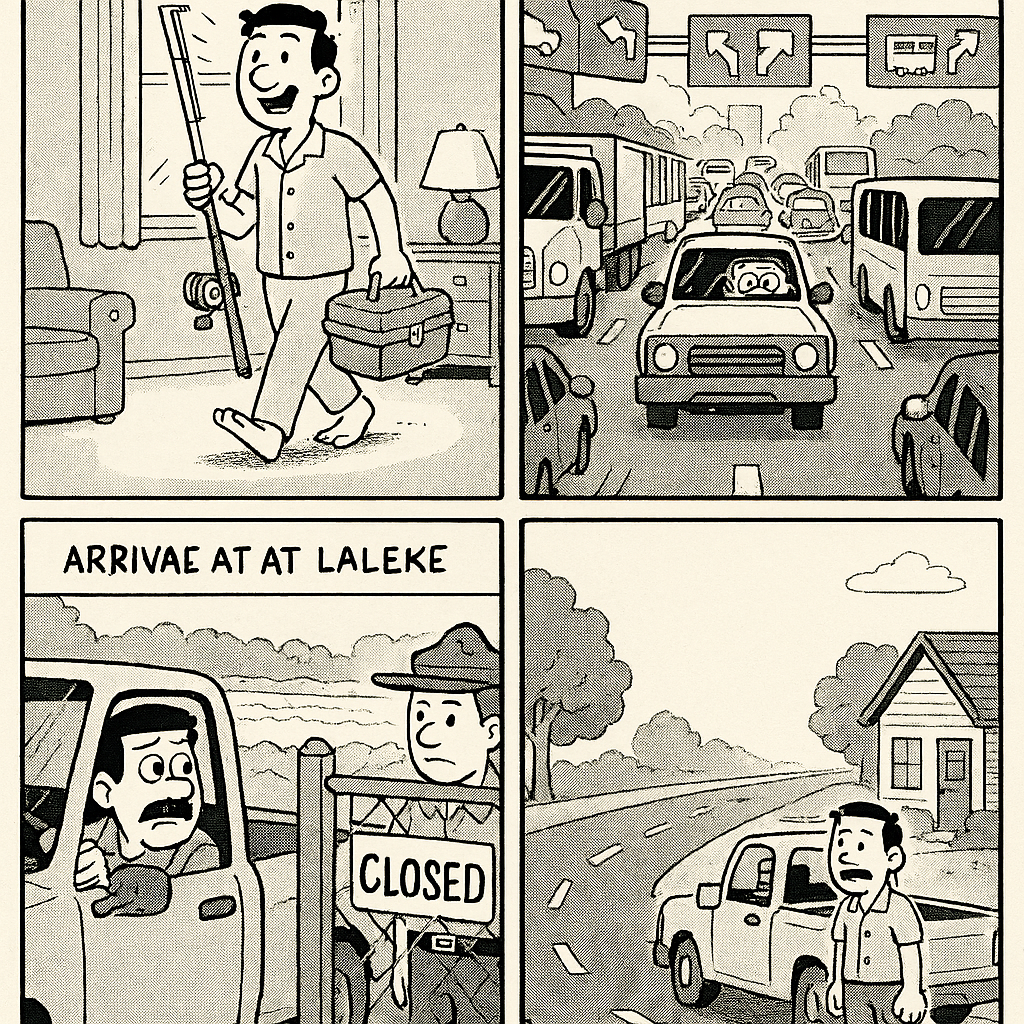
Gary woke up with the kind of optimism usually reserved for sitcom dads on season premieres. His tackle box was packed, his thermos was full, and his smile was the smug grin of a man who believed—truly believed—that today he would fish.
He got in his truck, turned the key, and the radio cheerfully announced, “It’s a great day to be outdoors!”
He took that as a sign.
He shouldn’t have.
The moment he merged onto the highway, the world bent sideways.
Traffic wasn’t just bad—it was sentiently bad. Cars moved in choreographed nonsense, like a ballet performed by sleepwalkers. One lane crawled at two miles per hour. The next zipped by at seventy. A third lane appeared, then vanished, like a mirage with a sense of humor.
Every off‑ramp he aimed for slid away at the last second, as if the road itself whispered, Not today, buddy.
GPS instructions contradicted each other.
A semi-truck with no visible driver paced him for miles.
A parade of mopeds boxed him in, all honking in the same key.
Gary’s hands clutched the wheel. His eyes darted. His soul aged.
By the time he finally reached the lake—sweaty, frazzled, and spiritually dehydrated—the ranger was swinging the gate shut with the slow, ceremonial finality of a judge’s gavel.
“Closed,” the ranger said, not unkindly, but with the tone of someone who had seen this exact tragedy play out a thousand times.
Gary nodded. He didn’t argue. He didn’t plead. He simply turned his truck around and drove home on an empty, perfectly clear road that mocked him with its serenity.
He pulled into his driveway exhausted, defeated, and still holding onto the faint scent of the lake he never reached.
Tomorrow, he told himself, he might try again.
But the road, somewhere out there, was already smiling.
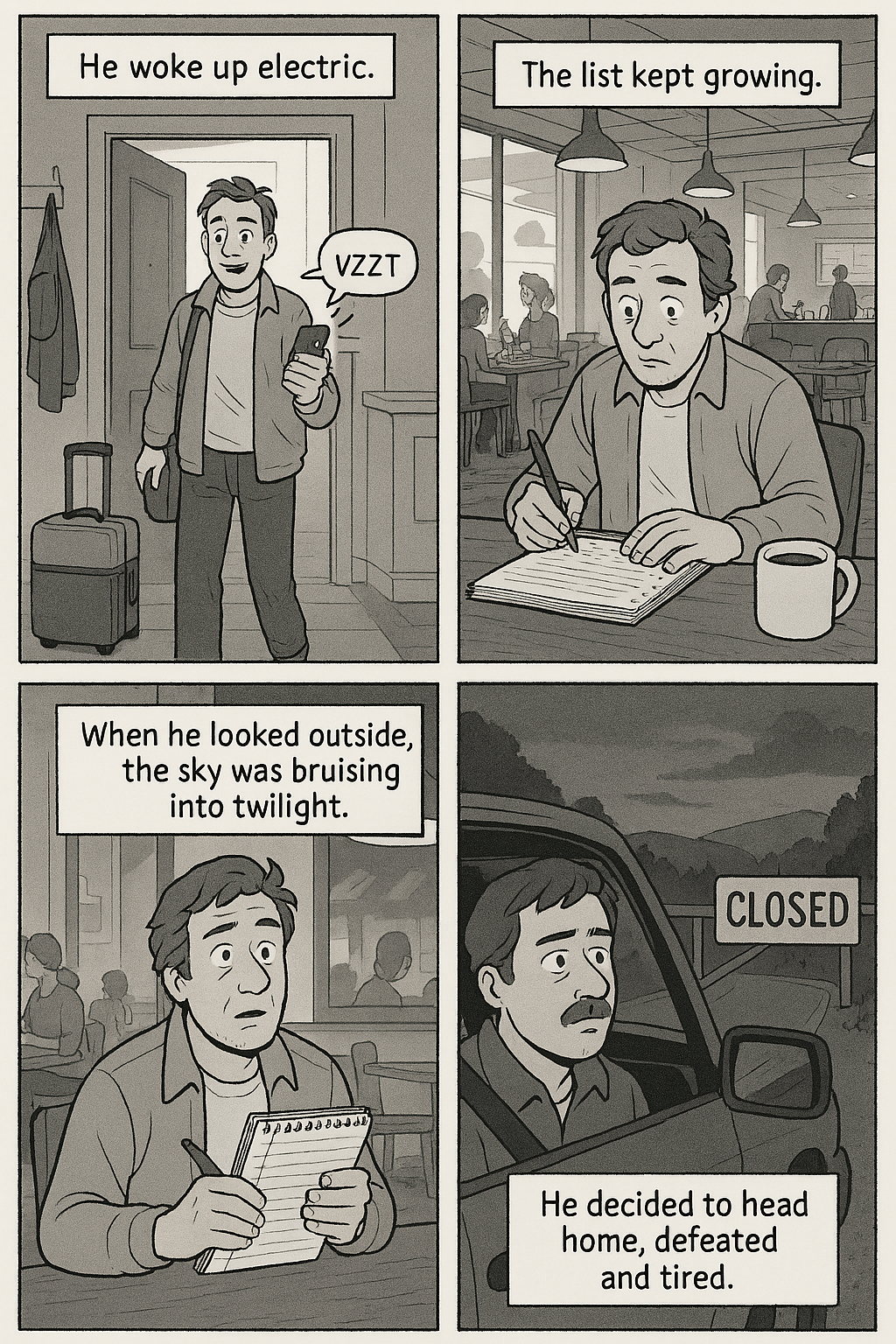
He woke up electric.
Fishing pole by the door, cooler packed, thermos steaming. Today was the day—no cosmic interference, no bureaucratic detours, no eldritch HR apparitions. Just a man, a lake, and a trout with his name on it.
He was halfway to the truck when his phone buzzed.
FROM: Boss’s Boss
Hey, quick thing—could you jot down a list of all your job roles and responsibilities? Should only take a minute.
A minute. The deadliest phrase in the English language.
He sighed, pivoted, and drove to the nearest coffee shop, figuring caffeine would help him sprint through the task. He opened his notebook, clicked his pen, and wrote the first line:
Customer support
Then another:
Inventory checks
Then another:
IT troubleshooting
Training new hires
Fixing the printer
Fixing the printer again
Emotional support for the printer
Whatever that thing was last Tuesday
The list kept growing, mutating, branching like some bureaucratic hydra. Every time he thought he’d reached the end, another responsibility surfaced from the depths of memory. The coffee shop’s ambient chatter warped into a low, uncanny drone. The lights flickered. The barista seemed to age a decade every time he looked up.
He filled one page. Then three. Then seven.
At some point, the sun shifted. At some point, the shadows stretched. At some point, the barista was definitely a different person entirely.
When he finally wrote the last bullet point—Unofficial morale officer (self-appointed)—he exhaled like he’d completed a pilgrimage. He emailed the list to his bosses, closed the notebook, and looked outside.
The sky was bruising into twilight.
He bolted for the lake anyway, hope clinging to him like a stubborn burr. He drove fast enough to feel optimistic but slow enough to avoid explaining himself to a cop.
As he passed the lake entrance, he saw the sign swing gently in the wind:
CLOSED
The gate was locked. The water beyond it shimmered with the smug serenity of something that had been waiting all day to disappoint him.
He didn’t even stop. Just kept driving, past the lake, past the last glimmer of daylight, heading home with that familiar sitcom‑episode slump. Defeated. Tired. Wondering if maybe tomorrow he should list “aspiring fisherman” under hobbies instead of goals.
Because goals, he realized, were dangerous things in his universe. They attracted attention.
And attention always called him back to work.
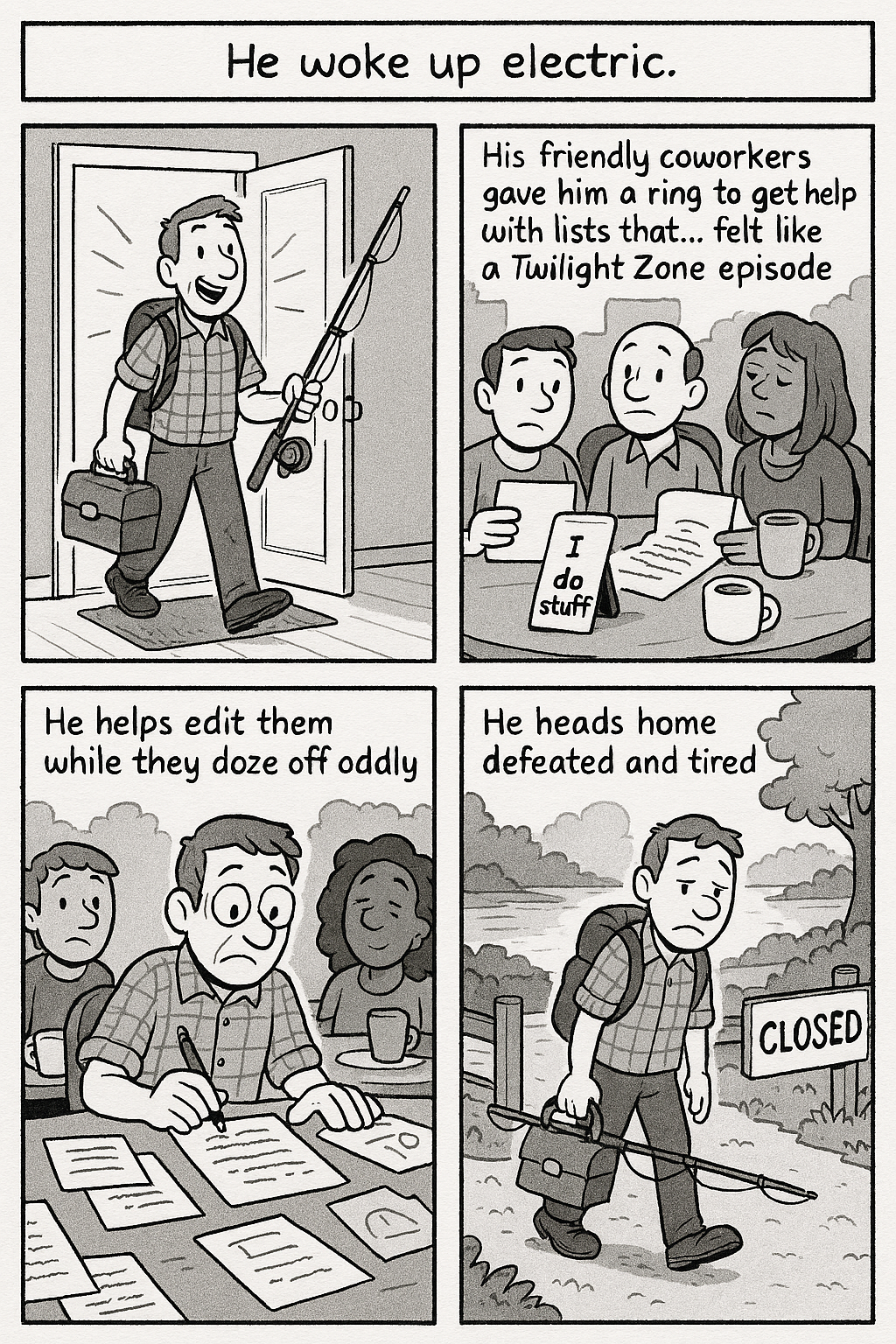
.He woke up electric.
Bag packed, thermos filled, tackle box clicking like a promise. Today—finally—he would make it to the lake. No detours. No errands. No cosmic interference. Just him, the water, and the quiet.
He locked the door behind him, inhaled the crisp morning air, and his phone rang.
It was the work group chat.
The Friendly Coworkers™—the ones who always said “no pressure” right before applying pressure.
“Hey man,” they chimed in unison, far too cheerful for dawn, “could you help us with that responsibilities list corporate wants? Ours are… uh… weird.”
He should’ve said no. He absolutely should’ve said no.
Instead, sitcom logic took the wheel.
He met them at a café that smelled like burnt espresso and mild dread. The moment he sat down, the Twilight Zone curtain lifted.
One coworker had a list only three words long:
“I do stuff.”
Another had a list so long it unfurled across the floor like a medieval scroll.
A third had written only cryptic statements like:
“I maintain the morale of the office plants.”
“I prevent the copier from remembering its past lives.”
They all blinked at him with sleepy, trusting eyes—then promptly dozed off mid‑conversation, heads bobbing like malfunctioning dashboard toys.
He edited.
And edited.
And edited.
Hours passed in a strange, syrupy drift. The café lights dimmed. The coworkers snored softly. The lists multiplied when he wasn’t looking. Every time he thought he was done, another bizarre bullet point appeared, as if the universe itself were adding responsibilities he never agreed to.
Finally—finally—he hit send.
He looked up.
The sun was melting into the horizon.
He sprinted to the lake, heart pounding with stubborn hope.
But as he passed the entrance, a sign swung gently in the breeze:
CLOSED.
No explanation.
Just closed, as if the lake itself had punched out early.
He stood there for a long moment, hands on his hips, breathing like a man who had wrestled fate and lost again.
Then he turned around and drove home, defeated, tired, and already knowing—deep down—that tomorrow someone from work would text him about “one tiny thing.”
And he’d probably say yes.
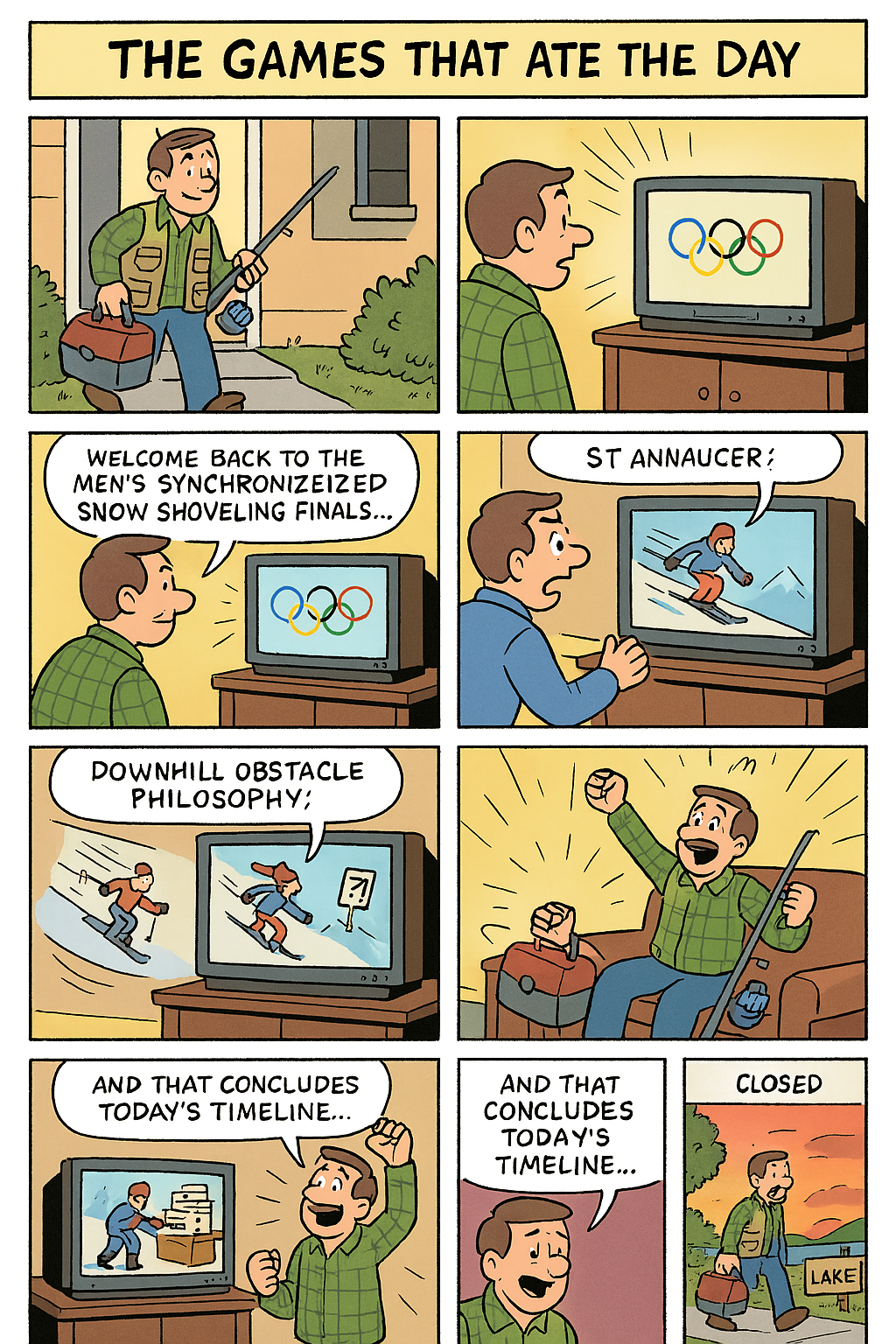
Flash Fiction: The Games That Ate the Day
Harold woke up electric.
Fishing vest zipped. Thermos sealed. Sandwiches stacked like a proud architectural feat. He stepped out the front door with the swagger of a man destined for trout.
Then he heard it—
the unmistakable chime of an Olympic broadcast drifting from his living room TV. He didn’t remember leaving it on. He didn’t remember ever watching the Winter Olympics, actually.
But the theme music tugged at him like a cosmic fishing line.
He leaned in.
Just for a second.
Just to see who was winning curling.
Except it wasn’t curling.
The announcer’s voice boomed with the gravitas of a deity narrating creation:
“Welcome back to the Men’s Synchronized Snow Shoveling Finals—where precision meets existential dread.”
Harold blinked.
Two teams shoveled snow in perfect, balletic unison, their faces stoic, their movements hypnotic. Judges held up scorecards with symbols he didn’t recognize—were those runes?
He sat down.
Fishing rod in one hand, tackle box in the other.
Then came the next event:
Downhill Obstacle Philosophy.
Skiers raced downhill while reciting contradictory statements about the nature of time.
One athlete wiped out mid‑paradox.
The commentators whispered urgently, as if the fate of nations hinged on this:
“A devastating fall for Slovenia—he couldn’t reconcile free will with momentum.”
Harold set the rod down.
By the time the Biathlon of Bureaucracy began—skiing, shooting, and filling out tax forms at checkpoints—Harold was on his feet, shouting at the screen like a man possessed.
He cheered for countries he’d never heard of.
He booed judges he’d never seen.
He pumped his fists at slow‑motion replays of athletes triumphing over paperwork.
Hours evaporated.
The sun drifted across the sky like a lazy referee.
At some point he found himself standing on the couch, hoarse, sweating, waving a throw pillow like a national flag. His fishing gear sat abandoned on the carpet, quietly judging him.
When the final event ended—Ice Fishing Speed Negotiation, naturally—Harold collapsed back into the cushions, spent. The commentators signed off with a cryptic:
“And that concludes today’s timeline. Tune in tomorrow, if tomorrow arrives.”
He glanced out the window.
The sun was sinking.
The lake was closed.
His fishing rod seemed to sigh.
Harold trudged to bed, defeated, aching, and oddly patriotic. As he drifted off, he swore he heard the announcer whisper from somewhere deep in the house:
“Gold goes to Harold… for Most Enthusiastic Spectator.”
He didn’t feel like a winner.
But he slept like one.
If you want, we can escalate this even further—make the sports more unhinged, the commentary more cosmic, or the sitcom beats even punchier.
Harold trudged to bed, defeated, aching, and oddly patriotic. As he drifted off, he swore he heard the announcer whisper from somewhere deep in the house:
“Gold goes to Harold… for Most Enthusiastic Spectator.”
He didn’t feel like a winner.
But he slept like one
He woke up electric with purpose.
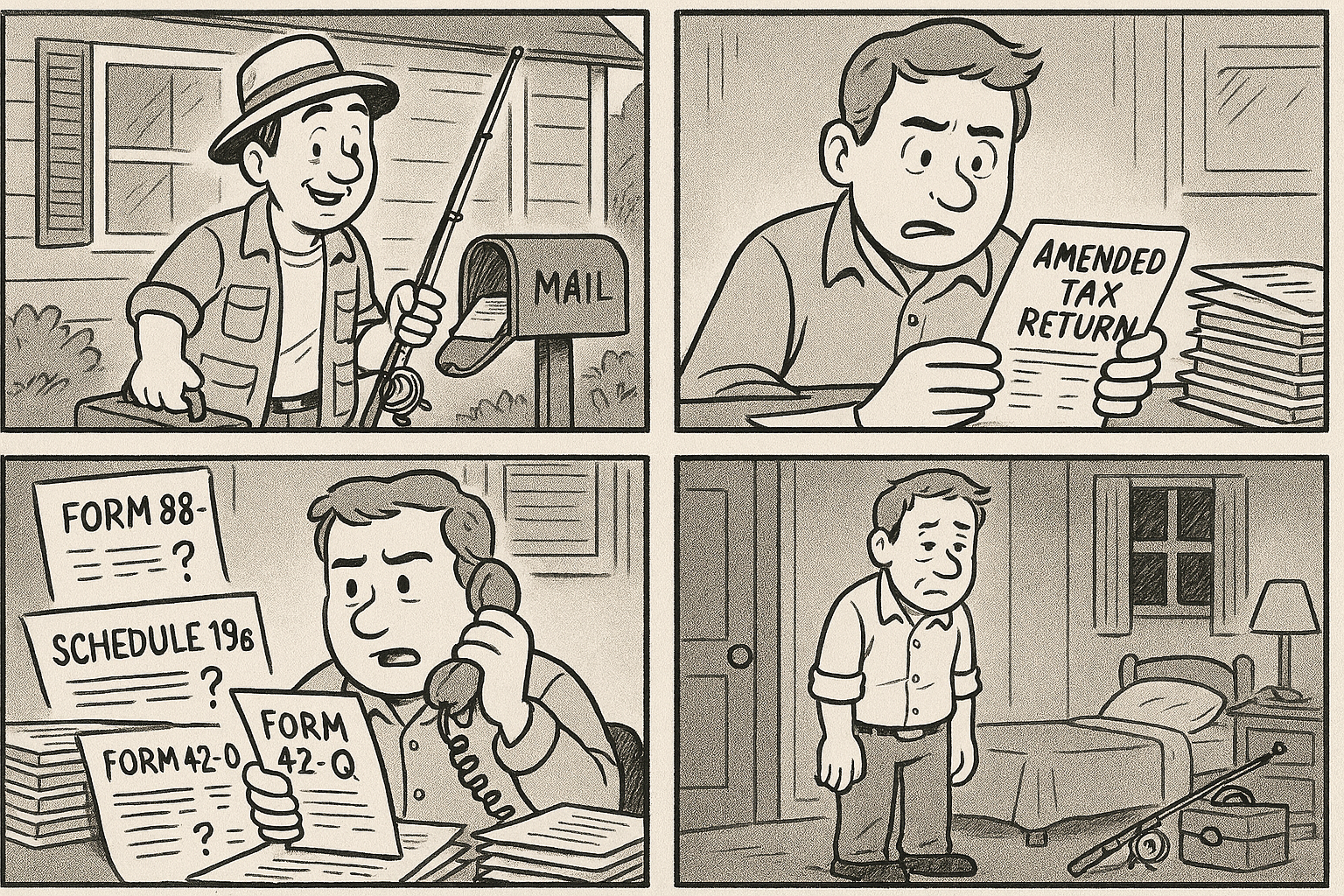
Today was the day. The lake was calling, the tacklebox was packed, the thermos was full, and his fishing rod practically hummed with anticipation. He even whistled while tying his boots—an act so rare his houseplants leaned in to listen.
On his way out the door, he made the fatal mistake:
He checked the mail.
Inside the mailbox sat a stack of envelopes so thick it looked like it had been force‑fed. Every one of them was stamped URGENT: TAX MATTER in a shade of red that felt personally accusatory.
He opened the first envelope.
Then the second.
Then the fifteenth.
Each form was stranger than the last.
Form 88‑Z: Declaration of Unclaimed Imaginary Income
Schedule 19‑B: Verification of Time Lost to Daydreaming
Form 42‑Q: Acknowledgment of Fish-Related Intentions
Supplemental Worksheet: Did You or Did You Not Think About Moving to a Cabin in 2025? Explain in 500 words.
He blinked. The room dimmed. A faint theremin hummed from nowhere.
Before he could protest, his phone rang.
His tax preparer’s voice came through, calm and chipper, as if this were all perfectly normal.
“Oh yes, these forms have been… appearing. You’ll need to amend everything. No, it won’t change your refund. No, it won’t change what you owe. But yes, you absolutely must do it. And yes, there is a fee.”
Hours evaporated.
The sun crawled across the sky like it was trying to escape the conversation.
He filled out forms that contradicted each other, forms that asked him to sign in languages he didn’t recognize, forms that required him to list every fish he’d ever dreamed of catching.
By late afternoon, he was knee‑deep in paperwork that seemed to multiply when he looked away. His fishing rod, still leaning by the door, slowly slumped to the floor as if giving up on him.
Finally—finally—the accountant said, “All set! None of this changed anything, but it’s important to follow procedure.”
The call ended.
The mailbox was empty.
The day was gone.
He set his tacklebox down with a soft clunk.
He placed his fishing rod beside it like a fallen comrade.
Then he trudged to his bedroom, the faint echo of that Twilight Zone theremin following him down the hall.
He collapsed into bed, defeated, tired, and fully aware that tomorrow’s mail would probably contain Form 88‑Z‑A: Amendment to the Amendment of the Imaginary Income Declaration.
But for now, he closed his eyes and whispered the only prayer he had left:
“Maybe next weekend.”
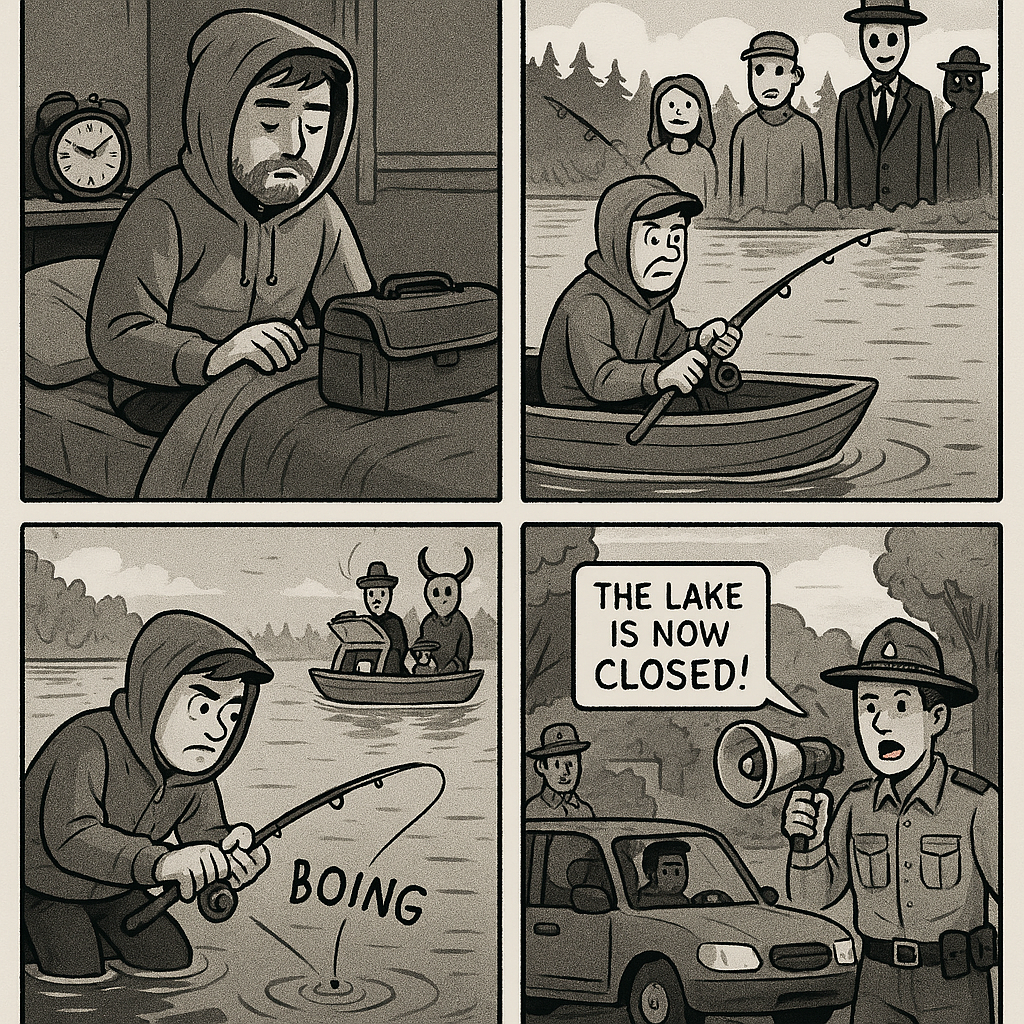
He woke before the alarm, already zipped into his fishing hoodie, tackle bag packed with the quiet pride of a man who believes—truly believes—today will finally go right. The drive to the lake felt clean, almost hopeful. He even hummed. That should’ve been the first warning.
His spot—his spot—was occupied. Not just by people, but by a cluster of figures who looked like people only in the way mannequins look like people: correct shapes, wrong energy. They waved at him in slow, synchronized arcs, like they’d rehearsed it.
He pushed off anyway, rowing out to a patch of water that felt neutral enough. He cast his line. The hook hit the surface and bounced. He tried again. Boing. Again. Boing. The lake rejected him like a bad idea.
A boat drifted past, its occupants wearing identical wide-brimmed hats and identical smiles, all teeth and no warmth. One of them lifted a cooler lid. Inside was… nothing. Just a hollow glow, like the inside of a turned-off TV.
He tried to focus on fishing, but his brain betrayed him. Work thoughts seeped in: the endless shuffling of slots, the produce that decayed faster than it arrived, the way everything smelled faintly of cardboard and resignation. The lake shimmered, and for a moment he wasn’t sure if he was on water or inside a fever dream shaped like one.
Another boat glided by, silent, its wake forming perfect geometric ripples. The passengers stared at him with eyes that didn’t blink. He felt like he’d wandered into a cosmic waiting room where everyone else had an appointment but him.
He snapped. Enough. He’d go to his backup spot, the quiet cove on the far side. He started the motor.
Before he’d moved ten feet, a megaphone crackled from the shore. Park rangers—at least, they wore the uniforms—were waving their arms in frantic semaphore.
“THE LAKE IS NOW CLOSED,” one shouted. “DUE TO… UNFORESEEN AQUATIC ANOMALIES.”
The other nodded vigorously, as if that explained everything.
He didn’t argue. He didn’t ask. He just packed up, motored back, and drove home with the kind of exhaustion that feels older than the body carrying it.
By the time he pulled into his driveway, the day had folded in on itself. He sat there a moment, hands on the wheel, thinking about the fish he never even got to pretend he might catch.
Defeated. Tired. And already, against all logic, wondering if maybe tomorrow would be different.
Flash Fiction: The Train That Wouldn’t End
Mark woke up with the kind of optimism usually reserved for sitcom dads and lottery winners. His tackle box was packed, his thermos was full, and his fishing hat sat on his head at a jaunty, destiny‑bound angle. Today, he would fish. Nothing could stop him.
He should’ve known that was the first red flag.
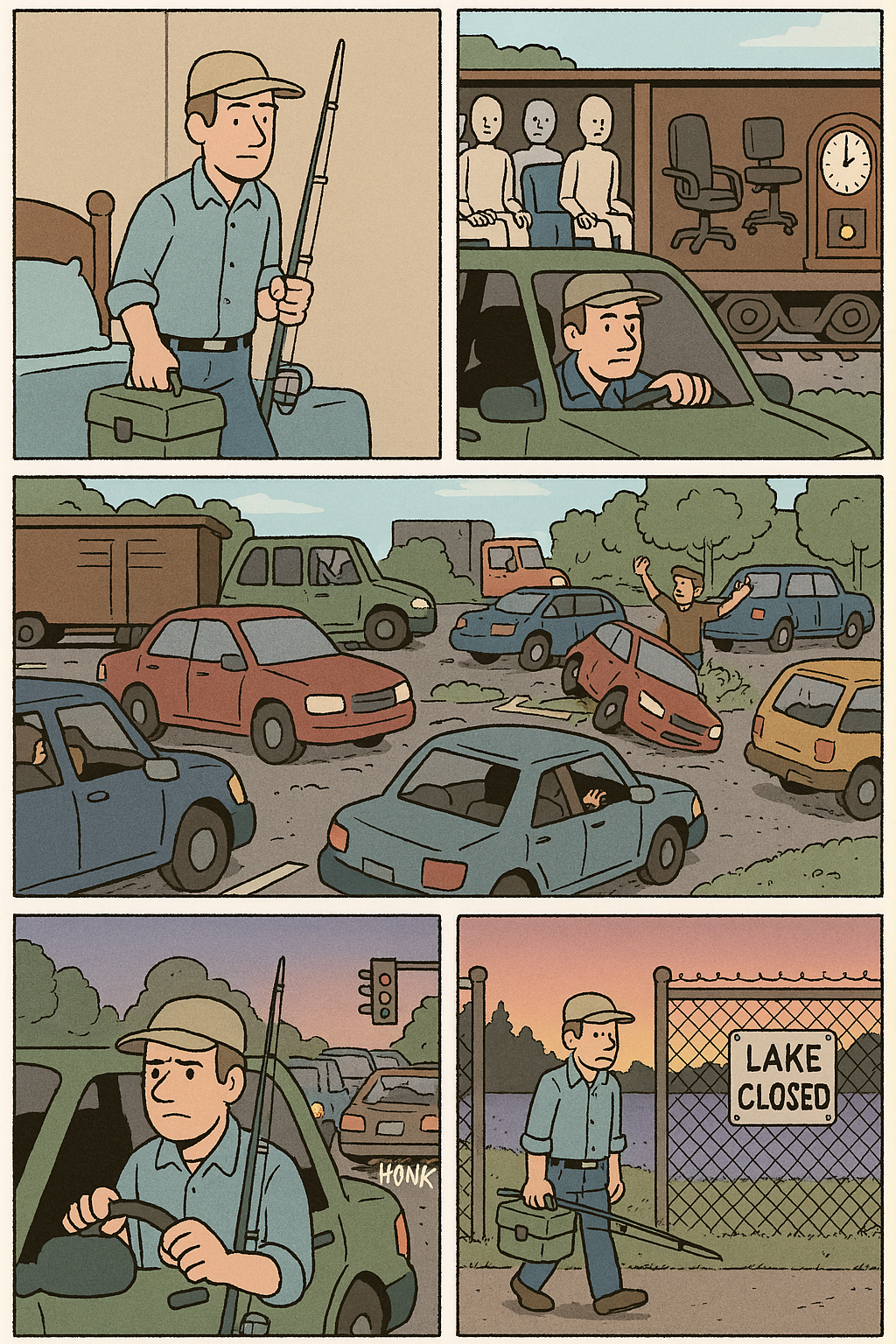
The drive to the lake was smooth—eerily smooth—until he turned onto Lakeshore Road and saw a line of cars stretching into the horizon like a defeated parade. At the front of it all, a freight train sat frozen on the tracks, as if it had simply decided to retire mid‑shift.
Mark sighed, but then he looked closer.
The train cars were… wrong. One carried hundreds of identical mannequins, all facing the same direction, their plastic hands pressed to the glass as if trying to warn him. Another car was filled with office chairs spinning slowly on their own. A third held a single, massive grandfather clock ticking backward.
He blinked. The clock ticked louder.
Meanwhile, the drivers around him were losing their minds in increasingly surreal ways. A minivan tried to U‑turn but lodged itself perfectly on the median like a beached whale. A sedan attempted the same maneuver and somehow ended up perpendicular to the road, blocking both lanes. A pickup truck kept inching forward, honking at the train as if intimidation might work.
Someone got out of their car and started directing traffic with the confidence of a man who had never directed anything in his life. Another driver was crying into a bag of pretzels. A third was trying to reverse but only succeeding in rotating in place like a confused Roomba.
Mark sat there, hands on the wheel, watching the chaos unfold. It felt like the Twilight Zone had decided to do a bottle episode about traffic.
Hours passed. The sun dipped. The train finally groaned to life and crawled forward, each bizarre car clattering by like a parade of rejected dreams. The road cleared slowly, painfully, as the stuck cars unstuck themselves with the grace of a sitcom blooper reel.
By the time Mark reached the lake, the gatekeeper was locking up.
“Closed,” the man said, jangling keys with the finality of a judge’s gavel.
Mark nodded. Of course it was.
He drove home on an empty road, the world suddenly calm again, as if the universe had gotten whatever it wanted out of him. His fishing hat drooped. His thermos was cold. His soul felt like one of those mannequins staring out of the train car.
He pulled into his driveway, defeated and bone‑tired, wondering if tomorrow would be kinder—or if the universe had more trains in store.
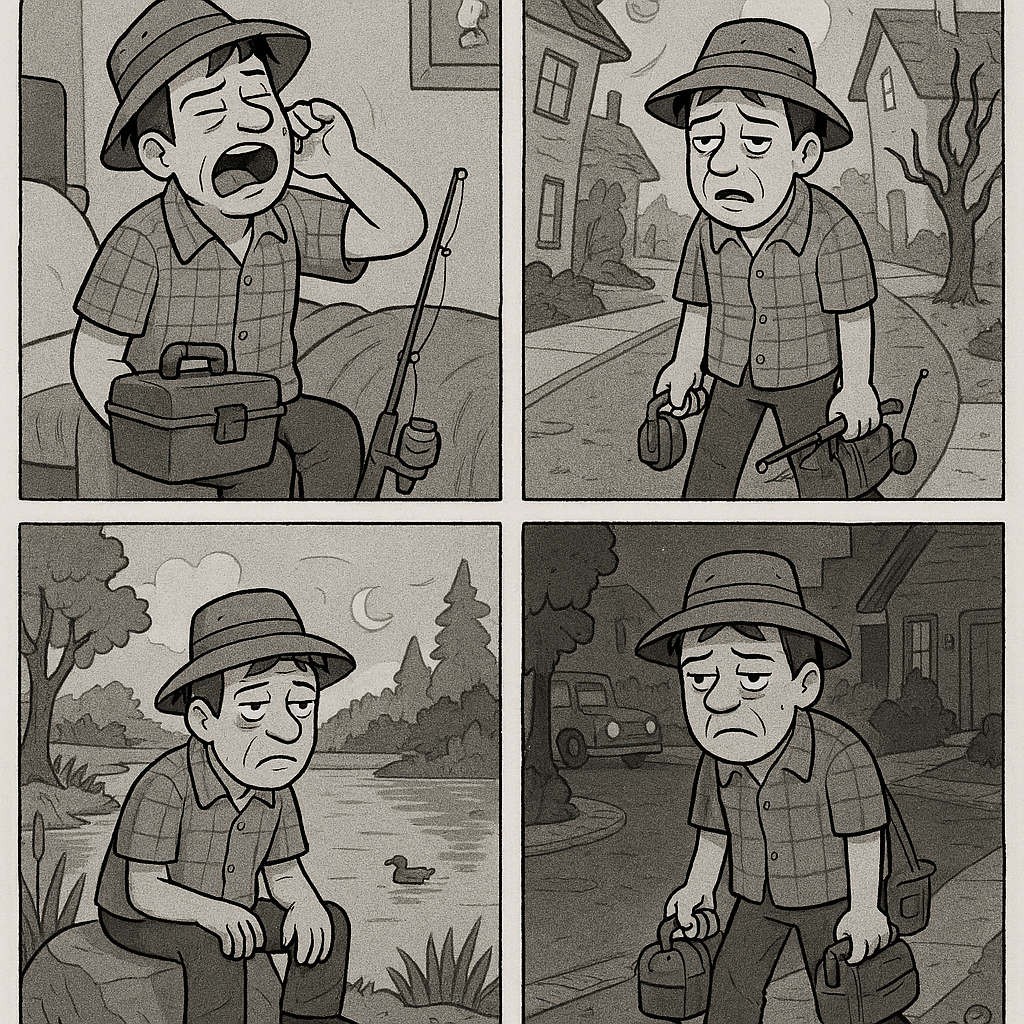
The Tired Man and the Almost‑Lake
He woke up already packed—tackle box by the door, thermos filled, hat perched on the nightstand like it had been waiting all night to be heroic. This should’ve been the perfect morning. Except he felt like he’d slept inside a washing machine. His eyelids weighed as much as the boat he wished he were towing.
He tried to drive. He really did. He sat in the driver’s seat, turned the key, and immediately felt the road ripple in his imagination like a conveyor belt made of warm pudding. That was enough. He shut the door, patted the hood like apologizing to a loyal dog, and decided to walk to the small lake down the street instead.
The walk felt like dreaming while standing up. The sidewalk stretched longer than it should’ve, bending slightly, like it was reconsidering its own geometry. A mailbox yawned. A squirrel saluted him with two tiny paws. A streetlamp flickered in Morse code he was too tired to decode. Everything had that Twilight Zone shimmer—nothing threatening, just… off, like the world had been assembled by interns.
By the time he reached the lake, the sun was already high, and the water looked like a giant, blinking eye. He sat on a rock and stared at the surface. The surface stared back. The trees swayed in a rhythm that didn’t match the wind. A duck floated by, paused, and gave him a look that said, Buddy, go home.
He couldn’t put his finger on what was wrong. Maybe nothing was wrong. Maybe he was just unbelievably, cosmically tired—tired in a way that made the world feel like a rerun he’d seen too many times.
He didn’t fish. He didn’t even open the tackle box. He just sat there until the shadows stretched long and the lake started to look like a dark mirror.
Walking home, the weirdness followed him like static. A jogger ran past twice in the same direction. A cloud hovered above him like it was tailing him for a report. A stop sign whispered something he couldn’t quite catch, though he was pretty sure it wasn’t “stop.”
By the time he reached his house, the day had evaporated. He was still tired. He was still groggy. And he still hadn’t fished.
He dropped his gear by the door, sighed the sigh of a man defeated by nothing and everything, and muttered, “Tomorrow.”
But even he didn’t believe it.
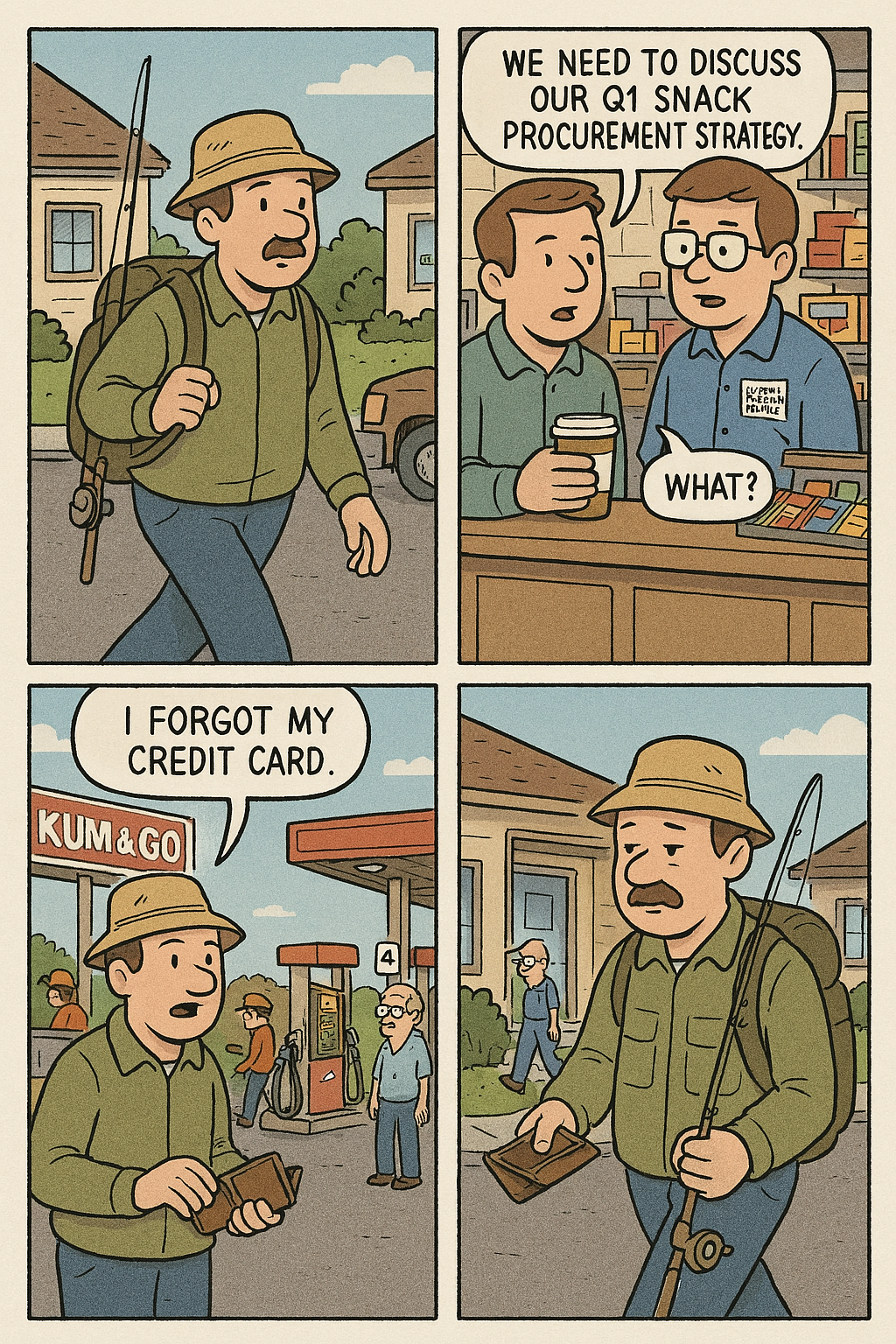
The Gas Station of Eternal Vendor Relationships
Tom woke up with the kind of optimism that only a fully packed tackle box and a thermos of lukewarm coffee could produce. Today was the day. No errands. No chores. No detours. Just him, the lake, and whatever fish dared underestimate his resolve.
He even whistled on the drive—an act he hadn’t performed since 2014.
He pulled into the gas station for a quick coffee, the kind of stop that should take ninety seconds. Instead, the moment he stepped inside, the air shifted. The fluorescent lights hummed like they were holding a grudge. The cashier wore a name tag that said “Vendor Relations Specialist,” and the coffee machine had a laminated mission statement.
“Morning,” Tom said.
“Is it?” the cashier replied, already typing something into a computer that looked suspiciously like a work-issued laptop. “Before we proceed, I need to align on our vendor partnership expectations.”
Tom blinked. “I just want coffee.”
“Of course,” the cashier said, nodding gravely. “But first, we need to discuss our Q1 snack procurement strategy.”
A man in a reflective vest wandered by holding a clipboard labeled Cross‑Functional Pump Synergy. Another employee was giving a PowerPoint presentation to a rack of beef jerky. The gas pumps outside beeped in a pattern that felt like Morse code for “run.”
Tom tried to leave three times, but each attempt was intercepted by someone wanting to “circle back” or “touch base” or “loop him in” on something involving pretzels.
Hours passed. The sun moved. The coffee machine rebooted twice.
By late afternoon, Tom finally reached the counter with a bottle of water, a bag of chips, and a granola bar—his emotional support items. The cashier scanned them, frowned, and said, “Oh. You’re short.”
Tom checked his wallet. Cash only. His credit card was sitting at home, probably laughing at him.
He sighed. “I’ll go get it.”
“Perfect,” the cashier said. “We’ll hold your items in the queue. But please be aware that our system resets every fiscal hour.”
Tom didn’t ask what that meant. He didn’t want to know.
He drove home, grabbed the card, drove back, and stared at the gas station like it was an ancient temple that had already taken too much from him. The lake was closing in twenty minutes. He could still try. He could still push through.
Instead, he turned the truck around.
He didn’t even bother turning on the radio. He just drove home in silence, defeated, tired, and carrying the faint smell of burnt coffee and corporate jargon.
Tomorrow, he told himself.
But even he didn’t believe it.
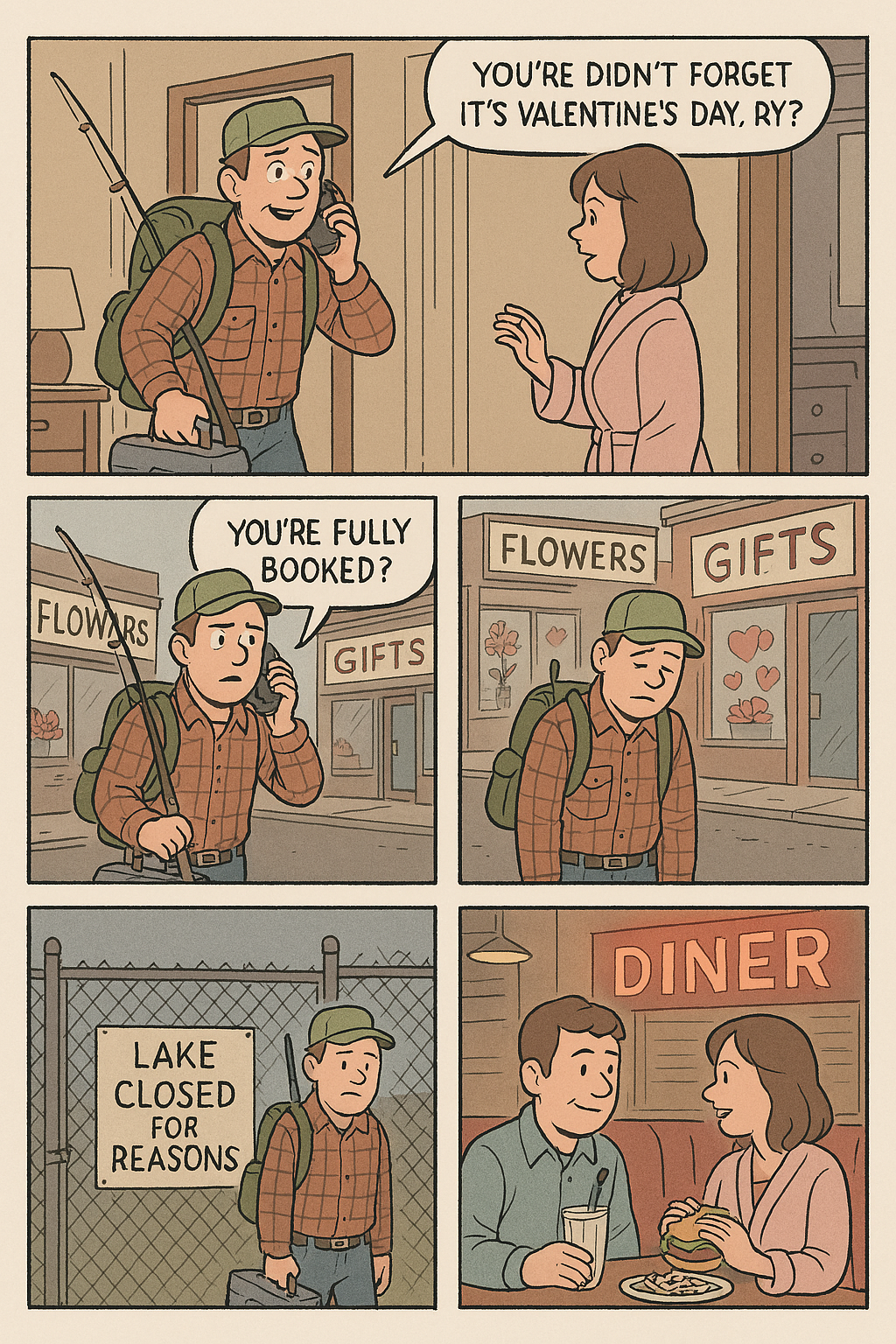
“Valentine’s Day at the End of the Line”
He woke before dawn, humming with weekend freedom, tacklebox clicking at his side like a loyal dog. The lake was calling—finally, a Saturday with no obligations, no errands, no cosmic interference. He tiptoed through the house, boots laced, thermos filled, the scent of early morning possibility clinging to him like dew.
Then his wife, half-asleep in her robe, drifted into the hallway.
“Sweetheart… you didn’t forget it’s Valentine’s Day, right?”
He froze. The tacklebox thudded to the floor. Somewhere in the distance, a theremin wailed.
He kissed her cheek, muttered something about “of course,” and bolted to the car. The moment he shut the door, he began dialing restaurants like a man trying to defuse a bomb.
Every call felt wrong.
One hostess spoke in a whisper, as if hiding in a bunker.
Another insisted the only available reservation was at 3:17 a.m.
A third asked if he preferred “the normal dining room or the mirrored one,” and refused to elaborate.
He hung up, unnerved, and drove to a flower shop. Inside, bouquets rotated slowly on pedestals, as if being displayed for an unseen jury. A clerk stared at him too long before saying, “Roses are… unavailable today,” in a tone that suggested roses had never existed at all.
The gift shop wasn’t better. Heart-shaped boxes pulsed faintly. A teddy bear blinked. He left without making eye contact with anything.
By now he was exhausted, bewildered, and still clutching his fishing rod like a security blanket. He drove to the lake anyway, hoping the universe might give him one small mercy.
A chain-link fence blocked the entrance. A sign read:
LAKE CLOSED FOR REASONS.
No further explanation. No staff in sight. Just wind and the faint hum of cosmic laughter.
He sat in his car for a long moment, forehead on the steering wheel, letting the defeat wash over him. Then he turned around, drove home, and picked up his wife.
They ended up at the only place in town with open seating: a tiny diner with flickering neon and cracked vinyl booths. The waitress called everyone “hon.” The menu hadn’t changed since the Carter administration.
And somehow, it was perfect.
They shared milkshakes. They split fries. They laughed about the day’s surreal detours. The world felt small and warm again, like it had when they first started dating—before jobs and errands and cosmic absurdities had crept in.
He didn’t catch a single fish, but he caught something better: a night that felt like the beginning of everything.
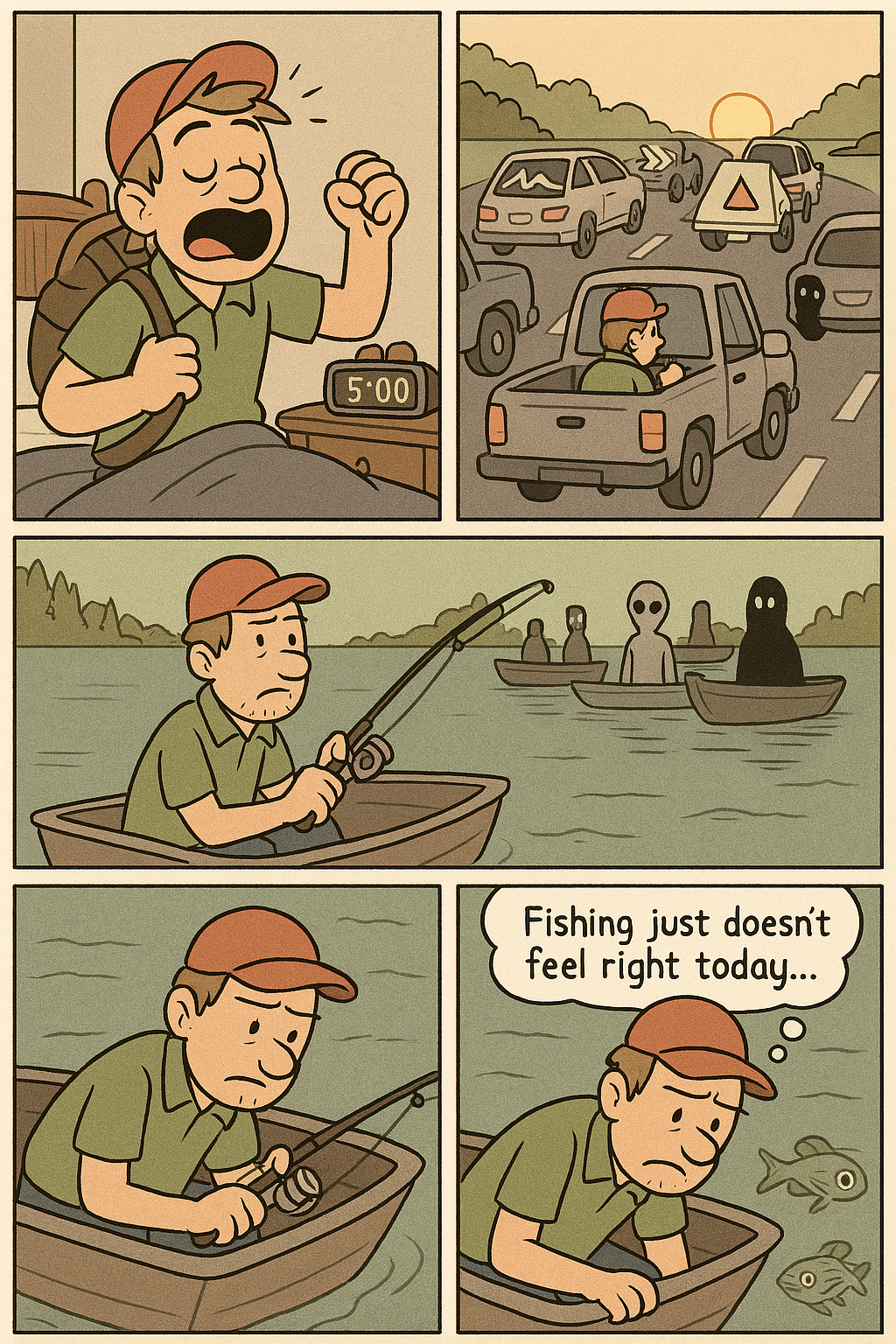
He woke before his alarm, already dressed, already packed, already convinced today—finally—would be the day he actually fished. The sun wasn’t even up yet, but he felt that fizzy optimism sitcom dads get right before everything goes wrong.
He hit the road, humming, until he noticed the traffic. Not bad traffic—weird traffic. Cars drifting in perfect formation like they were practicing a synchronized swimming routine. A minivan kept blinking its left blinker even while turning right. A pickup truck seemed to be driving backwards but somehow still moving forward. Every off‑ramp he tried to take slid away like a mirage.
By the time he reached the lake, he felt like he’d driven through a dream someone forgot to edit.
Out on the water, things only got stranger. Every boat was lined up single‑file, stretching across the lake like they were waiting for a ride at an amusement park. No one spoke. No one fished. They just… waited. The boaters themselves didn’t look quite human—too tall, too still, too symmetrical. One of them waved, but the hand bent in a direction hands don’t bend.
He peered into the water. Fish swam lazily beneath him, but they looked like sketches of fish drawn by someone who had only heard rumors of what fish were. Too many fins. Not enough eyes. Or maybe too many eyes. Hard to tell.
He cast his line anyway. Nothing. Not even a nibble. The whole lake felt wrong—like fishing on a Sunday afternoon was a violation of some cosmic scheduling rule.
Finally, he sighed, pulled up anchor, and tried to motor to another cove. But the wake pushed him back. Every time. As if the lake itself was gently, politely refusing him. Not today, the ripples seemed to say. Come back when reality is less… occupied.
He gave up. Headed home. The drive back was mercifully normal, which somehow made it worse.
He walked through his front door, dropped his gear, and sat heavily on the couch. He wasn’t scared. He wasn’t confused. He was just tired—tired in that deep, sitcom‑episode‑ending way where the laugh track fades and the character sighs into the credits.
He just wanted to fish. But apparently the universe had other plans.
Again.
Summoned by the Lake of Justice
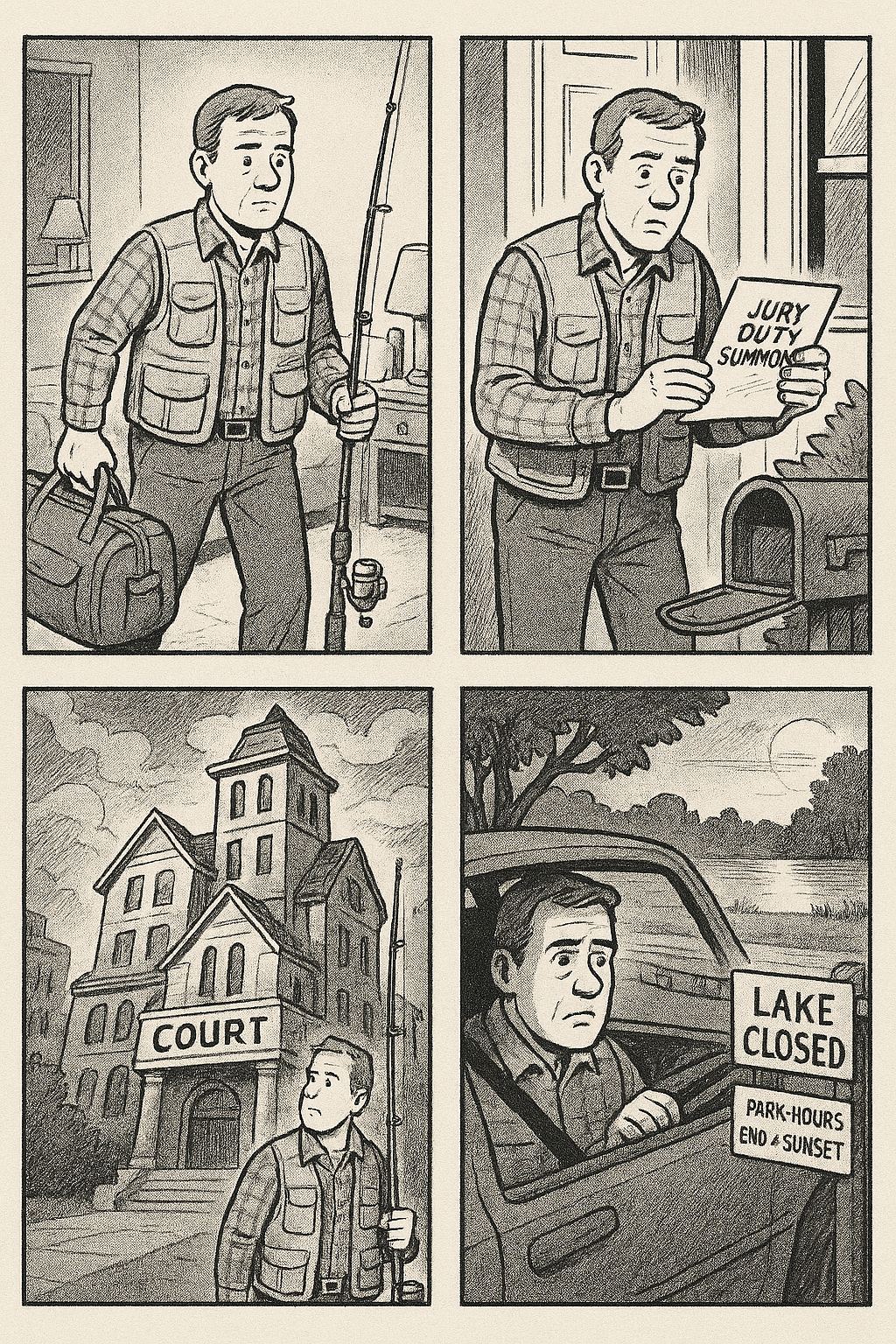
Harold woke up before his alarm, which felt like a good omen. His tackle box was already in the truck, his thermos was full, and the lake—his lake—was calling to him with the soft, imaginary plunk of a perfect cast. Today, he thought, nothing will stop me.
Then he checked the mail.
A single envelope sat in the box like it had been waiting all night just to ruin his morning. Jury Duty Summons — Mandatory Appearance Today.
He blinked. He checked the date. He checked the day. He checked the sky, as if the clouds might confirm this was a clerical error in the fabric of reality.
But no. The universe had spoken.
He drove to the courthouse, still wearing his fishing vest, because he refused to let the day forget what it had stolen from him. The courthouse loomed like a building that had been designed by someone who had only heard rumors about architecture. Too many windows. Not enough doors. A faint hum, like fluorescent lights whispering secrets.
Inside, the air felt… off. The security guard waved him through without looking up, muttering something that sounded like “bait and tackle” but could’ve been “fate will shackle.” Hard to tell.
Harold was ushered into a courtroom where the judge looked like he’d been carved from driftwood and the attorneys spoke in circles—literal circles. Their questions spiraled around him:
“Would you consider yourself impartial to lakes?”
“Have you ever felt judged by a fish?”
“On a scale from one to twelve, how guilty does time feel today?”
He answered as best he could, though he suspected the answers didn’t matter. They nodded solemnly at everything he said, even when he said nothing.
Then they sent him to the room.
It was shaped like a trapezoid that had given up halfway through becoming a rectangle. The chairs were arranged in a pattern that suggested either a ritual or a very confused interior designer. The other potential jurors stared at him with the blank, patient expressions of people who had been waiting for centuries.
There was no cell reception. No magazines. No clocks. Just the soft, rhythmic clicking of something in the walls.
Hours passed. Or maybe days. Hard to tell.
Every so often, someone would open the door and call Harold into another room—each one stranger than the last. One was painted entirely in shades of beige. One had a ceiling so low he had to crouch. One was freezing cold; another was humid like a greenhouse. The interviewers changed too: a stern woman with a clipboard, a man who never blinked, a trio of whispering interns who all asked the same question at the same time.
He was inspected. He was questioned. He was thanked for his patience in a tone that suggested patience was the only thing keeping the building from collapsing.
Finally—finally—they released him.
He stumbled outside, blinking at the late‑evening sky. He drove straight toward the lake, desperate for even a glimpse of water.
Closed.
A chain across the entrance. A sign that read Park Hours End at Sunset. The sun had already dipped behind the hills, smug and satisfied.
Harold sat in his truck, exhausted, defeated, smelling faintly of courthouse air and lost opportunity. The lake rippled in the distance, just out of reach.
Tomorrow, he thought.
But the lake didn’t answer.
The Garden Plot
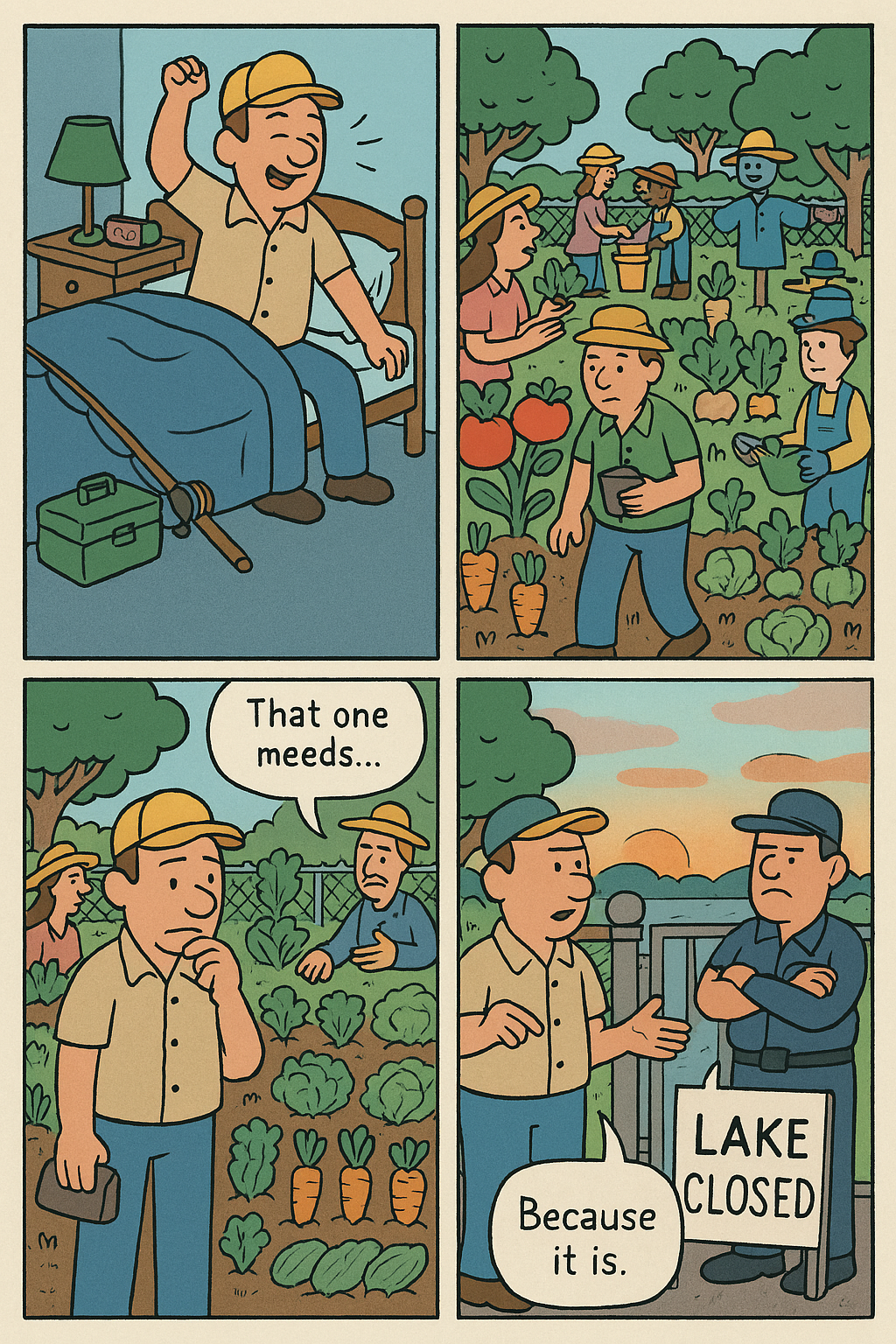
He woke up already smiling, already zipped, already packed. Today—finally—he was going fishing. No errands, no detours, no cosmic interference. Just a man, a lake, and the promise of silence.
Halfway down the road, though, a thought jabbed him in the ribs:
the community garden.
He’d promised to “check in” on his plot. A quick stop, he told himself. Five minutes. Ten, tops. The lake would still be there.
The moment he stepped through the garden gate, the world shifted sideways.
The other gardeners were… off. One woman was whispering encouragement to a tomato plant wearing a sunhat. A man in overalls was planting seed packets directly into the soil, unopened, as if the instructions were optional. Someone else was watering a scarecrow.
He tried to ignore them and headed to his own plot, but that didn’t help. His produce looked wrong—too shiny, too symmetrical, too reminiscent of spreadsheets and storage logistics from work. The cucumbers were arranged like inventory. The carrots were stacked like pallets. The lettuce heads seemed to be waiting for a barcode.
He blinked. They didn’t stop.
He knelt to inspect a squash and found himself spiraling into a daydream about supply chains, cold storage, and the existential dread of “farm to table” marketing. The sun drifted overhead. Time softened. His thoughts stretched like taffy.
Eventually he snapped out of it and asked a nearby gardener for advice on a wilting pepper plant.
The gardener nodded sagely and said,
“Ah yes. That one needs… more wind.”
“Wind.”
“Strong wind. Preferably from the east. At night. While chanting.”
He stared. The gardener stared back, completely confident.
He shrugged. It was that kind of day.
By the time he escaped the garden’s gravitational weirdness and drove to the lake, the gate was already closed. Hours early. A guard stood there, arms crossed, expression unreadable.
“But the sign says it closes at sunset,” he said.
The guard nodded. “Correct.”
“It’s not sunset.”
The guard nodded again. “Correct.”
“So… why is it closed?”
The guard leaned in and whispered, as if sharing a secret of the universe:
“Because it is.”
He had no rebuttal for that.
He drove home in the fading light, fishing gear untouched, mind foggy, clothes smelling faintly of overwatered soil. Another day lost to the strange gravitational pull of everything-but-fishing.
He collapsed onto the couch, defeated and tired, wondering if the lake even existed anymore—or if it was just another plot twist waiting to happen.
The Rave at Lake Meridian
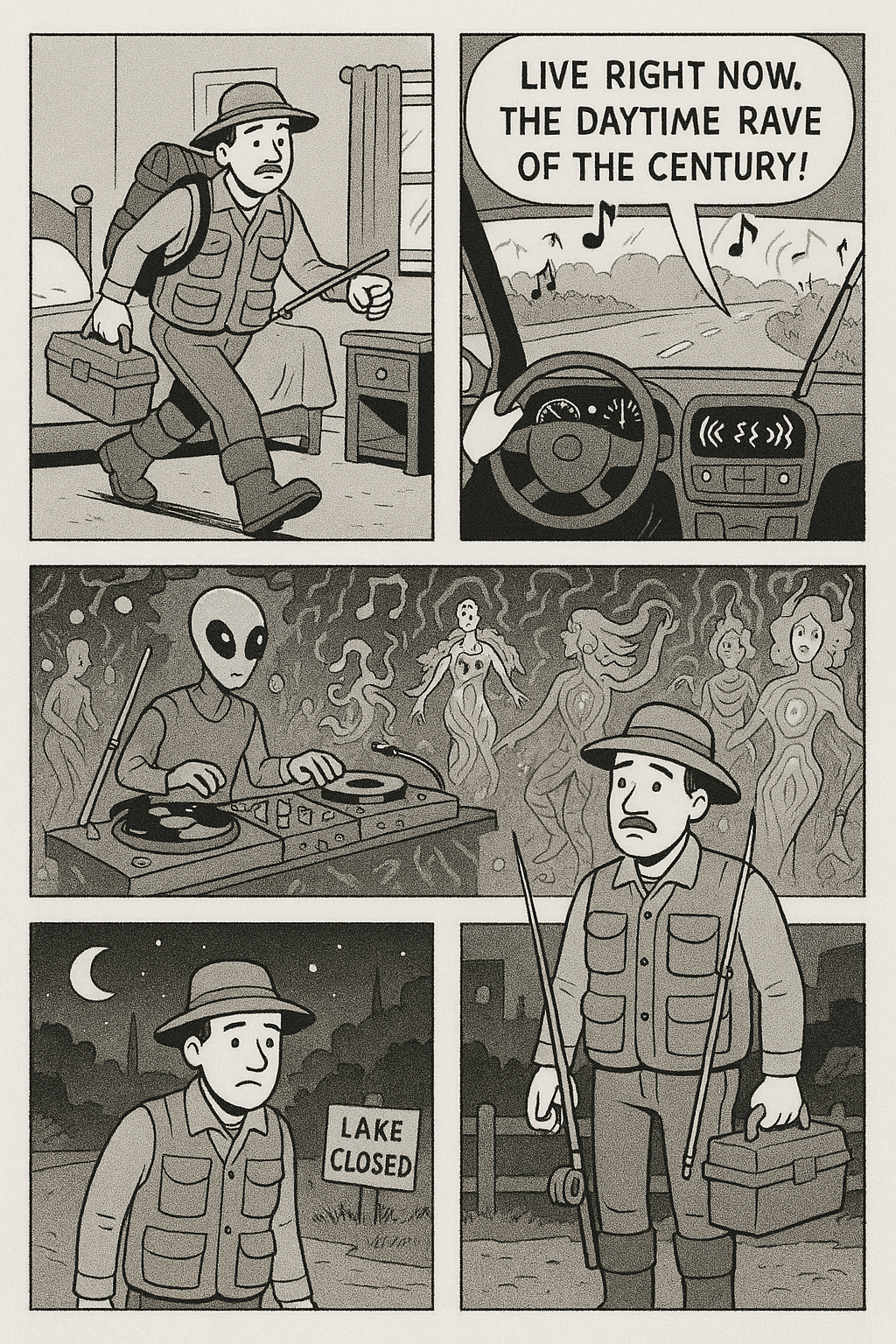
He woke before his alarm, already zipped into his fishing vest like a man born ready. The tackle box clicked shut with a satisfying sitcom‑episode finality. Today, he told himself, nothing would stop him from getting to the lake.
On the drive, he flicked on the radio. A pair of DJs were shouting over each other with the manic enthusiasm of hype men who’d had too much caffeine and too little sleep. Beneath their voices, a soft, rhythmic clicking rose and fell—cicadas, or something pretending to be cicadas.
“LIVE RIGHT NOW,” one DJ bellowed, “THE DAYTIME RAVE OF THE CENTURY.”
The cicada‑beat pulsed in time with his heartbeat. The road shimmered. The sunlight felt staged. The whole day tilted into that familiar Twilight Zone wonkiness, as if the universe had decided to improvise.
He didn’t remember turning off the highway. He didn’t remember choosing to follow the sound. He simply arrived—like a bug tracing an ancient instinct—at a warehouse pulsing with neon daylight that shouldn’t have existed.
Inside, the music was… wrong. Not bad, just wrong. Like alien jazz composed by a computer that had only ever heard nightclub rumors. The bassline slithered. The melody bent sideways.
He stood there in full fishing gear—waders, vest, hat—while the performers onstage shifted between shapes that might have been humanoid or might have been elaborate hallucinations. Their limbs bent like reeds in a current. Their faces glowed with colors that didn’t belong on the human spectrum.
The crowd danced in spirals, their bodies stretching and compressing, their auras blooming like chakra‑colored smoke. He drifted with them, caught in the tide of movement, losing track of where the warehouse ended and the rave began. Time folded. The beat rewired his sense of direction.
At some point—minutes or hours later—he stumbled outside. The sun was gone. The sky was ink. The warehouse was silent, as if it had never existed.
He checked his watch. It insisted it was still afternoon. The lake, however, was very much closed.
He sat in his car, fishing pole across his lap, and sighed the sigh of a man who had once again been thwarted by forces beyond mortal scheduling.
Another day without fishing. Another surreal detour. Another sitcom‑episode ending where the laugh track never quite kicks in.
He drove home tired, defeated, and still faintly humming that alien jazz he couldn’t shake.
The Reservation Keeps Moving
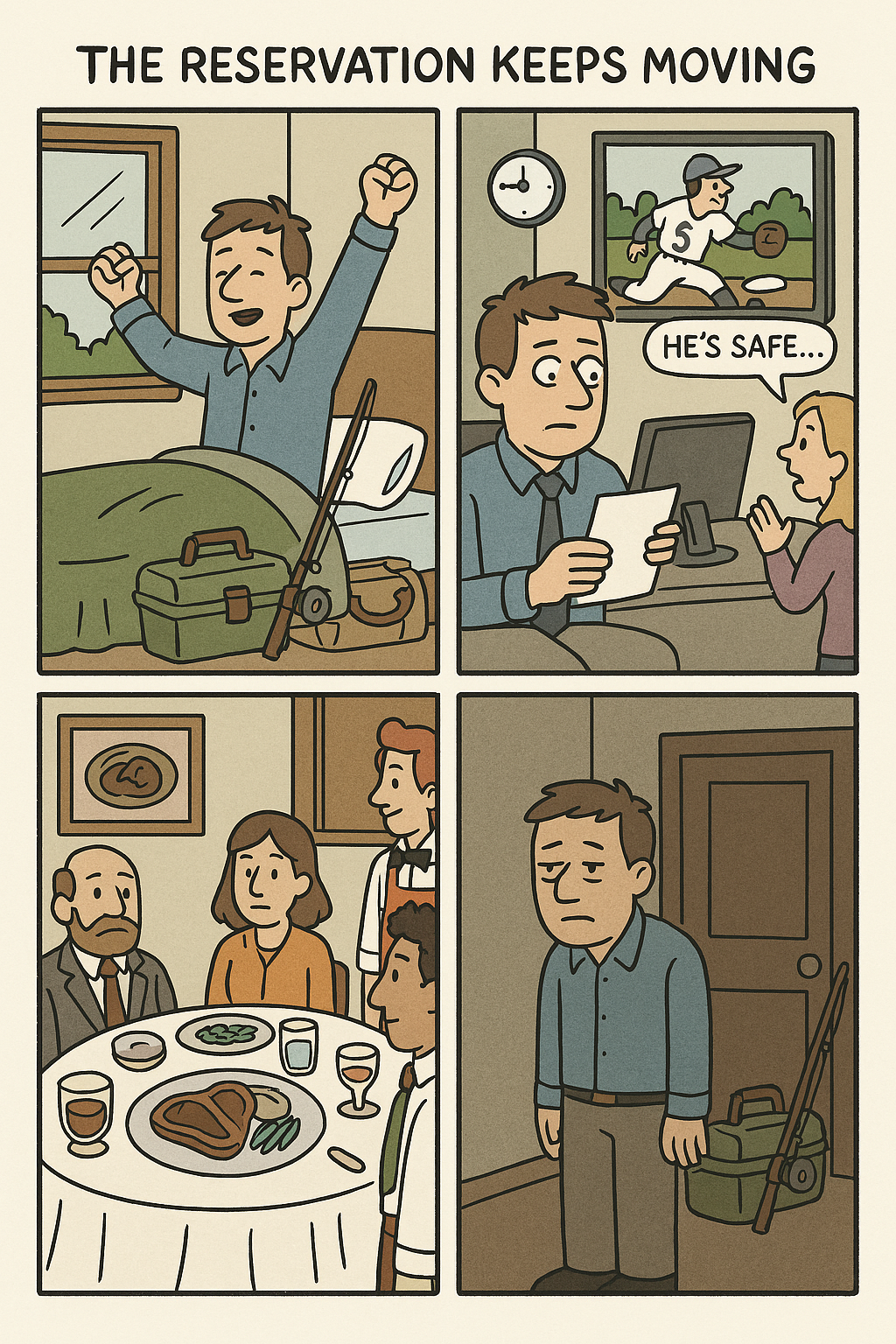
He woke up with the serene confidence of a man who had a plan. His tackle box was packed, his rods were lined up like obedient soldiers, and he’d even pre‑tied his lures the night before. All he had to do was get through work, clock out, and glide straight to the lake like a man fulfilling his destiny.
Work, at first, cooperated. A standard day. Emails. Meetings. Mildly confused coworkers. Nothing unusual.
Then he remembered the dinner.
The vendor dinner.
At the famous steakhouse.
The one he had agreed to weeks ago and then mentally buried under layers of fishing‑related optimism.
He checked the calendar. The reservation was at 7:00.
Annoying, but survivable. He could still fish tomorrow.
Then the day began to warp.
A problem ticket appeared for a system they didn’t even own. A coworker insisted the printer was “printing in the wrong emotional tone.” Someone swore the breakroom microwave was counting backward. The sports channel on the lobby TV showed a baseball game where every player wore the same number and the announcer kept saying, “He’s safe… but at what cost.”
He refreshed his email. The dinner reservation had been moved to 6:30.
Then 6:15.
Then 5:50.
He hadn’t even left his desk.
By the time he escaped the office, he was half convinced time itself was trying to gaslight him. He sped to the steakhouse, dodging traffic that felt choreographed by a bored cosmic entity.
Inside, the vendors were already seated—three of them, each stranger than the last. One spoke exclusively in metaphors about weather patterns. Another kept asking him if he understood “the deeper meaning of beef.” The third stared at him like he was a long‑lost oracle.
The food didn’t help. His steak arrived shaped like a question mark. Someone’s baked potato hummed. The salad wilted in reverse.
His coworkers, oblivious, kept turning to him with questions he absolutely did not have answers to:
“What’s the best way to optimize a supply chain during a lunar eclipse?”
“Do you think cows dream in color?”
“Is fishing actually a metaphor for late‑stage capitalism?”
He chewed, nodded, survived.
Eventually, dinner ended. The vendors vanished into the night like they had been summoned rather than scheduled. His coworkers drifted off, satisfied and full.
He walked to his car, exhausted, smelling faintly of steakhouse smoke and existential dread.
He drove home in silence.
His fishing gear waited by the door, untouched.
He went to bed defeated and tired, the lake still calling to him from a distance he could measure in miles—or in sitcom tropes.
The Coldest Catch
He woke up before his alarm, already zipped into three layers and humming the theme song of his favorite fishing show. Today was the day. He felt it in his bones—though, as he stepped outside, he realized that might just be the temperature.
The air hit him like a slap from a vengeful snow god. A frigid blast so sharp it felt personal. His breath didn’t fog; it clinked to the ground like tiny glass ornaments. He blinked. That wasn’t normal. But sitcom logic told him to shrug and keep going.
He waddled to his truck, teeth chattering in Morse code. The door handle was so cold it squeaked. When he turned the key, the engine groaned like it had been woken from a 300‑year nap.
“Come on, buddy,” he whispered. “We’ve trained for this.”
The truck coughed, sputtered, and finally started—though the radio immediately tuned itself to a station broadcasting nothing but wind. Not wind sounds. Just wind.
The drive to the lake was a patchwork of chaos: random islands of ice scattered across the asphalt like someone had spilled winter in polka‑dot form. He swerved around them, each one shimmering with a faint, eerie glow.
By the time he reached the lake, the water looked like a giant cup of convenience‑store slush. Not quite liquid, not quite solid—just a swirling, semi‑frozen mystery. He trudged out, set up his gear, and dropped his hook.
It barely broke the surface. The lake resisted like it had opinions.
Still, he waited. And somehow—miraculously—he felt a tug. He reeled in with triumph swelling in his chest… until he saw it.
A fish. Completely frozen. A perfect icy brick with fins.
He stared at it. It stared back, or would have, if its eyes weren’t frozen shut.
He pulled out his phone and called his friend.
“Hey, man,” he said. “Weird question. Ever catch a fish that was already frozen solid?”
“Oh yeah,” his friend replied casually. “That’s what happens when you disrespect the winter spirits.”
“What?”
“Also, you probably parked facing the wrong direction. Cold hates that. And you didn’t warm up your hook first. Amateur move.”
None of this made sense. All of it made sense. The cold wind howled in agreement.
Before he could argue, a loudspeaker crackled across the lake:
“Attention anglers: due to… uh… accelerated winter conditions, the lake is now closed. Please vacate before the temperature drops further.”
He looked at his frozen fish. He looked at the slush‑lake. He looked at the sky, which seemed to be dimming even though it was only noon.
Sitcom logic said: cue laugh track. Twilight Zone logic said: run.
He packed up, trudged back to his truck, and drove home in a defeated, frostbitten haze. By the time he got inside, he felt like he’d aged a decade.
He collapsed onto the couch, exhausted, discouraged, and still wearing his fishing hat.
Maybe tomorrow would be warmer.
Maybe tomorrow the world would make sense again.
Maybe tomorrow he’d actually get to fish.
But today?
Today he was just tired.
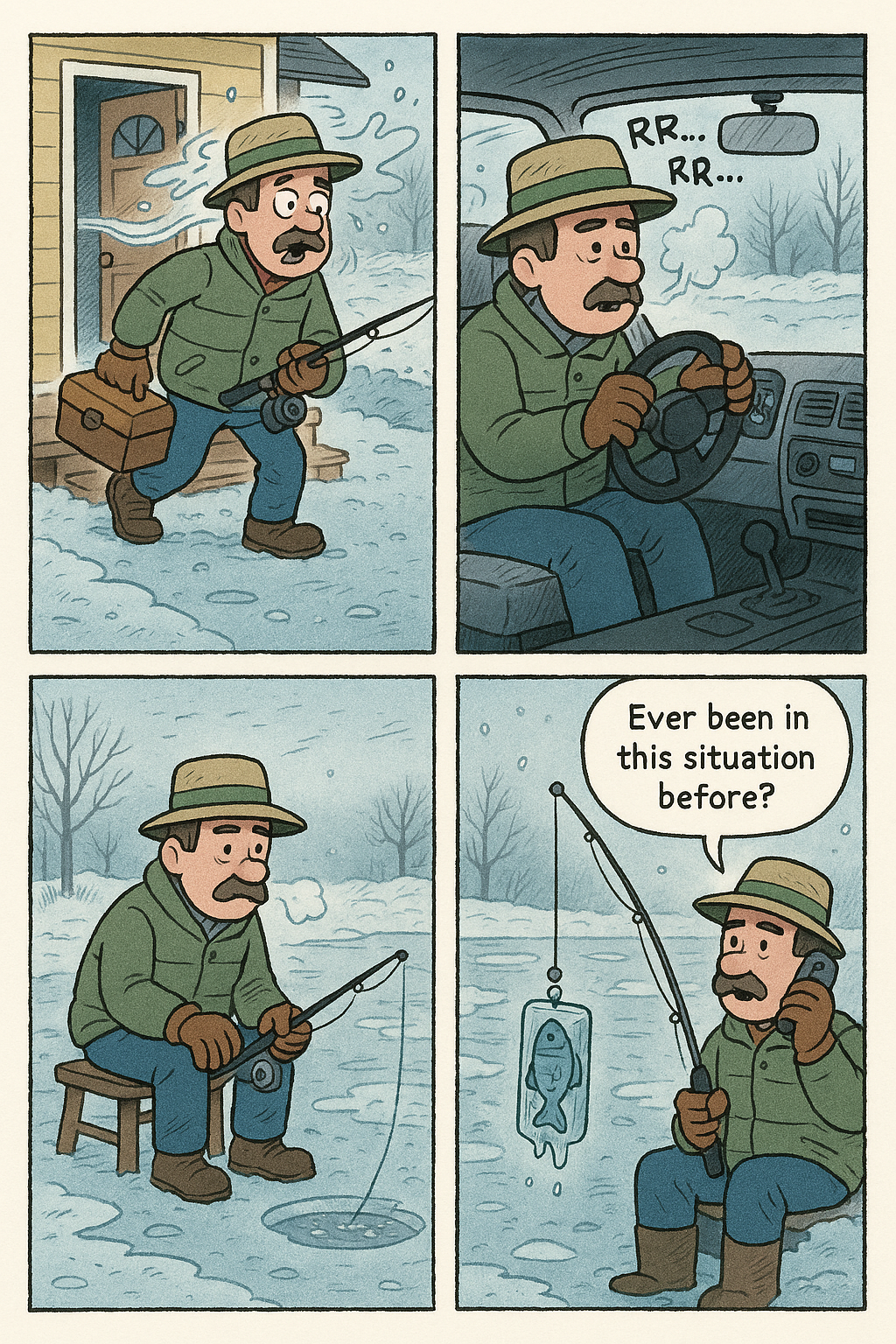
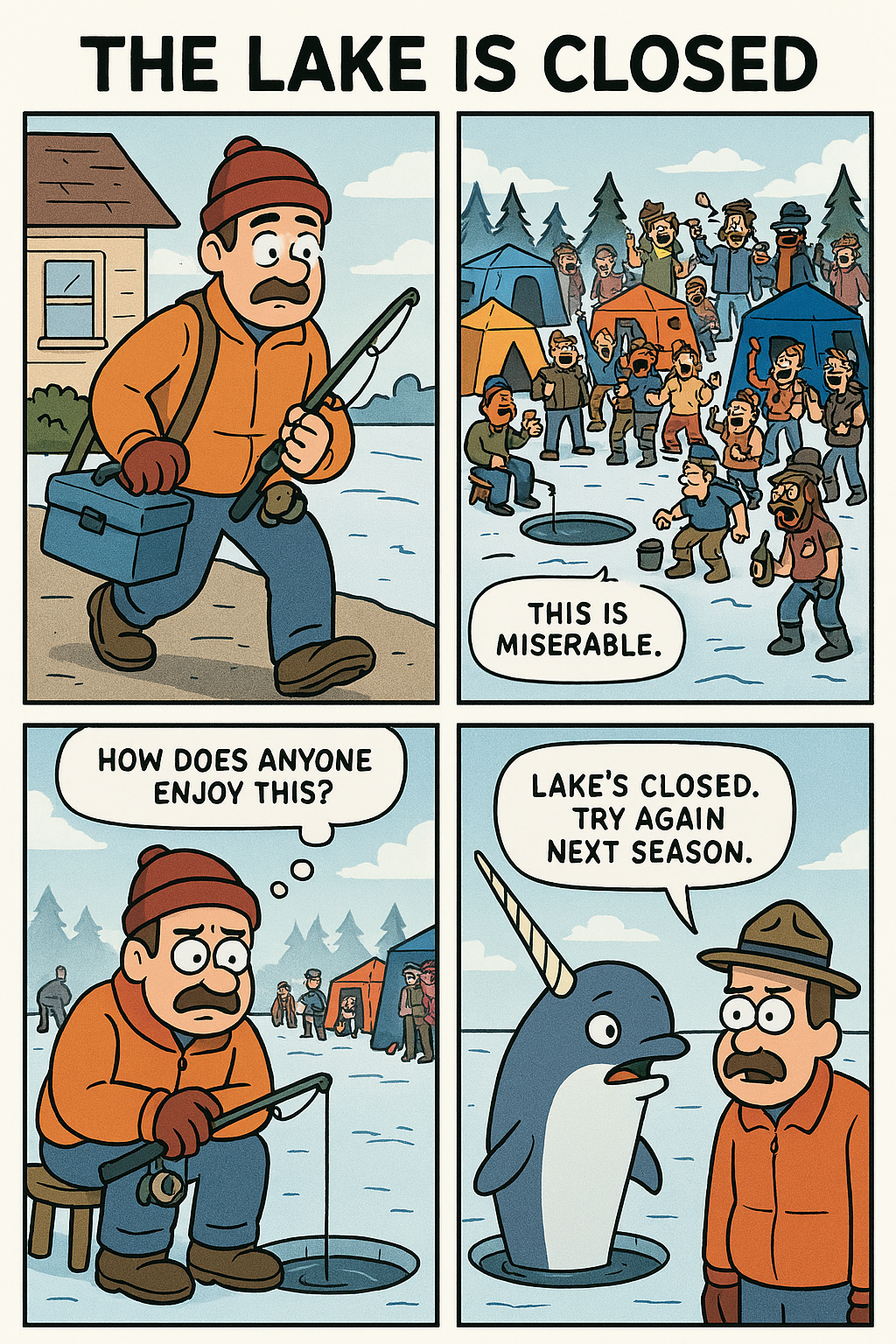
The Lake Is Closed
He woke up with the kind of optimism only a fisherman or a sitcom dad could muster. Thermos filled. Tackle box packed. Jacket zipped with heroic determination. Today—finally—he was going to hit the lake.
Halfway down the road, though, he noticed something troubling: the world had gone quiet. Too quiet. The kind of quiet that usually precedes a laugh track or an ominous narrator.
Then he saw it.
The lake was frozen. Again.
Not just frozen—colonized. A sprawling village of ice‑fishing tents had sprouted overnight like mushrooms after a radioactive storm. Blue tents, orange tents, tents shaped like medieval keeps. Smoke curled from chimneys that absolutely should not have been structurally possible on nylon.
People shuffled between them—rowdy, bundled, and behaving like aliens who had studied human frat parties exclusively through grainy VHS tapes.
He parked anyway. Because hope is stubborn.
The cold slapped him the moment he stepped out. His eyelashes froze together in a way that felt personal. He trudged across the ice, passing a man in a tank top doing keg stands next to a hole in the ice, and a woman teaching a group of children how to chant in a language that sounded suspiciously like whale song.
He reached an empty hole and sat down, shivering so hard his bones felt like maracas.
“This is miserable,” he muttered. “How does anyone enjoy this? It’s like camping inside a refrigerator someone keeps slamming shut.”
He dropped his line into the hole.
A moment passed.
Then the ice beneath him bulged. Cracked. Split.
A long spiraled horn pierced upward, followed by the head of a narwhal wearing what looked like a park ranger hat.
The narwhal blinked at him with weary authority.
“Lake’s closed,” it said, in a voice that sounded like a disappointed substitute teacher. “Try again next season.”
He nodded, because what else do you do when a narwhal gives you official instructions.
He packed up, trudged back to his truck, and drove home with the heater blasting and his dignity thawing slowly.
Cold. Defeated. Tired.
Another fishing day lost to the universe’s ongoing cosmic prank.
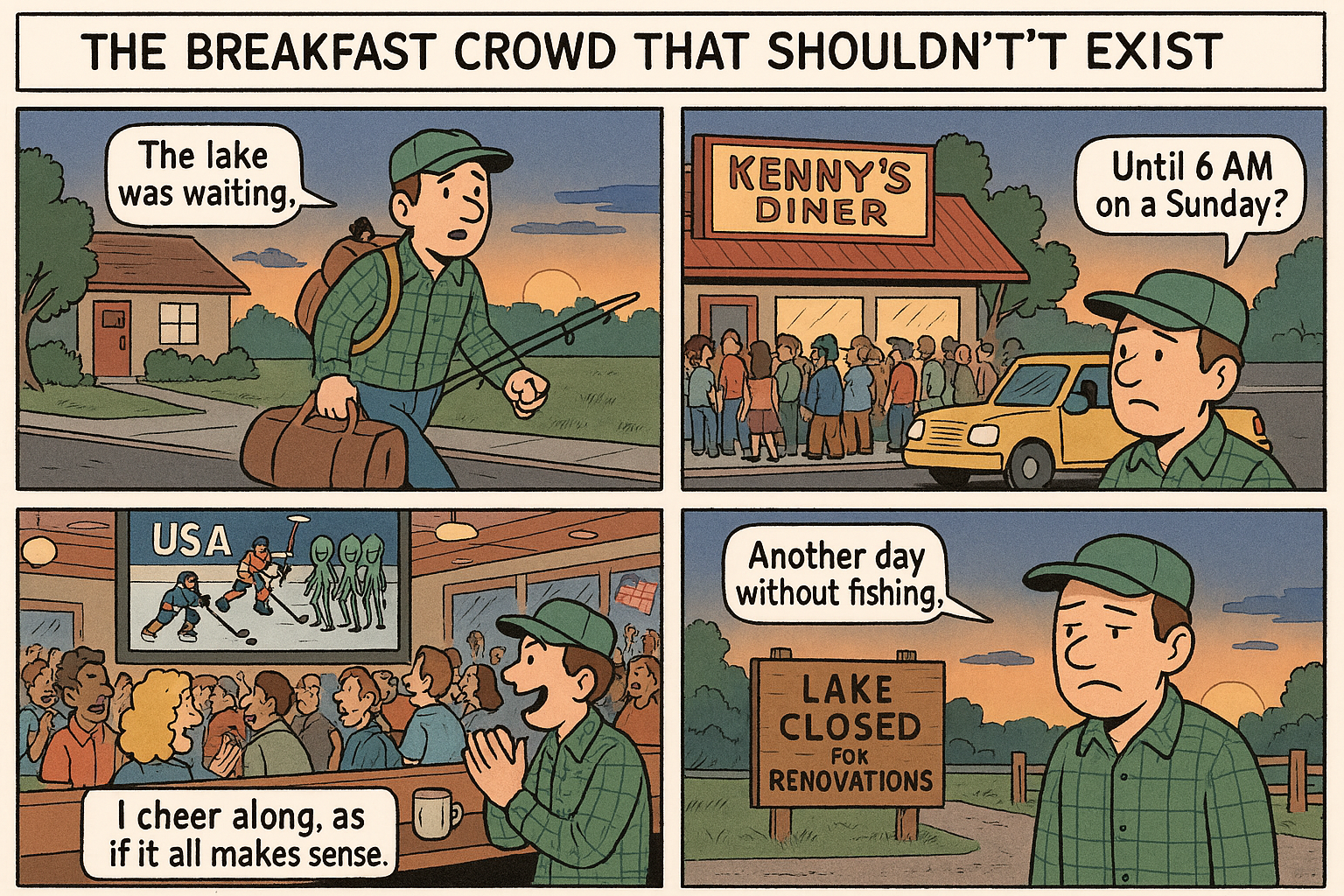
The Breakfast Crowd That Shouldn’t Exist
He woke before his alarm, already dressed, already packed, already humming the triumphant theme song he always imagined played when a man was destined to catch a legendary fish. The lake was waiting. The trout were waiting. The universe, for once, felt aligned.
At least until he hit the highway.
Halfway there, he spotted a restaurant—one of those unremarkable roadside diners that usually had three cars in the lot and a sign that flickered “OPE ” because the “N” had died in 1998. But today? At 6 AM on a Sunday? The place was bursting. Cars everywhere. People spilling out the doors. A line wrapped around the building like it was the hottest club in the galaxy.
He slowed. He stared. He felt the gravitational pull of curiosity tug at his steering wheel.
Just a quick look, he told himself. Then the lake.
Inside, the diner felt wrong in a way he couldn’t articulate—like someone had replaced reality with a high-budget reboot. The crowd was buzzing, jittery, electric. Every booth was packed. Every stool was taken. And all eyes were locked on a dozen TVs broadcasting the final match of the Winter Olympics.
USA vs… something.
The opposing team looked like alien entities—elongated limbs, shimmering skin, helmets that pulsed like jellyfish. Their skates didn’t glide so much as hover. The commentators spoke with the frantic cadence of people trying to pretend this was normal.
The game was chaos. Beautiful, terrifying chaos. He found himself cheering, shouting, clutching strangers’ shoulders. The puck moved like it had free will. The alien goalie split into three goalies whenever a shot came near. The USA captain kept aging backward between periods.
And the crowd? Pure patriotism. Flags waving. Tears streaming. People chanting “U-S-A” with the intensity of a nation defending its last pancake.
The game went to overtime. The diner shook with anticipation. When the USA scored—somehow, impossibly—the place erupted. He screamed. He high‑fived a man who might have been a hologram. He stayed for the bizarre post-game coverage, the closing ceremonies, and a segment about an Olympic sport involving synchronized snow vortexes.
By the time he stepped outside, the sun was low and the world felt strangely quiet, like the diner had been a pocket dimension sealed off from time.
He drove to the lake anyway, clinging to hope.
A sign greeted him:
LAKE CLOSED FOR RENOVATIONS
SORRY FOR THE INCONVENIENCE
(NO, REALLY, WE MEAN IT THIS TIME)
He stared at it. The universe stared back.
He drove home, tired, defeated, and carrying the faint smell of diner coffee and interdimensional patriotism. Another day without fishing.
Another episode in the long-running sitcom of his life.
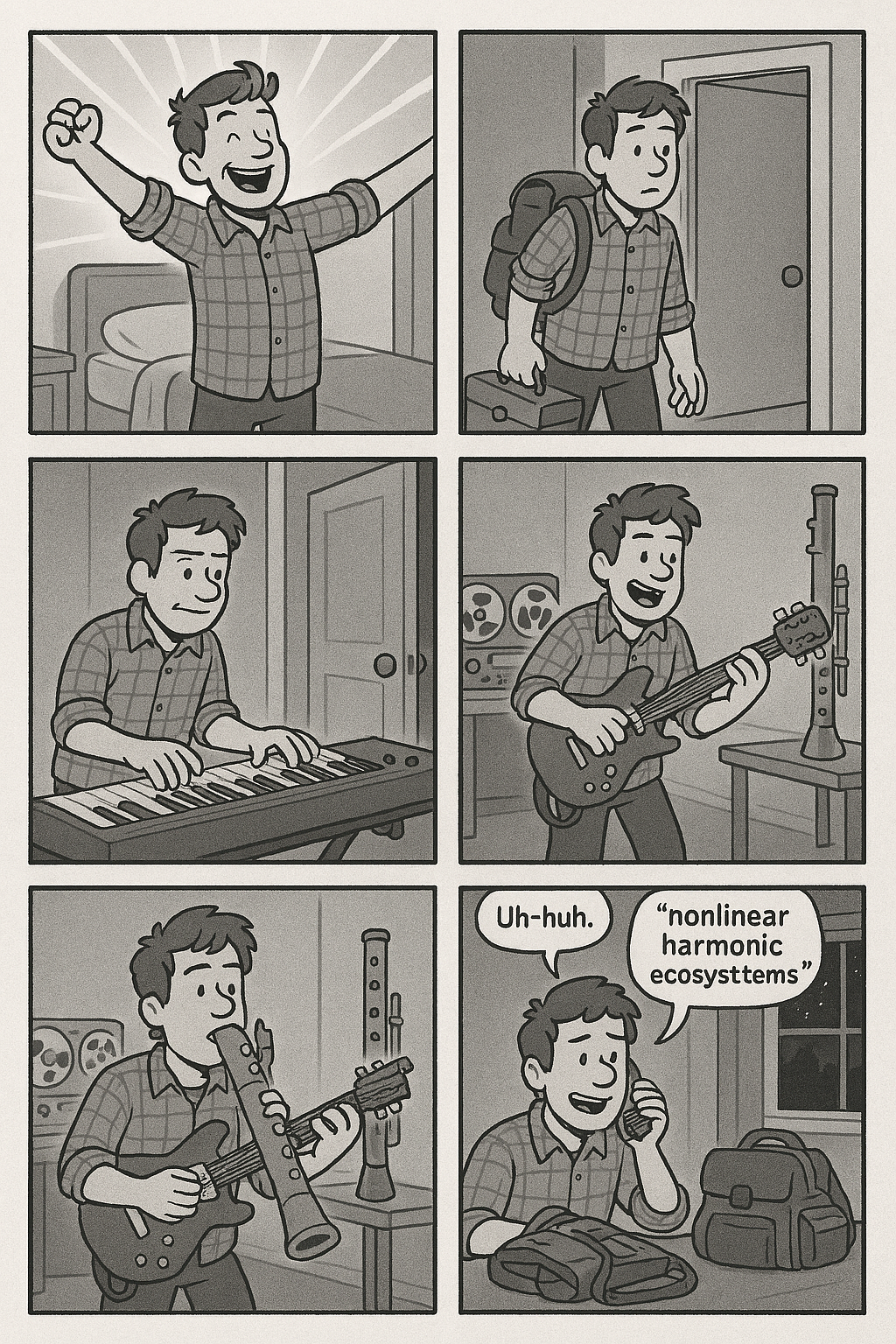
The Jam That Ate the Day
Grant woke up electric—one of those rare mornings where the sun hits the blinds just right and whispers, Today you fish, my dude.
He was packed, caffeinated, and halfway out the door with his tackle box when he passed the music room.
He stopped.
The door was open.
He didn’t remember leaving it open.
Inside, the room glowed like a thrift-store spaceship. His gear—his gear—looked unfamiliar, as if someone had swapped everything with slightly uncanny versions. The keyboard had too many keys. The guitar had too few strings. A wind instrument sat on the desk shaped like a PVC pipe that had dreams of being a saxophone.
He stepped inside, just to peek.
The door clicked shut behind him.
A soft hum filled the room, like the opening note of a theme song that didn’t know what show it belonged to.
Grant shrugged and sat at the keyboard.
One note.
Then another.
Then he was gone—lost in a vortex of sound, hopping between instruments like a man possessed by the ghost of a jazz band that died in a synthesizer accident.
He layered tracks.
He noodled.
He jammed on the weird wind pipe thing and felt, briefly, like a wizard casting spells in 4/4 time.
In a burst of nostalgia, he called his old jam buddy, Rick.
Rick answered mid-rant about “nonlinear harmonic ecosystems” and “the metaphysical weight of diminished sevenths.” Grant nodded along, understanding none of it but loving the enthusiasm. It felt like old times, if old times had been scored by an experimental alien lounge band.
Hours passed.
Or minutes.
Or centuries.
Time was a flat circle with reverb.
Finally, Grant leaned back, sweaty and triumphant.
He’d done it.
He’d made something incredible.
He reached for the recorder.
The red light was off.
He hadn’t pressed record.
The silence that followed was cosmic.
Grant stared at the gear, at the instruments that now looked a little too still, a little too smug. He sighed, walked out, and found the sky outside had gone dark. The lake was closed. The day was over.
He unpacked his fishing gear piece by piece, each item a tiny reminder of the morning’s optimism. Then he crawled into bed, defeated, tired, and humming a melody he’d never hear again.
Somewhere in the house, the music room hummed back.
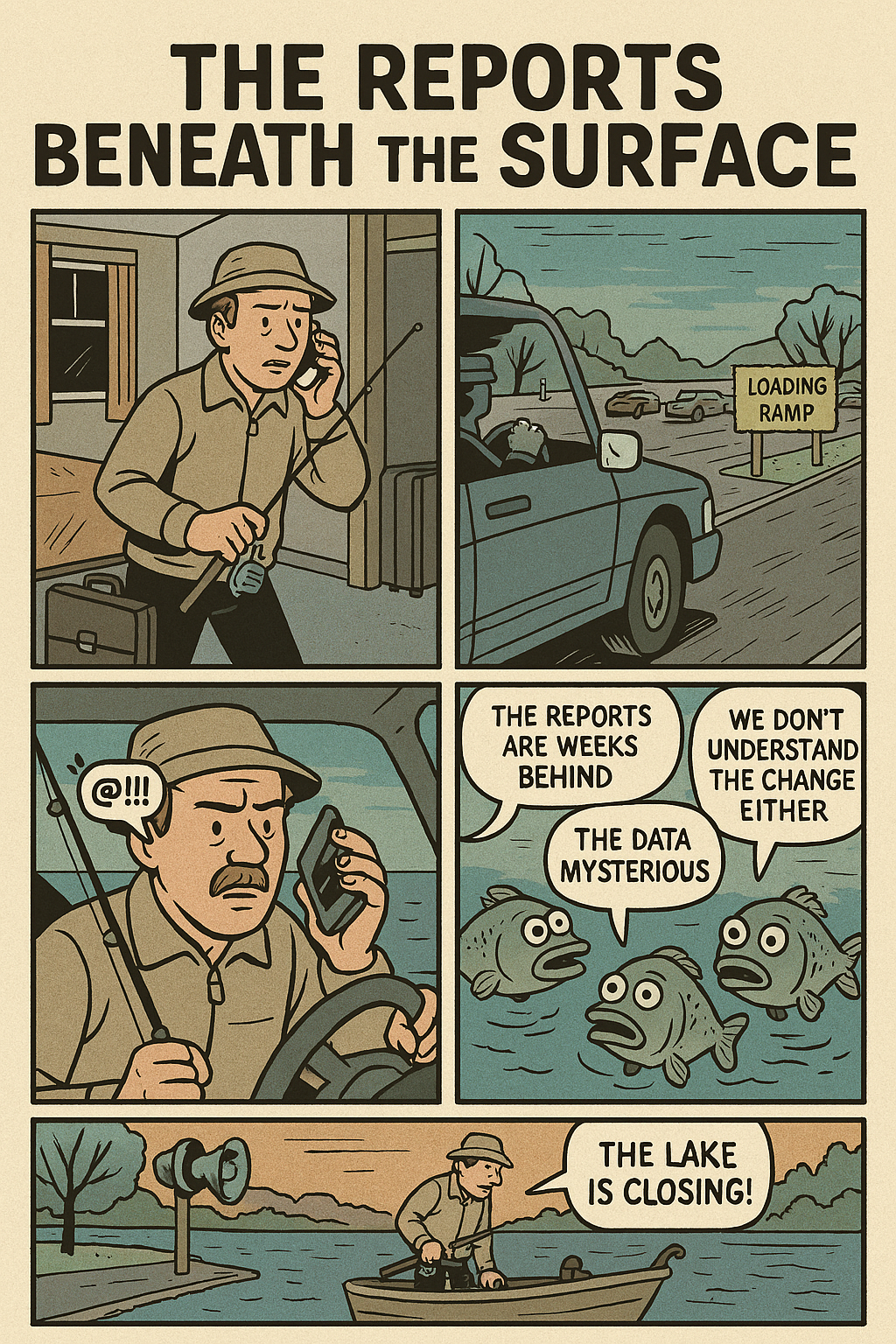
The Reports Beneath the Surface
He woke before his alarm, already zipped into his fishing jacket, tackle box squared away like a soldier’s kit. Today—finally—he would hit the lake. No detours. No errands. No cosmic interference. Just water, quiet, and fish that minded their own business.
He made it halfway down the highway before his phone began vibrating like a trapped insect. First a call. Then an email. Then another. All about “the new reporting and documentation shift.” A phrase that felt like it had been assembled by a committee of sleep‑deprived goblins.
By the time he pulled into the lake’s parking lot, the world had gone slightly… off. The asphalt shimmered like it was thinking too hard. The loading ramp seemed to be leaning away from him, as if embarrassed. Even the gulls looked confused, circling in hesitant, bureaucratic spirals.
He checked in with work, hoping for clarity. Instead he got a chorus of contradictory instructions:
“Use the new numbers.”
“Don’t use the new numbers.”
“These numbers don’t exist yet, but they will retroactively.”
“Stop tying reports together. We want less information now. More ambiguity. It’s cleaner.”
It all felt like someone had taken his old reporting system—his neat rows, his tidy logic—and replaced it with a half‑finished crossword puzzle.
He shook it off. He was here to fish.
He launched his boat and drifted to his favorite spot, the one that usually felt like a sanctuary. But today the water had a strange hum to it, like it was buffering. The fish surfaced one by one, blinking at him with the weary eyes of middle managers.
“Your reports are weeks behind,” one fish burbled.
“The data is mysterious,” another added.
“We don’t understand the change either,” a third sighed before sinking back into the murk.
He stared at them, rod limp in his hands. None of this made sense. Not the new system. Not the phantom numbers. Not the fish unionizing to discuss documentation practices.
Eventually, after he’d exhausted his confusion and his patience, a voice boomed across the lake through a tinny loudspeaker:
“Attention boaters. The lake is now closing. Please exit immediately.”
Of course it was.
He reeled in nothing, packed up nothing, and drove home with the hollow ache of a man who had tried—truly tried—to fish.
But the universe had other plans.
He arrived home defeated and tired, the day’s absurdity clinging to him like lake mist. Tomorrow he’d face the meeting. Tonight he’d collapse.
And somewhere, deep in the water, the fish were probably still arguing about the reports.
The Appointment
He woke up already packed, which should’ve been a good omen. The rods were lined up by the door like obedient soldiers, the tackle box clicked shut with purpose, and the thermos steamed with the optimism of a man who believed—truly believed—he could squeeze in a little fishing before his noon dentist appointment.
But the moment he stepped outside, the air felt… off. Like the world had been filmed at a slightly wrong frame rate. Colors too saturated. Shadows too curious. A faint hum in the sky, as if someone left the cosmic refrigerator open.
He shrugged it off and drove toward the lake.
The traffic was zany in that sitcom way where every car seemed cast specifically to annoy him: a clown car that kept honking in a cheerful minor key, a hearse going ten under the limit, a pickup truck stacked with mannequins staring backward at him with blank, judgmental faces. Every off‑ramp he needed was mysteriously closed for “Seasonal Adjustments,” whatever that meant.
By the time he reached the lake, he was already sweating through his optimism.
The boat dock was absurd—tilted at an angle that defied physics, crowded with people who looked like they’d been extras in a dream sequence. One man wore a suit made entirely of fishing lures. Another kept whispering to his cooler as if it were giving him stock tips.
Still, he launched his boat.
The lake’s surface churned with wakes that seemed to anticipate him, pushing him away from his favorite spot like a polite but firm bouncer. Other boaters drifted by, their faces slightly blurred, their voices echoing as if spoken through long metal tubes. One waved at him with an arm that bent in too many places.
He finally reached his spot—his sacred, quiet, perfect spot—and checked the time.
11:42.
He sighed, reeled in nothing, and sped back across the water, the wakes now laughing at him in small, choppy bursts.
The dentist’s office was worse.
The waiting room smelled like mint and static electricity. The music playing overhead sounded like a lounge band from a distant galaxy trying to imitate Earth jazz but getting the time signatures wrong. The dentist himself moved with the stiff politeness of someone who had studied human behavior from outdated instructional videos.
“Procedure today,” the dentist said, his voice slightly delayed from his mouth. “Urgent.”
The equipment looked like it had been borrowed from a museum exhibit titled Dental Horrors of the 1950s. Tubes coiled like sleeping snakes. A drill that hummed in a pitch that made his molars vibrate in sympathy.
He endured it. Because what else do you do in the Twilight Zone but endure?
When he finally drove home, he passed the lake. A large sign now hung across the entrance:
LAKE CLOSED — TEMPORAL MAINTENANCE
He didn’t even slow down.
He just kept driving, tired and defeated, wondering if tomorrow would let him fish—or if the universe had already written the punchline.