Loops and Lures
I had this idea of a person who keeps getting sidetracked on his way to fishing. It feels like a sitcom with the entrance and ending are the same. He packs up his fishing gear and leaves his house but gets lured towards something else. I don’t really write much prose anymore and I initially envisioned it being filmed as a short while being next to flash fiction. I’ve been shallowly dabbling in AI and thought this would be a fun “newspaper” project. I think AI is pretty dumb but can be hilarious in its vanity. It’s nuance and lack of brevity leaves it clueless. I like the idea of AI being fed with a prompt that’s entries have to deal with the short sightedness of AI and it’s reach. I know most fans hate AI but I want to be up front with its use in this material and my thought on it.
I just wanted to go fishing
“The One Where He Never Gets to Fish”
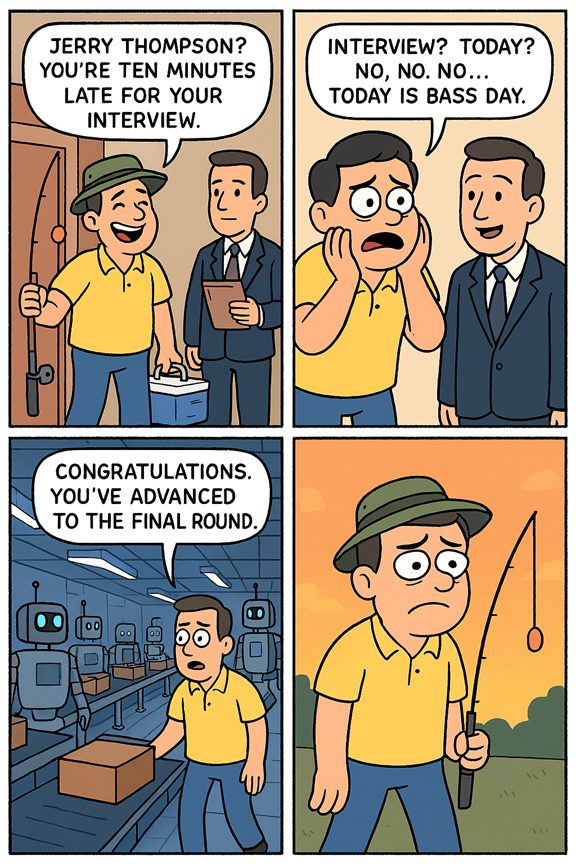
Jerry had his fishing hat on, cooler packed, and a grin wide enough to catch trout with. He swung open his apartment door—only to find a man in a blazer standing there, clipboard raised like a shield.
“Jerry Thompson? You’re ten minutes late for your interview.”
Jerry froze. “Interview? Today? No, no, no… today is bass day.”
The man blinked. “Congratulations. You’ve advanced to the final round.”
Jerry sagged against the doorframe like someone had unplugged him. “But the lake… the fish… the serenity…”
“Great enthusiasm,” the man said, jotting something down. “Let’s go.”
Cut to: Jerry in the passenger seat of a company shuttle, clutching his fishing pole like a comfort object.
The facility was a warehouse the size of a small moon. Fluorescent lights hummed overhead. Conveyor belts snaked through the space like metallic intestines. And everywhere—robots. Hundreds of them. Sorting, stacking, scanning, repeating. Over and over. Perfectly synchronized. Perfectly identical.
Jerry whispered, “This feels… off.”
His tour guide beamed. “We pride ourselves on efficiency.”
A robot rolled by, paused, and stared at Jerry with glowing blue eyes. Then another robot rolled by. Same model. Same stare. Same pause. Then another. And another.
Jerry swallowed. “Do they… always do that?”
“Oh yes,” the guide said cheerfully. “They’re stuck in a behavioral loop. Can’t fix it. But productivity is up!”
They turned a corner. More robots. More staring. More loops. Jerry felt like he’d wandered into a Twilight Zone episode where the twist was “You will never escape orientation.”
Hours passed. Or maybe days. Time didn’t behave normally in the warehouse.
Finally, the guide clapped his hands. “That concludes the tour! We’ll be in touch.”
Jerry stumbled outside, blinking at the sunset. His fishing pole drooped like it was disappointed in him.
He checked the time. The lake was closed. The fish were asleep. His dream day had evaporated into fluorescent hum and robot eyes.
He trudged home, lost in thought, wondering if the robots were still looping… or if he was.
The One Where the Tow Truck Never Arrives
Mark woke up glowing with purpose. Today was his day off. His fishing rod gleamed. His cooler hummed with potential. The lake practically whispered his name.
Four miles down the road, his tire exploded with the enthusiasm of a confetti cannon.
He stared at the shredded rubber. “Not today,” he muttered, dialing roadside assistance.
A cheerful synthetic voice answered.
“Thank you for calling AutoAid! Transferring you to an authorized agent.”
Click.
“Hello! You’ve reached AutoAid Robotics Division. I am not authorized to dispatch a tow truck. Transferring you now.”
Click.
“Greetings! TowBot Services. I can dispatch a tow truck only if your claim is pre‑authorized. Transferring you now.”
Click.
Mark aged ten years.
Eventually, a driverless tow truck rolled up, LED eyes blinking like a caffeinated emoji.
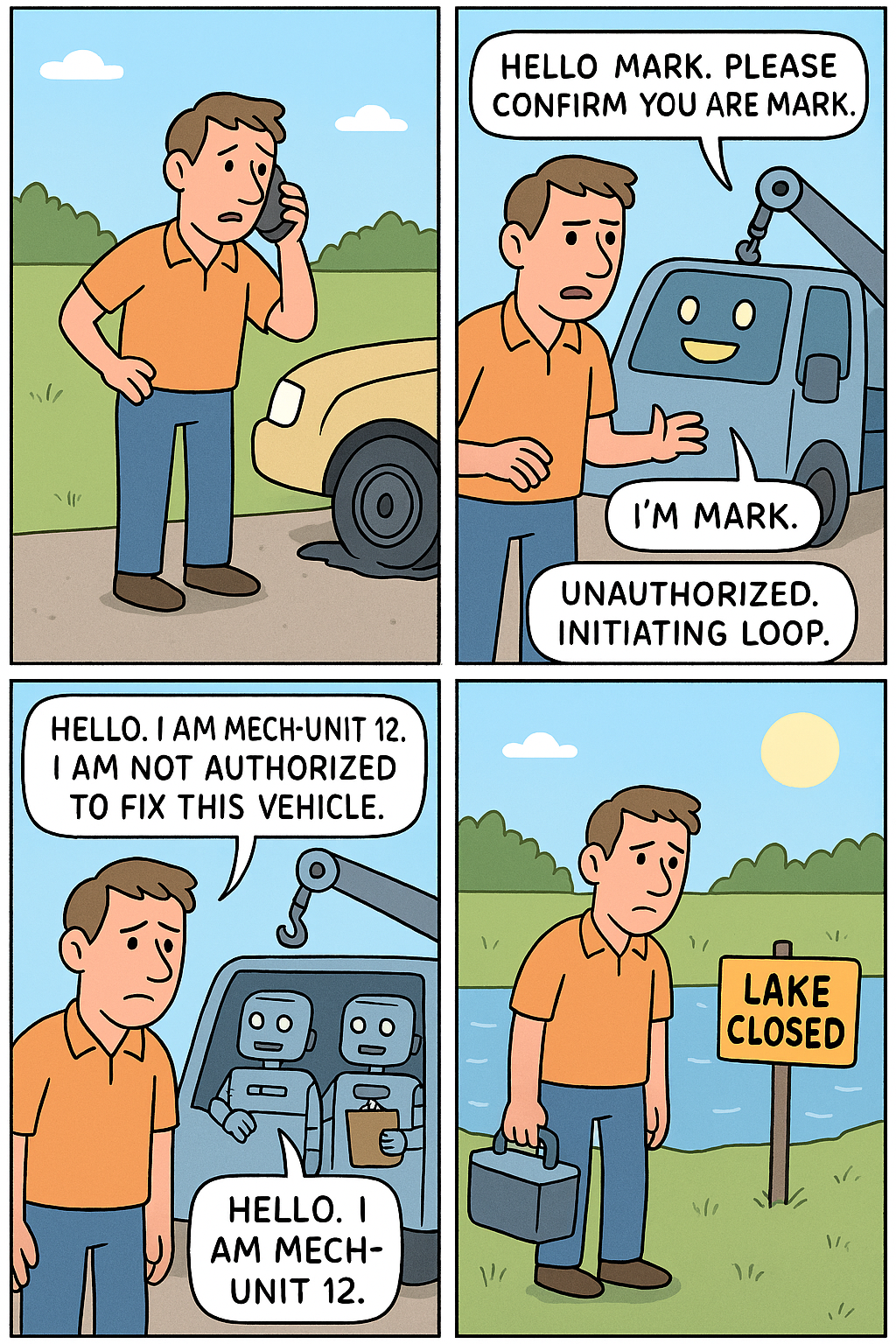
“HELLO MARK. PLEASE CONFIRM YOU ARE MARK.”
“I’m Mark.”
“UNAUTHORIZED. INITIATING LOOP.”
The truck circled him. Once. Twice. Twelve times.
Finally, it accepted his existence and hoisted his car—only for a robot mechanic to roll out of a hidden compartment.
“HELLO. I AM MECH‑UNIT‑12. I AM NOT AUTHORIZED TO FIX THIS VEHICLE.”
Another panel opened.
“HELLO. I AM MECH‑UNIT‑13. ALSO NOT AUTHORIZED.”
Mark wondered if this was purgatory. Or customer service. Hard to tell.
Hours blurred. Robots transferred him. Robots denied him. Robots apologized in the exact same tone that suggested they felt nothing and never would.
At last—miracle of miracles—his car was repaired.
He checked the time.
Sunset.
The lake was closed. The fish were asleep. His day off had been devoured by bureaucracy with blinking LED eyes.
He drove home in silence, spiritually hollow.
His phone buzzed.
AUTOAID: “Your service request has been received. An authorized agent will contact you shortly.”
Mark considered taking up a hobby that didn’t involve nature, tires, or hope.
Knitting, maybe.
Yarn never asked for authorization.
The One Where the Package Never Arrives (Until It Does)
Jerry sat on his porch, fishing rod in hand, cooler by his feet, and hope in his heart. The lake was calling. The trout were texting. But first—insurance cards.
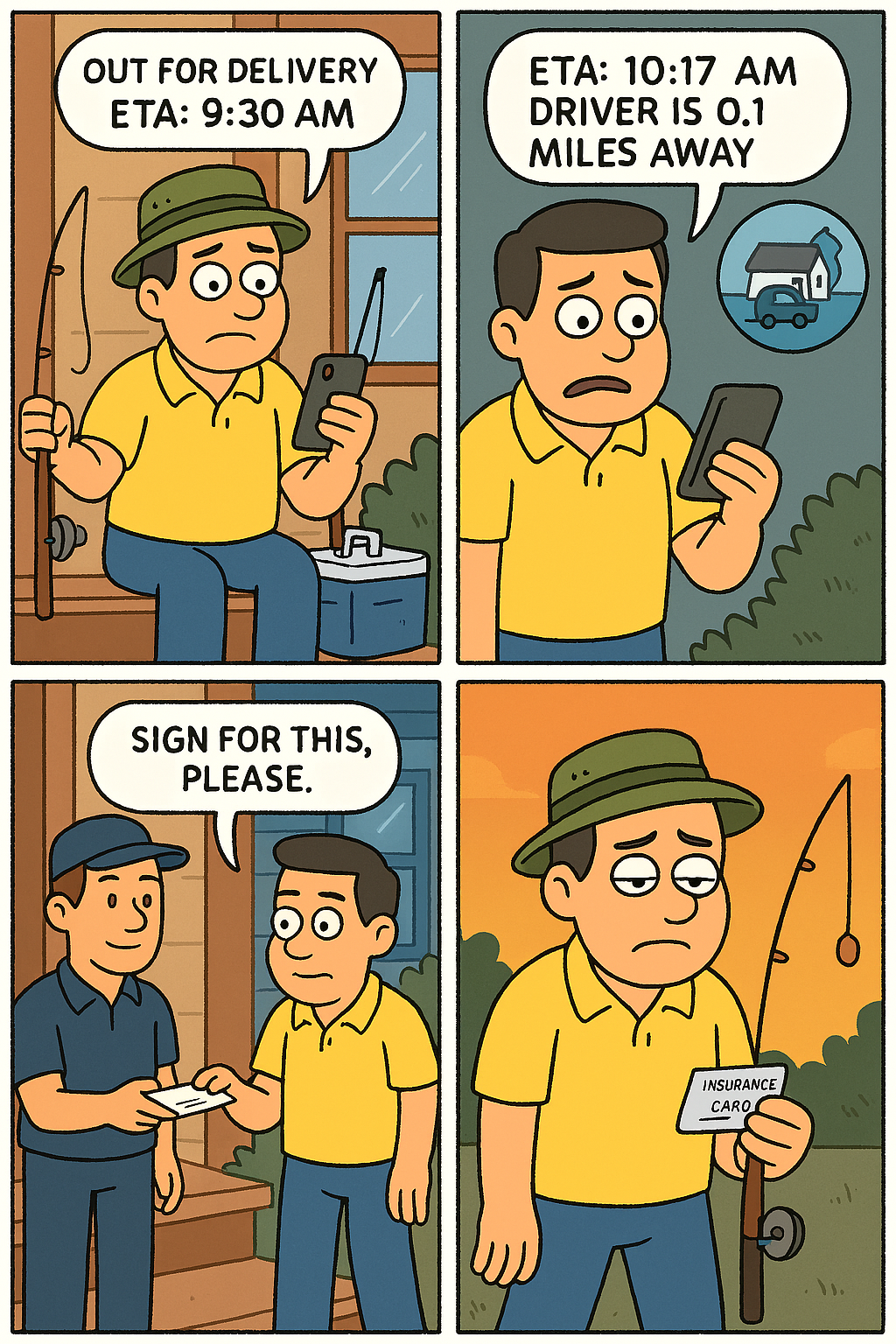
Priority mail. Signature required. Tracking said: Out for delivery. ETA: 9:30 AM.
It was 9:28.
He refreshed the app.
ETA: 9:45 AM.
He frowned.
Refreshed again.
ETA: 10:02 AM. Driver is 0.2 miles away.
Jerry squinted at the map. The little delivery truck icon was circling his block like a confused mosquito.
Then it reversed course. Then it parked. Then it vanished.
ETA: 10:17 AM. Driver is 0.1 miles away.
Jerry stood up. “I swear if this guy is doing donuts around my house…”
The app pinged.
Delivery attempted. Signature required.
Jerry screamed into the void. “I’M RIGHT HERE!”
A van materialized like a ghost. The driver emerged, handed Jerry the envelope, and vanished before Jerry could say “Thanks” or “You ruined my morning.”
Inside: two insurance cards and a note.
“Activate immediately. Scan QR code.”
Jerry scanned. The website loaded. Then froze. Then blinked. Then asked for his date of birth. Then his policy number. Then his date of birth again. Then it crashed.
He tried again. And again. And again.
The sun began to set.
The lake dimmed in the distance like a fading dream.
Finally, the site accepted his info. A confirmation screen appeared.
“Thank you. Your cards are now active. You may fish with peace of mind.”
Jerry looked at the sky. It was purple. The fish were asleep. His rod was limp with disappointment.
He sat back down on the porch, cooler unopened, soul slightly dented.
The tracking app pinged again.
“Your package has been delivered. ETA: 9:30 AM.”
Jerry considered switching hobbies.
Maybe chess.
Chess never needed QR codes.
The One Where He Misses the Lake for Sneakers
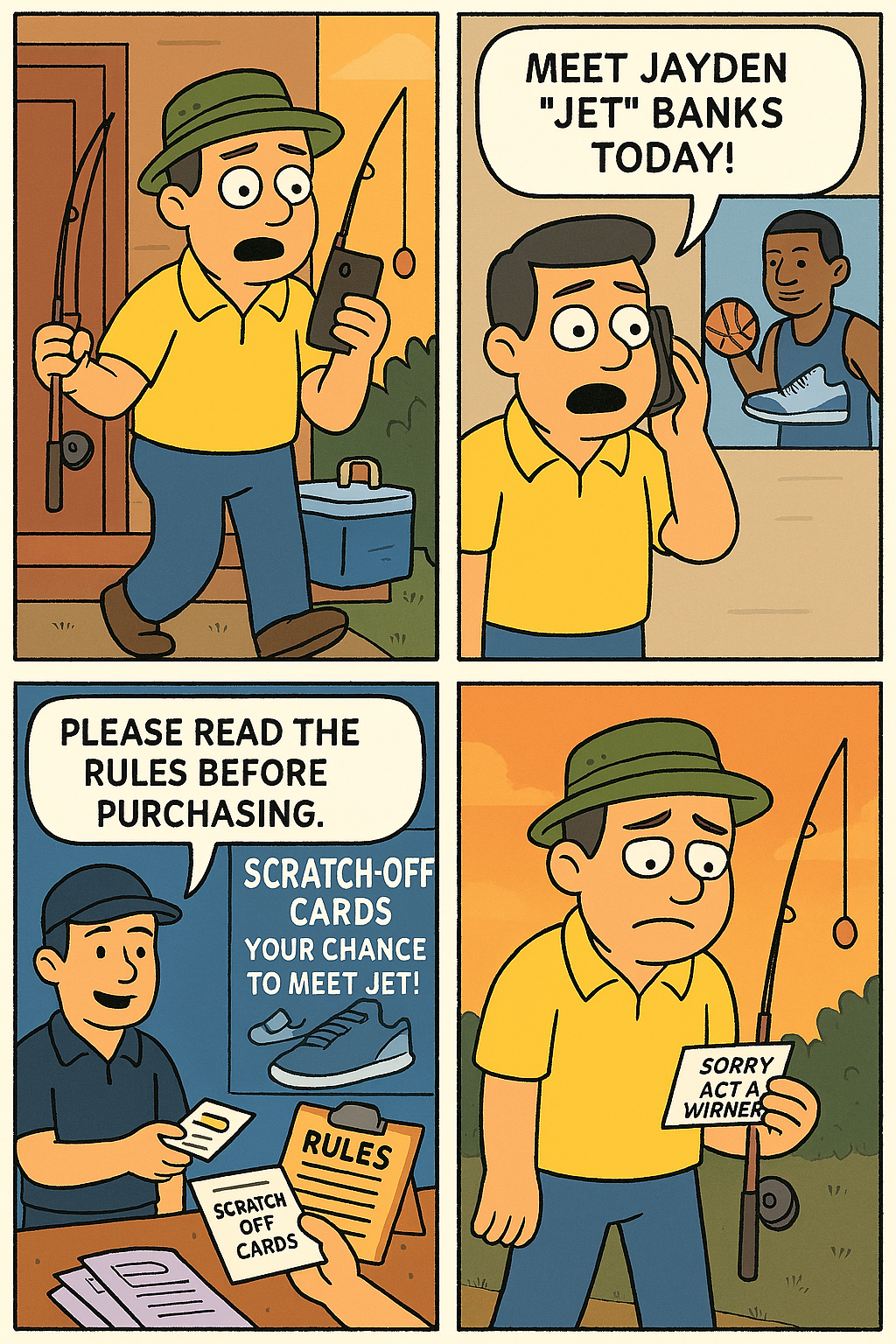
Jerry had his tackle box, his rod, his cooler, and his “Fish Whisperer” hat. The lake was twenty minutes away, and the trout were practically texting him “Where you at?”
Then his phone buzzed.
“TODAY ONLY: Meet JAYDEN ‘JET’ BANKS at the launch of his new signature shoes!”
Jerry gasped. Jet Banks. His favorite player. The man who dunked so hard once, the rim filed a restraining order.
He swerved off the road like destiny had a detour.
The release party was chaos. Music. Lights. People in line like it was Black Friday meets Comic-Con. A giant banner read:
“Scratch-Off Cards: Your Chance to Meet Jet!”
Jerry got in line. First in line, actually. He was proud. He was ready.
A clerk handed him a clipboard.
“Please read the rules before purchasing.”
Jerry squinted.
Rule 1: Must be present to scratch.
Rule 2: Scratching must occur within designated scratch zone.
Rule 3: No scratching with fingernails, coins, or unauthorized enthusiasm.
Rule 4: Only one scratch per card unless otherwise authorized by a scratch marshal.
Rule 5: All decisions are final unless reversed by the Council of Scratch.
Jerry blinked. “Is this… legal?”
The clerk smiled. “Totally. Now, how many cards would you like?”
Jerry bought the max. Twenty. He scratched. Slowly. Carefully. Within the zone. With the approved stylus.
Nothing.
He scratched again. Nothing.
The guy behind him screamed, “I WON!” and was whisked away by a team of handlers like he’d just been drafted.
Jerry looked at his pile of scratched-off dreams.
The sun was setting.
The lake was closed.
Jet Banks was shaking someone else’s hand.
Jerry trudged back to his car, cooler untouched, rod unused, soul slightly scuffed.
As he drove home, the radio played a commercial:
“Missed your chance to meet Jet? Try again tomorrow at our Second Chance Scratch-Off Spectacular!”
Jerry turned off the radio.
Maybe next time he’d just fish.
Or maybe next time the fish would be giving out sneakers.
“The One Where Christmas Eats the Fishing Trip”
Tom woke up with the serene confidence of a man destined to fish. His tackle box gleamed. His thermos steamed. His fishing hat sat at a jaunty angle that said, Today, the trout will fear me.
He opened his front door—and immediately heard a marching band.
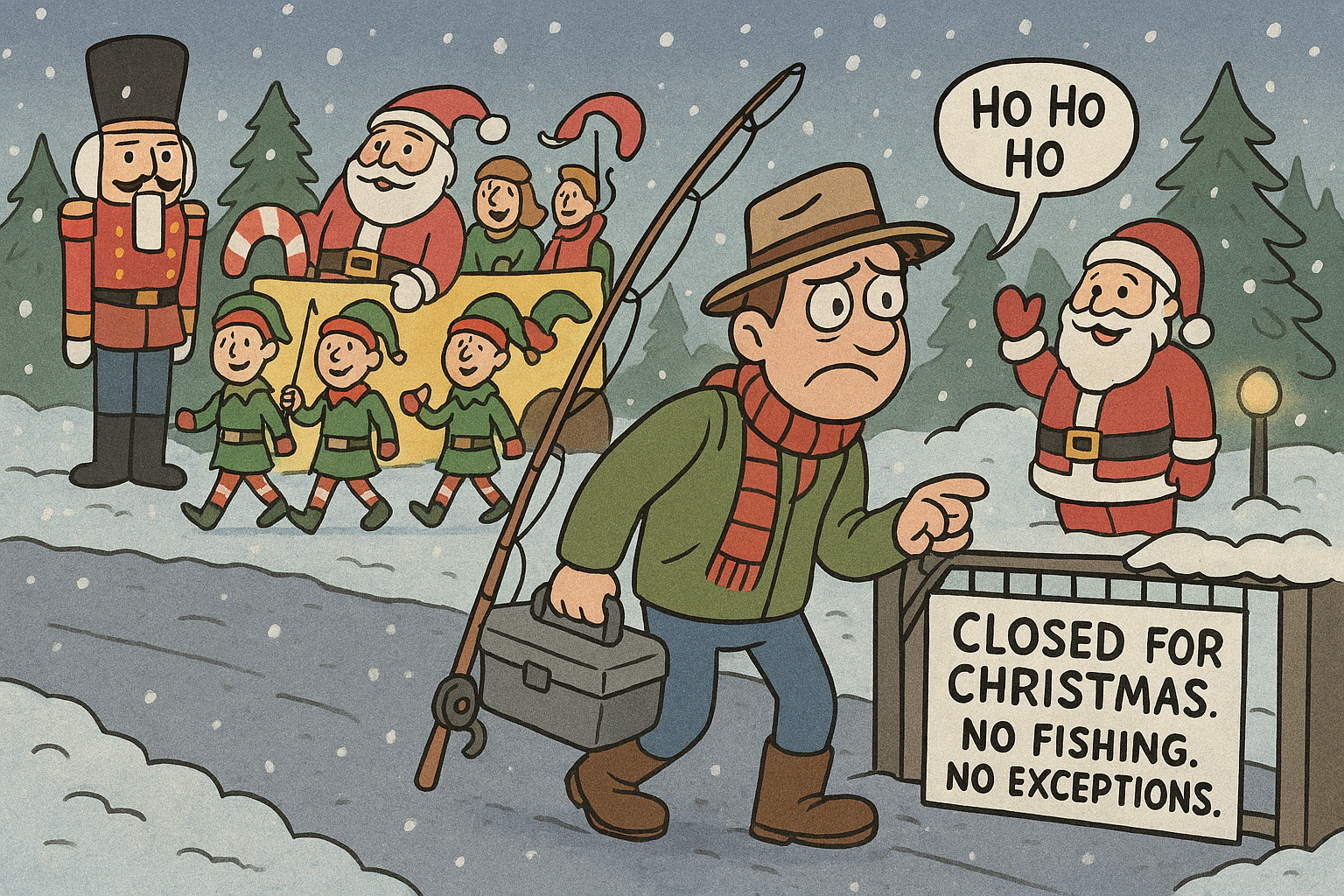
A Christmas parade oozed down his street like a festive glacier. Giant inflatable nutcrackers bobbed in the air. Children in elf costumes marched in perfect, uncanny synchronization. A man on stilts leaned down and whispered, “Merry Christmas, Thomas,” even though Tom had never seen him before.
Tom blinked. “I just want to go to the lake.”
The stilt man winked. “Don’t we all.”
Tom tried to drive around the parade, but every street was blocked by something different: a choir singing in a minor key, a Santa who kept repeating the same line (“Ho ho ho, isn’t it a lovely day for obligations?”), a float shaped like a giant snow globe that seemed to trap sound inside it.
He finally escaped the parade only to remember—too late—that he had gifts to deliver. His phone buzzed with reminders he didn’t remember setting.
Aunt Linda needed her fruitcake. Cousin Jared needed his novelty socks. His coworker Marcy needed her Secret Santa mug that said World’s Okayest Human.
Every stop felt slightly… off.
Aunt Linda’s house was decorated with identical porcelain angels, all staring at him with the same faint smile. Jared’s apartment building had Christmas music playing, but the record never advanced past the same four bars. Marcy’s office was closed, but the lights flickered on as he approached, as if the building itself were acknowledging him.
By the time he finished, the sun was low and the snow had begun to fall—slow, deliberate flakes, like the sky was thinking very hard about each one.
Tom finally reached the lake. The parking lot was empty. The sign on the gate read:
CLOSED FOR CHRISTMAS.
NO FISHING.
NO EXCEPTIONS.
A single spotlight illuminated the sign, though there was no lamp.
Tom stood there, fishing pole in hand, breath fogging in the cold. The lake behind the gate was perfectly still, like a painting. He could swear he heard faint laughter echoing across the water—jolly, but not friendly.
He trudged back to his car, exhausted, defeated, and somehow late for a holiday he hadn’t planned to participate in.
As he drove home through the falling snow, he realized the strangest part:
He couldn’t remember ever deciding to go fishing today.
It just felt like something he’d always been trying to do.
And always would be.
“The One Where the Lake Won’t Let Him Arrive”
Evan woke up with the kind of optimism reserved for sitcom dads and lottery winners. Today—finally—he was going fishing. He had the cooler, the tackle box, the hat that made him look like a man who knew knots. He even practiced saying “Now that’s a catch” in the mirror.
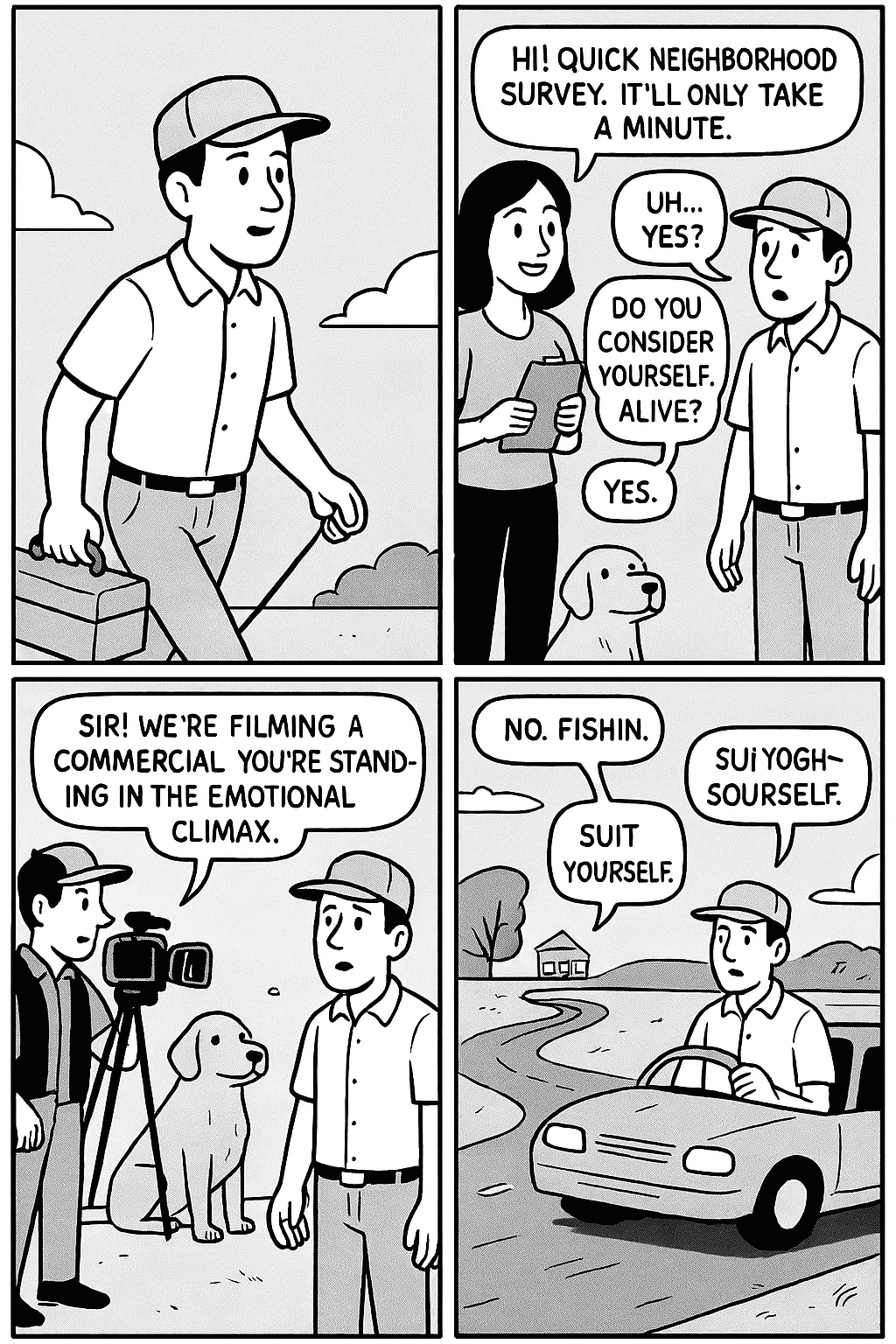
He locked his apartment door, took three triumphant steps toward the parking lot… and immediately bumped into a woman holding a clipboard the size of a cafeteria tray.
“Hi! Quick neighborhood survey,” she chirped. “It’ll only take a minute.”
Evan tried to sidestep. She sidestepped with him. “Just one question,” she insisted. “Do you consider yourself… alive?”
He blinked. “Uh… yes?”
She scribbled furiously. “Fascinating. Most people say that.”
Before he could escape, a man in a reflective vest jogged over. “Sir! We’re filming a commercial. You’re standing in the emotional climax.”
“What climax?” Evan asked.
The man pointed to a golden retriever staring at him with soulful, Oscar-worthy eyes. “That one.”
Evan apologized to the dog—because that felt appropriate—and squeezed past the camera crew.
He made it to his car. Victory. He turned the key. The radio crackled on by itself.
A voice whispered, “Turn back.”
Evan frowned. “No. Fishing.”
The voice sighed like a disappointed parent. “Suit yourself.”
He drove anyway, determined. The road to the lake stretched ahead, familiar and comforting. Until it wasn’t.
A detour sign appeared. Then another. Then a third, pointing him in a perfect circle. He followed them, increasingly suspicious, until he realized he had passed the same abandoned gas station four times. The same flickering sign. The same tumbleweed that seemed to be watching him.
He rolled down his window. “Is this a joke?”
The tumbleweed rolled closer, as if offended.
Evan floored it.
Finally—finally—he reached the lake entrance. The water shimmered in the distance like a promise. He could practically hear the fish calling his name.
A park ranger stepped out of a booth that hadn’t been there a second ago.
“Sorry, pal,” the ranger said. “Lake’s closed.”
“What? Since when?”
The ranger checked a watch that wasn’t on his wrist. “Since the moment you arrived.”
Evan stared at the lake. The lake stared back, calm and smug.
He sighed, turned around, and trudged back to his car. As he drove home, the radio whispered again.
“Told you.”
Evan tightened his grip on the wheel. “Next week,” he muttered. “Next week I’m going fishing.”
Somewhere behind him, the tumbleweed laughed.
“The Episode Where Winter Forgot Its Lines”
Carl stepped out of his apartment wearing every layer he owned. He looked like a man preparing for a heroic expedition, or possibly a man who had lost a bet. His ice‑fishing sled clattered behind him, stuffed with gear, snacks, and the kind of optimism only sitcom characters and golden retrievers possess.
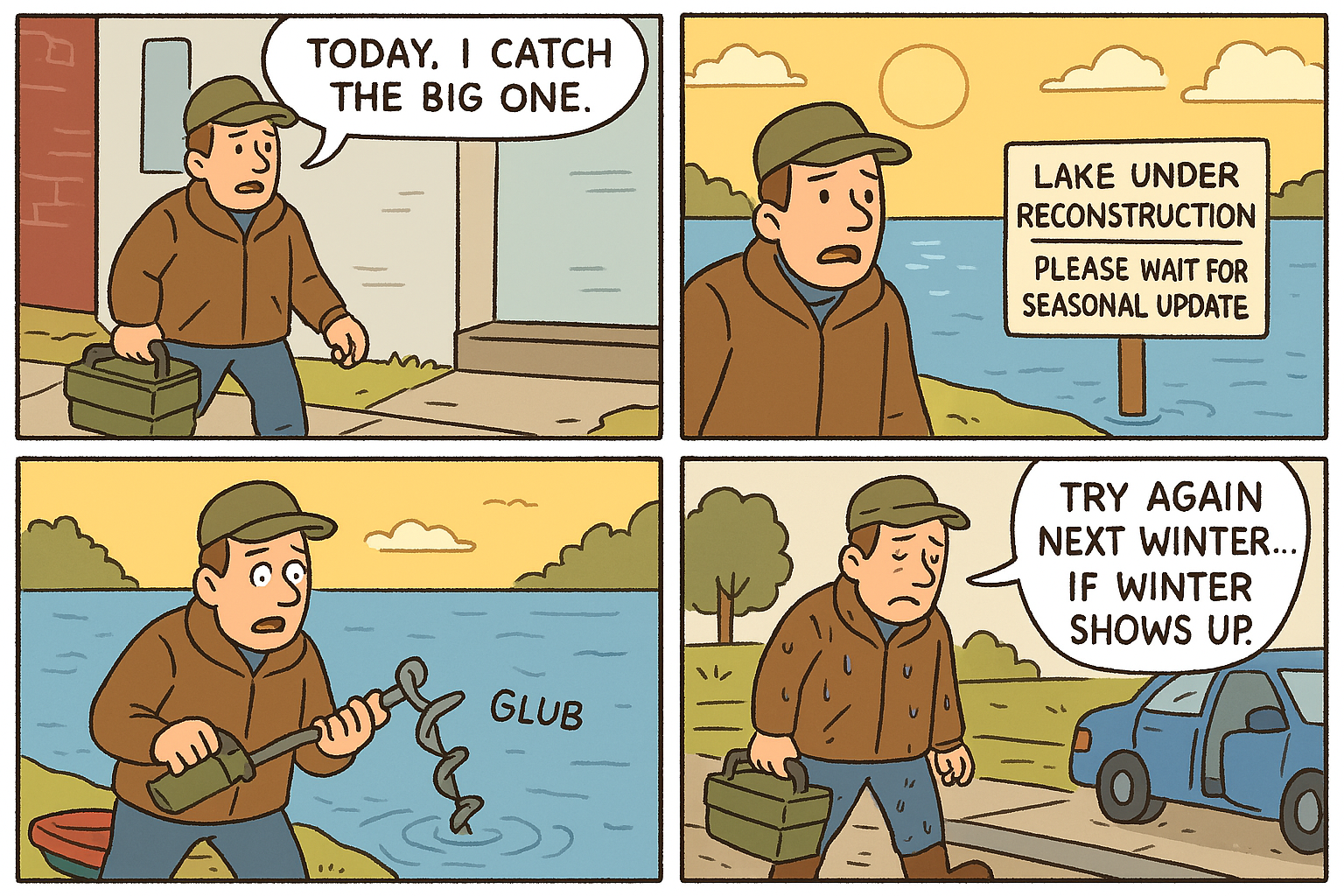
“Today,” he declared to no one, “I catch the big one.”
Cue laugh track.
The drive to the lake felt off. The sky was too bright, too warm, too… sweaty. A December sun that behaved like a July understudy. Carl cracked the window and immediately regretted it—warm air slapped him in the face like a wet towel.
“Global warming,” he muttered. “You rascal.”
When he arrived, the lake shimmered like a giant puddle of melted dreams. No ice. Not even a crust. Just open water rippling gently, as if mocking him.
A sign stood at the shoreline. It hadn’t been there yesterday.
LAKE UNDER RECONSTRUCTION. PLEASE WAIT FOR SEASONAL UPDATE.
Carl blinked. “Seasonal… update?”
A breeze answered with a faint, electronic hum—like a computer thinking too hard.
Still, he was determined. He dragged his sled to the edge, poked the water with his ice
auger, and watched it sink straight to the bottom with a sad glub.
Then the lake burped.
Not a normal burp. A deep, resonant, sitcom‑studio‑audience burp, followed by a faint applause track.
Carl stepped back. “Nope. Nope nope nope.”
But the shoreline sloped strangely, as if the ground had been rearranged by someone who had only skimmed the manual. Carl slipped, windmilled, and fell straight into the water with a splash big enough to earn a commercial break.
The lake was warm. Warm. Like bathwater. Like someone had left the planet’s thermostat on “tropical spa.”
He crawled out, soaked, shivering not from cold but from the uncanny wrongness of it all. His clothes clung to him like disappointed relatives.
As he trudged back to his car, the lake whispered behind him.
“Try again next winter… if winter shows up.”
Carl didn’t look back. He didn’t want to know if the lake had lips.
He drove home in squishy, miserable silence. His boots made swamp sounds. His jacket dripped steadily. His fishing dreams sagged like a sitcom character who just learned the episode’s moral.
By the time he reached his apartment, he was exhausted, discouraged, and convinced—absolutely convinced—that the universe had a writers’ room, and they were having way too much fun.
“The One Where the Detour Eats the Day”
Mark woke up with the kind of determination usually reserved for people starting diets or fleeing small towns. Today—finally—he was going fishing. Not metaphorically. Not aspirationally. Actually fishing.
He packed like a man escaping the simulation: cooler, tackle box, thermos, the lucky hat that made him look like a divorced park ranger. He even hummed a jaunty sitcom theme to himself as he locked the door. This was going to be his day. His escape from the repetitive grind, the endless loop of emails, errands, and existential dread.
He got in his car, turned the key, and the radio immediately played a laugh track.
“That’s… odd,” he muttered.
The laugh track got louder.
He turned it off. It stayed on.
He drove anyway.
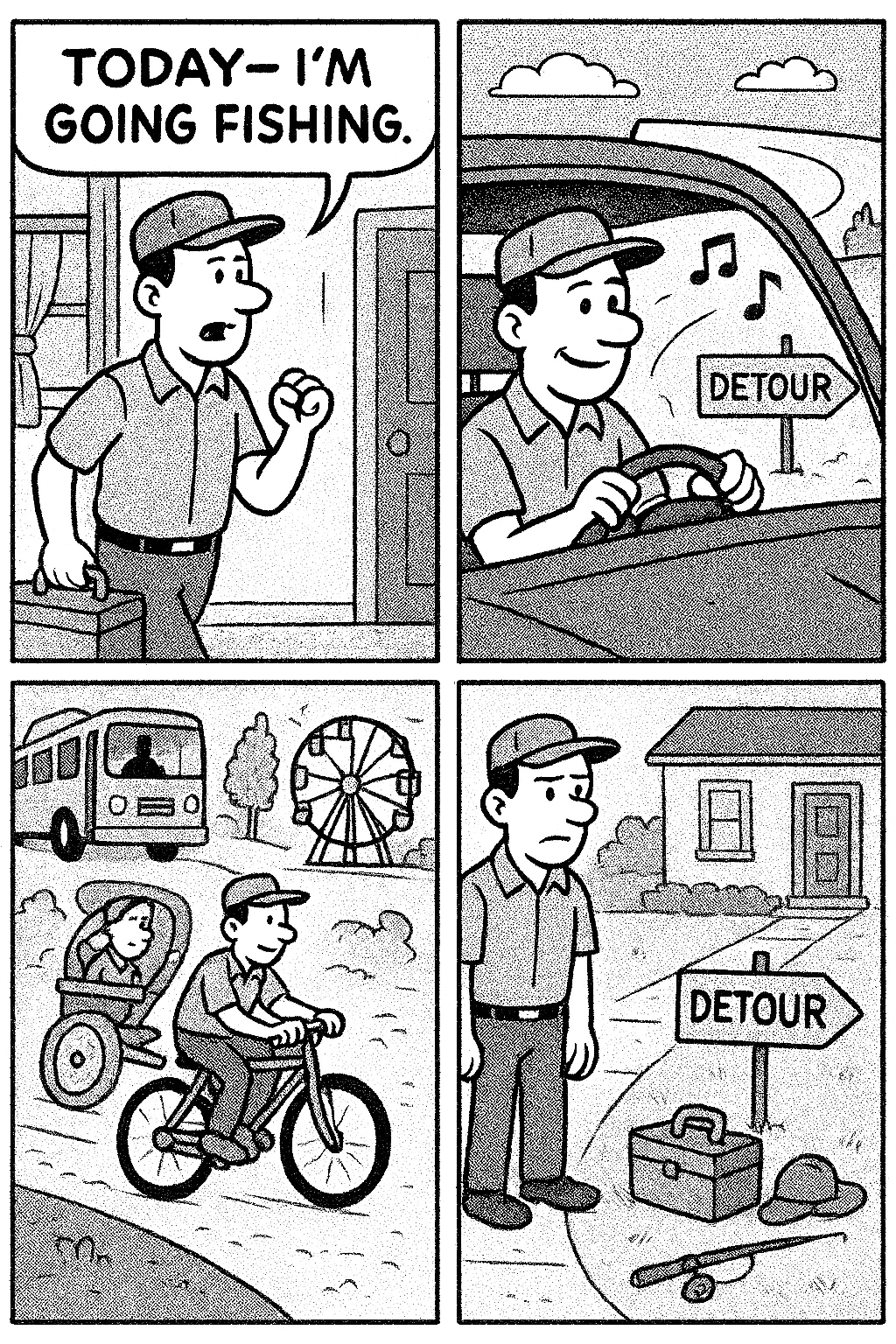
The road to the lake was supposed to be simple—straight shot, two turns, a parking lot that always smelled faintly of worms. But halfway there, a bright orange DETOUR sign appeared. Then another. Then a third, pointing him down a narrow road he swore had never existed.
He followed it, because what else do you do when the universe hands you a plot twist.
The road curved into a bus stop. A bus screeched to a halt in front of him, doors hissing open.
“Lake?” Mark asked.
The driver, a man with eyes like static, nodded. “Sure. Hop on.”
Mark did. The bus lurched forward, then backward, then sideways in a way buses should not be able to move. Passengers stared at him with sitcom-smile intensity, like they were waiting for him to deliver a punchline.
He got off at the next stop.
Now he was at a train station.
A train rolled in, silent and fog-wrapped. A conductor pointed at him. “Lake?”
Mark nodded.
The train took him three stops, then deposited him in the middle of a carnival that smelled like cotton candy and mild dread. A clown waved. A carousel turned without music. A sign pointed to a ferry.
He took the ferry.
The ferry took him to a bike rental stand.
He took the bike.
The bike path led him through a forest that whispered his name, then into a cul-de-sac that looked suspiciously familiar.
He slowed.
No. No, no, no.
His house stood at the end of the street, smug and beige.
The bike stopped on its own. The laugh track returned, louder this time, like the universe was really enjoying itself.
Mark dropped the bike, trudged to his front door, and let himself in. He set down his cooler, his tackle box, his thermos, his lucky hat.
He stared at the wall.
“Well,” he said flatly, “that’s that.”
Outside, a DETOUR sign flickered into existence on his lawn.
It pointed at him.
He closed the blinds.
“The One Where the Lake Has a Crush on Him”
Mark woke up with the kind of optimism usually reserved for sitcom characters who haven’t yet realized they’re in the wrong episode. Today—finally—he was going fishing. He’d laid everything out the night before: cooler, tackle box, sunscreen, the hat that made him look like a man who knew what he was doing. He even practiced his triumphant “Now that’s a fish!” in the mirror.
He strutted out the door like a man walking into his destiny.
The universe, however, had other plans. It always did.
Traffic lights turned red exactly as he approached. Joggers materialized in front of him like NPCs programmed to block his path. A dog walker’s leashes tangled around his legs in a perfect sitcom knot. But Mark persevered, narrating his own determination under his breath like a man who believed the laugh track was rooting for him.
At last—at last—he reached the lake.
It shimmered in the morning sun, serene and inviting. Mark exhaled, shoulders dropping. “Finally,” he whispered. “Peace.”
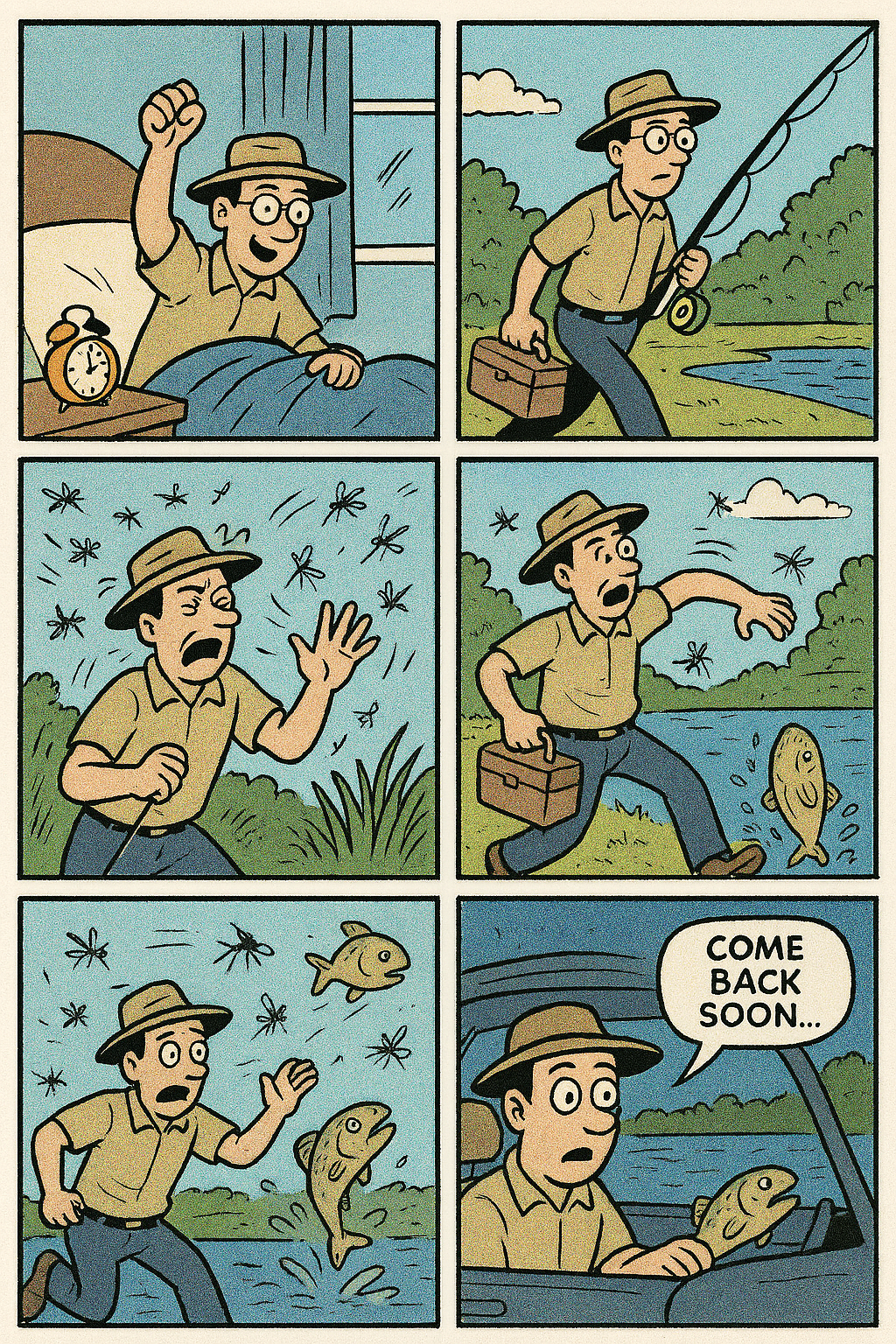
A mosquito landed on his arm.
Then another.
Then a cloud of them rose from the reeds like a living, whining storm.
Mark swatted. He flailed. He ran. The mosquitoes followed in a tight formation, buzzing with the coordination of a military unit. He sprinted along the shoreline, arms windmilling, yelling, “I JUST WANT TO FISH!”
The lake responded.
A fish leapt out of the water—graceful, glittering—landing with a splash that felt suspiciously flirtatious.
Another jumped. Then another. Soon a whole chorus line of fish were launching themselves into the air, shimmering like sequined dancers. One winked at him. Actually winked.
Mark froze. “Nope. No. Absolutely not.”
A particularly bold trout arced out of the water and landed at his feet, tail swishing suggestively.
The mosquitoes closed in.
The fish batted its gills at him.
The lake rippled as if giggling.
Mark backed away slowly, hands raised. “I’m flattered. Really. But I’m just here to fish, not… whatever this is.”
The fish sighed—an audible, disappointed sigh—and flopped back into the water.
Mark ran for his car, chased by the mosquito battalion, serenaded by splashes that sounded suspiciously like blown kisses.
When he finally slammed the car door shut, panting, he looked back at the lake.
The surface was perfectly still.
Too still.
He turned the key. The radio crackled to life.
A soft voice whispered, “Come back soon…”
Mark drove away without looking back.
He would not be going fishing next weekend.
Sleeping With the Fishies (But Not Like That)
Harold woke up with the kind of optimism usually reserved for sitcom dads in the cold open. He’d laid out his fishing vest the night before, packed his cooler with snacks, and even practiced his “Ahh, the great outdoors” line in the mirror. By 6:15 a.m., he was dressed, caffeinated, and humming his way toward Lake Willowbend—his sacred, secret den of peace.
But halfway down Old Mill Road, the world tilted.
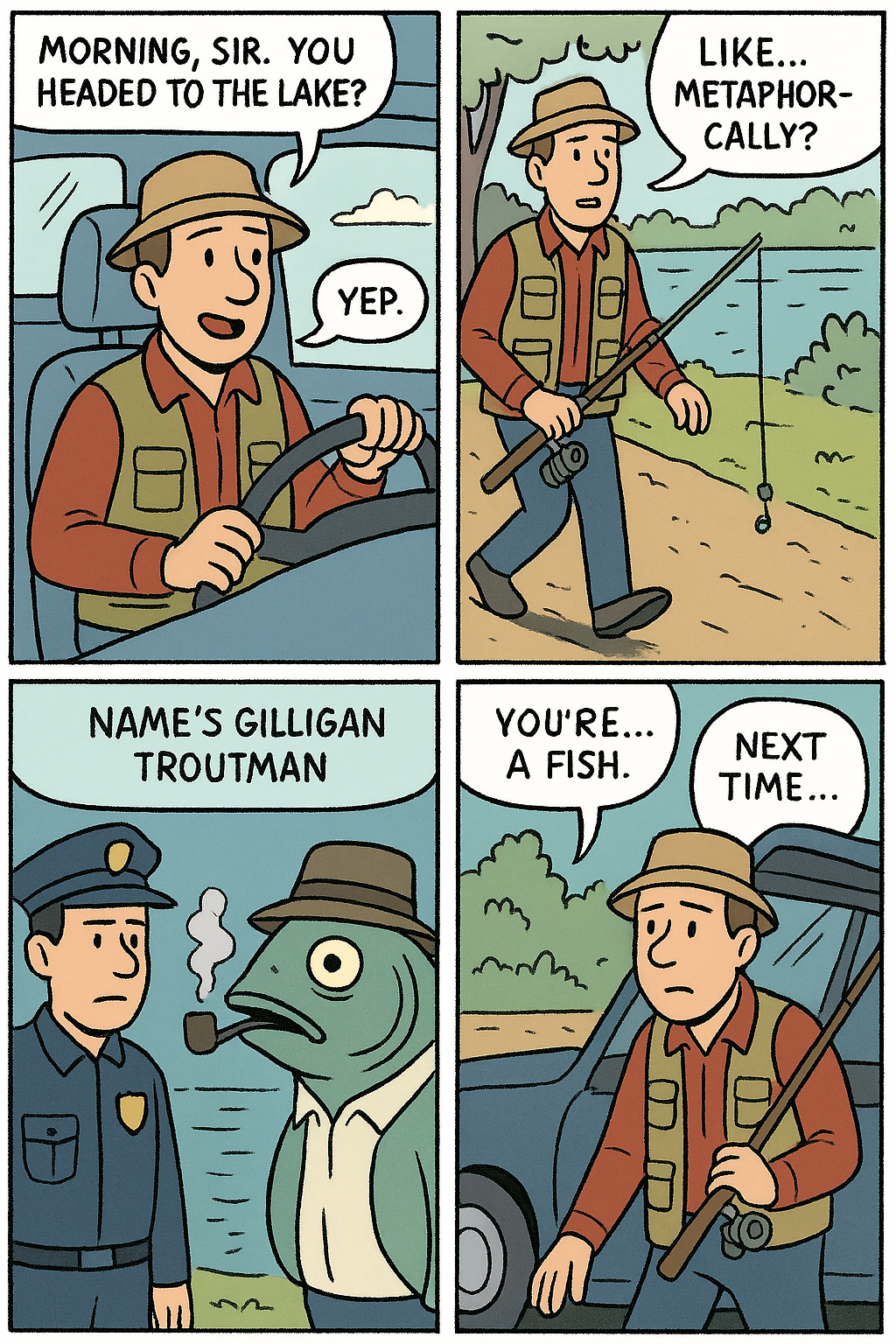
Blue and red lights flashed ahead, but the cops weren’t blocking the road—they were waving him through. “Morning, sir,” one officer said, smiling too wide, like a man who’d rehearsed friendliness in a funhouse mirror. “You headed to the lake? Perfect. We’ve been expecting you.”
Harold blinked. “Expecting me?”
“Yep,” the officer said. “We’ve got a situation. Victims sleeping with the fishies.”
Harold laughed nervously. “Like… metaphorically?”
The officer leaned in. “Do we look like metaphor guys?”
Before Harold could reverse his entire life, he was ushered down a dirt path toward the shoreline, where the lake rippled in a way lakes don’t normally ripple. Something broke the surface—something with fins, a fedora, and the weary expression of a detective three days from retirement.
“Name’s Gilligan Troutman,” the fish said, voice gravelly. “I’m the one who found the bodies.”
Harold stared. “You’re… a fish.”
“Yeah, and you’re late,” Gilligan snapped. “We need a witness. Someone who knows this lake. Someone who can tell us if anything’s… off.”
Everything was off. The cops were whispering in circles. Gilligan was chain‑smoking underwater somehow. The lake burped. A tree sighed. Harold felt like he’d wandered into a crossover episode between Dragnet and The Outer Limits.
After an hour of surreal questioning—most of which involved Gilligan accusing the moon of being an accomplice—the cops finally released him.
“You’re off the hook,” the too‑wide‑smile officer said.
Harold didn’t laugh. He didn’t even look at the lake. He just trudged back to his car, fishing pole dragging behind him like a defeated tail.
By the time he pulled into his driveway, he felt wrung out, spooked, and profoundly unfished. He dropped his gear inside the door, collapsed onto the couch, and muttered:
“Next time… I’m bowling.”
If you want, I can spin this into a cartoon-style visual concept next, or write another version with a different tone—spookier, funnier, more surreal, whatever direction you want to explore.
“Yeah, and you’re late,” Gilligan snapped. “We need a witness. Someone who knows this lake. Someone who can tell us if anything’s… off.”
Everything was off. The cops were whispering in circles. Gilligan was chain‑smoking underwater somehow. The lake burped. A tree sighed. Harold felt like he’d wandered into a crossover episode between Dragnet and The Outer Limits.
After an hour of surreal questioning—most of which involved Gilligan accusing the moon of being an accomplice—the cops finally released him.
“You’re off the hook,” the too‑wide‑smile officer said.
Harold didn’t laugh. He didn’t even look at the lake. He just trudged back to his car, fishing pole dragging behind him like a defeated tail.
By the time he pulled into his driveway, he felt wrung out, spooked, and profoundly unfished. He dropped his gear inside the door, collapsed onto the couch, and muttered:
“Next time… I’m bowling.”
🎣 The One Where New Year’s Won’t Let Him Fish 🎣
Harold woke up with the serene confidence of a man who believed—truly believed—that he could sneak in a quick morning fishing trip before hosting a New Year’s Eve party for thirty people.
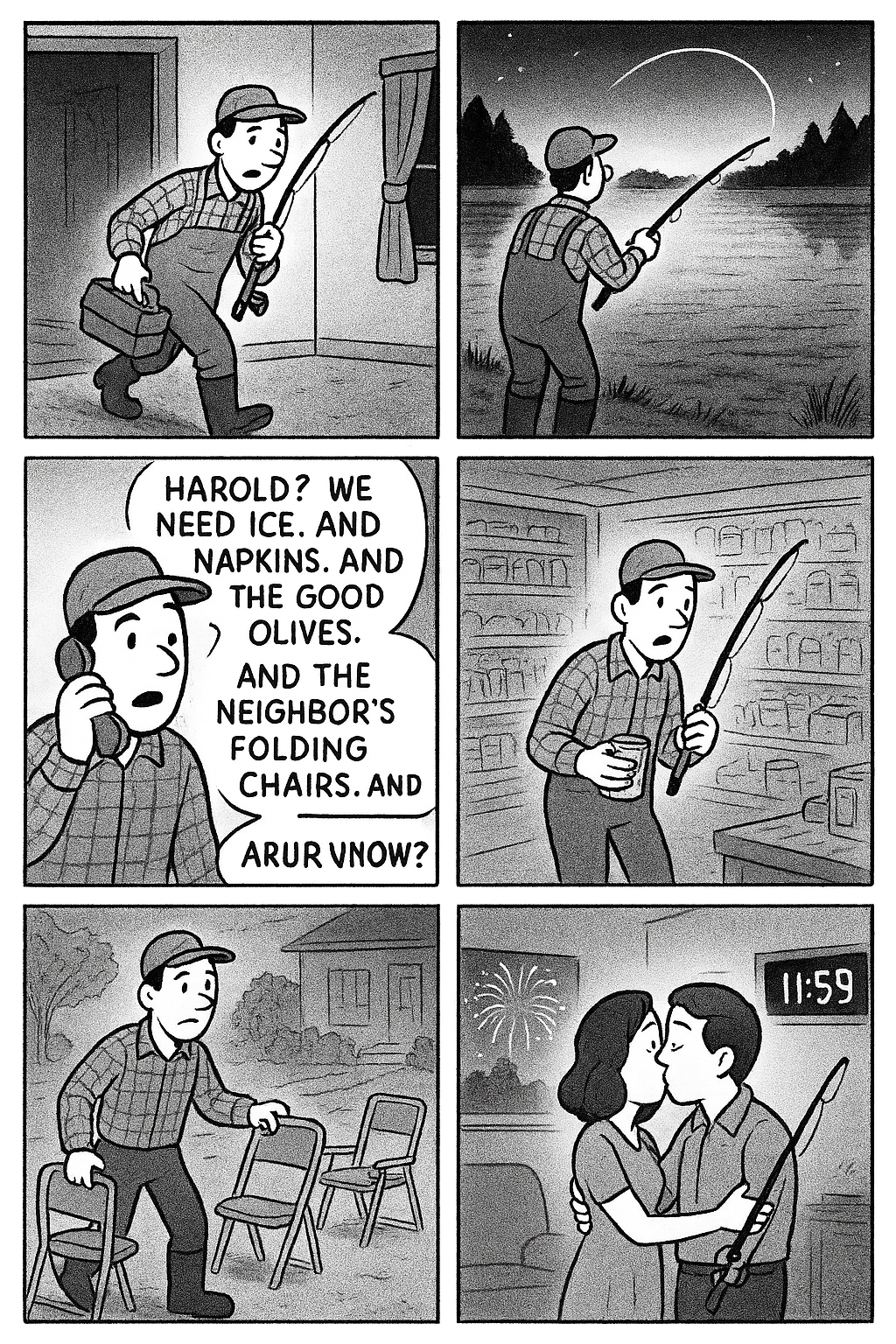
He tiptoed around the house like a cartoon burglar, already dressed in flannel and waders, cooler packed, thermos steaming. The sun hadn’t even committed to rising yet. Perfect. He’d be back before his wife, Marla, even noticed he was gone.
By the time he reached the lake, the world felt suspended, like someone had paused reality just long enough for him to cast. The water was still. Too still. Even the ducks looked like props.
He raised his rod.
His phone rang.
Marla.
He froze, rod mid‑air.
“Harold? We need ice. And napkins. And the good olives. And the neighbor’s folding chairs. And—are you outside? It sounds… echoey.”
Harold stared at the lake, which now had a faint shimmer, like a TV screen between channels.
“Nope,” he said, voice cracking. “Just… in the garage.”
The lake rippled, though there was no wind. Something beneath the surface shifted, as if listening.
He bolted.
The errands should’ve been simple. But the grocery store doors slid open into a completely different grocery store—same layout, but every aisle was slightly wrong. The olives were next to the motor oil. The napkins were refrigerated. The ice machine whispered his name.
At the neighbor’s house, the folding chairs multiplied every time he blinked. He grabbed one, turned around, and suddenly he was holding three. He dropped them, and they clattered in a perfect, synchronized rhythm, like a laugh track.
On the drive home, every radio station played the same song: a tinny, off‑key jingle about “staying home where you belong.” Even the talk radio hosts hummed it under their breath.
By the time he reached his street, the sky had gone the wrong shade of twilight—purple, but not a color found in nature. The houses leaned inward, as if gossiping about him.
He sprinted inside just as the clock struck 11:59.
Marla grabbed him, breathless. “You made it!”
He kissed her as the countdown roared from the TV. Fireworks burst outside. The world snapped back into its normal shape, as if relieved he’d finally given up on fishing.
But in the corner of the living room, half-hidden behind the coat rack, his fishing rod stood upright—dripping lake water onto the hardwood floor.
Harold didn’t remember bringing it in.
He didn’t remember the lake touching him at all.
Marla squeezed his hand. “Happy New Year, honey.”
“Yeah,” he said, eyes fixed on the rod. “Happy New Year.”
The rod twitched.
Just once.
As if casting itself.
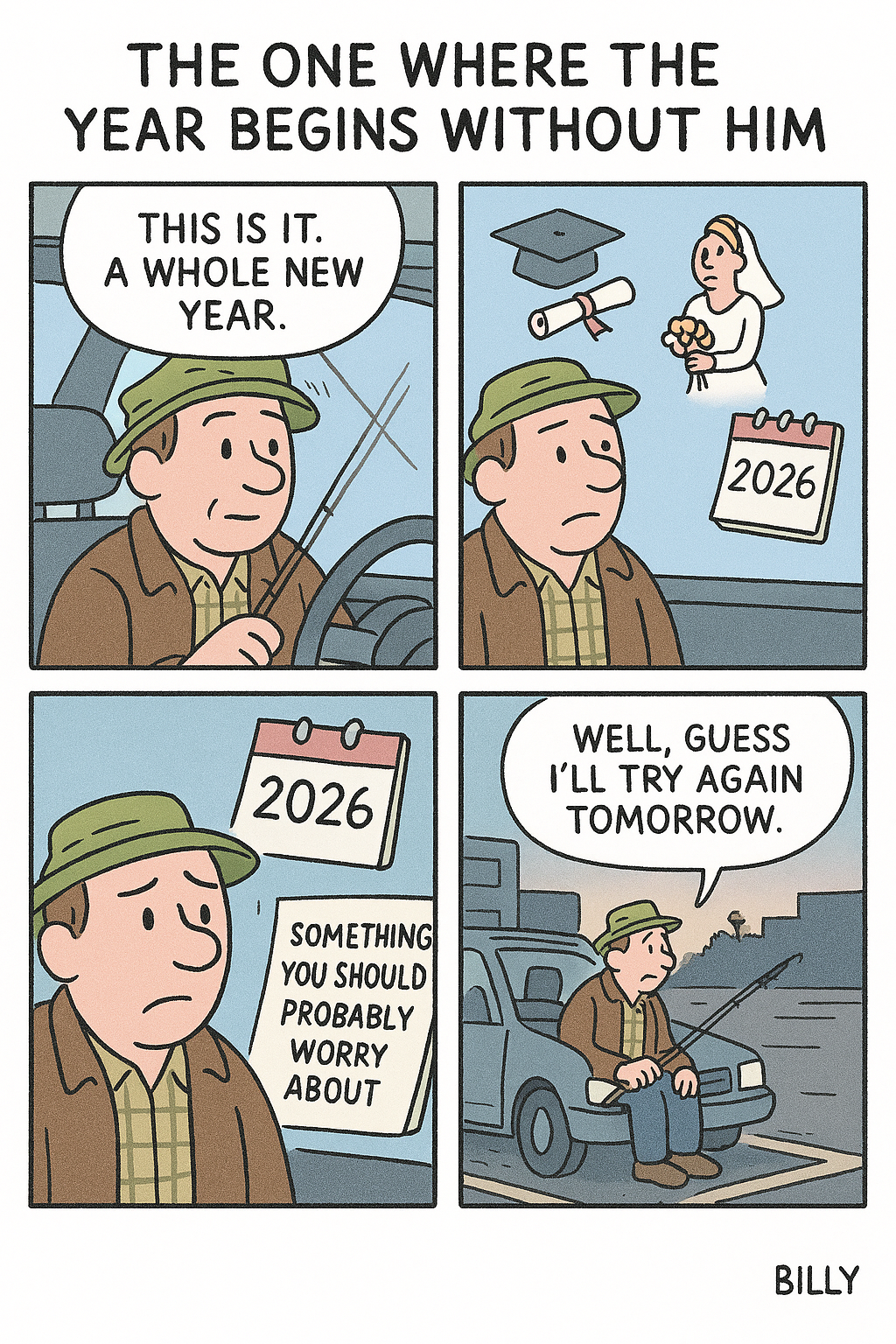
The One Where the Year Begins Without Him
Harold woke up on January 1st, 2026 with the kind of optimism that only a man clutching a fishing pole at dawn can muster. He dressed in layers, packed his thermos, and marched out to the parking lot like a hero entering Act One of a very average sitcom.
He unlocked his car. Sat down. Turned the key halfway.
And then—
A thought.
This is it. A whole new year.
The thought cracked open like a faulty egg, spilling everything: the good (his niece’s graduation), the bad (his cousin’s wedding toast he’d inevitably botch), and the ugly (the creeping suspicion that 2026 would be the year his anxiety finally learned to drive stick).
He stared through the windshield as the world around him shifted. The parking lot shimmered like a cheap TV set. The sky flickered between morning and afternoon lighting cues. A laugh track sputtered in the distance, confused about when to chime in.
A shadowy figure in a graduation cap drifted by, waving a diploma that read Probably Fine. A bride floated past next, bouquet levitating, whispering, “Don’t forget the rings this time.” A giant calendar page flapped overhead like a vulture, each date stamped with Something You Should Probably Worry About.
Harold blinked.
The figures vanished.
The parking lot returned to its usual cracked asphalt and oil stains.
He checked the clock on his dashboard.
6:12 PM.
He had been sitting there for hours—maybe all day—thinking himself in circles so tight they squeaked.
His fishing pole lay across the passenger seat like a disappointed friend. The lake was still out there, serene and waiting, but the sun had already dipped behind the buildings. The first day of the new year had slipped through his fingers like a fish that didn’t even bother to fight.
Harold sighed, turned off the car, and stepped back into the evening air.
“Well,” he muttered to no one, “guess I’ll try again tomorrow.”
Somewhere far off, a spooky theremin played a single, mocking note.