Loops and Lures
I had this idea of a person who keeps getting sidetracked on his way to fishing. It feels like a sitcom with the entrance and ending are the same. He packs up his fishing gear and leaves his house but gets lured towards something else. I don’t really write much prose anymore and I initially envisioned it being filmed as a short while being next to flash fiction. I’ve been shallowly dabbling in AI and thought this would be a fun “newspaper” project. I think AI is pretty dumb but can be hilarious in its vanity. It’s nuance and lack of brevity leaves it clueless. I like the idea of AI being fed with a prompt that’s entries have to deal with the short sightedness of AI and it’s reach. I know most fans hate AI but I want to be up front with its use in this material and my thought on it.
I just wanted to go fishing
🎣 “The One Where the Fisherman Joins a Vampire Cult (Briefly)”
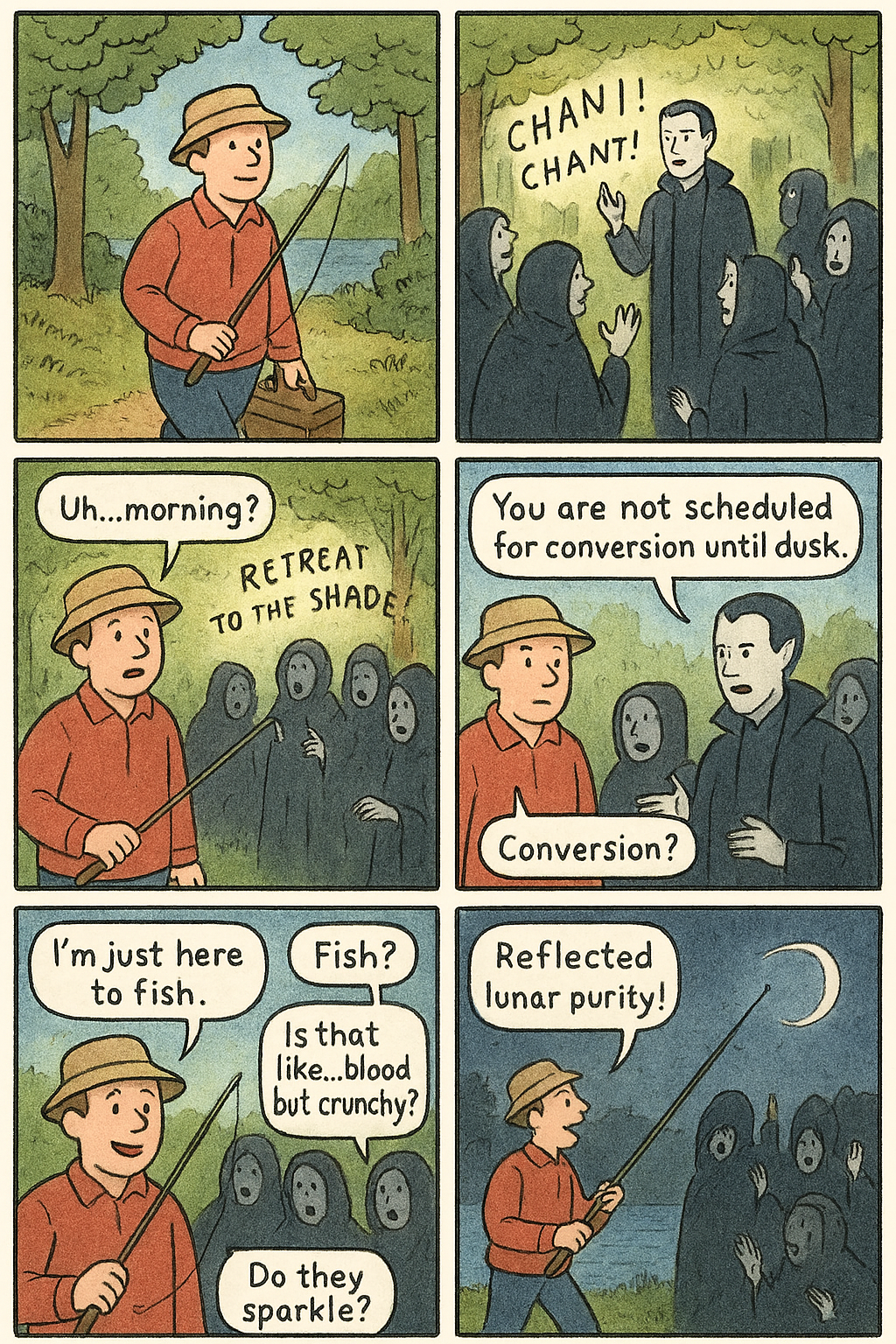
On the second morning of the new year, Dale McCray woke up with the kind of optimism only a man with a brand‑new fishing license and zero responsibilities could feel. He tiptoed out of the house like a sitcom dad avoiding a laugh‑track‑triggering mishap, clutching his tackle box like it contained state secrets.
The sky was crisp, the air was quiet, and the lake—his lake—waited for him.
Or so he thought.
Halfway down the wooded trail, he heard chanting. Not the normal “someone brought a Bluetooth speaker” kind of chanting. More like “ancient ritual meets community theater” chanting.
He rounded a bend and froze.
A circle of pale figures in matching cloaks stood beneath the trees, hissing in unison. One held a goblet. One held a bat. One held a clipboard, which somehow made it worse.
“Uh… morning?” Dale said, because sitcom protagonists never run when they should.
The cloaked figures gasped.
“Sunlight!” one shrieked.
“Retreat to the shade!” another cried.
They scrambled under a massive pine like goth raccoons.
A tall vampire with excellent posture stepped forward. “You are not scheduled for conversion until dusk.”
“Conversion?” Dale squeaked. “I’m just here to fish.”
The vampires murmured among themselves.
“Fish?”
“Is that like… blood but crunchy?”
“Do they sparkle?”
Dale, because he was polite to a fault, ended up giving an impromptu fishing lesson to a coven of vampires who took notes like they were attending a seminar titled ‘Angling for the Recently Undead.’
They oohed at the bobbers.
They aahed at the lures.
One asked if worms had souls.
But every time Dale tried to inch toward the lake, someone would casually say something like, “When you return at dusk, we’ll begin your transformation,” or “Your mortal essence will pair nicely with moonrise.”
Classic sitcom misunderstanding, except with more fangs.
By the time the sun dipped behind the ridge, Dale realized he had two options:
Stay and become a night‑dwelling creature of eternal hunger.
Leave and maybe—maybe—get home in time for leftovers.
He chose leftovers.
He slipped away as the forest darkened, but the vampires spotted him just as he reached the water’s edge.
“Wait! Your conversion!”
“Come back! We made pamphlets!”
Dale panicked and lifted his fishing rod like a talisman. The moonlight hit the metal hook just right, sending a cold silver glint across the clearing.
The vampires recoiled in horror.
“Reflected lunar purity!”
“Shield your eyes!”
“Why does it burn like emotional honesty?!”
They scattered, hissing and tripping over their own cloaks.
Dale didn’t wait to see if they recovered. He sprinted back to his truck, dove inside, and slammed the door.
He never cast a single line.
By the time he got home, he was sweaty, exhausted, and carrying the faint smell of pine and undead disappointment. But he was alive. And unconverted. And honestly, that felt like a win.
He collapsed on the couch, fishing rod still in hand.
“Tomorrow,” he muttered. “Tomorrow I’m definitely going fishing.”
The laugh track agreed.
🎣 “The One Where the Lake Says ‘Not Today’”
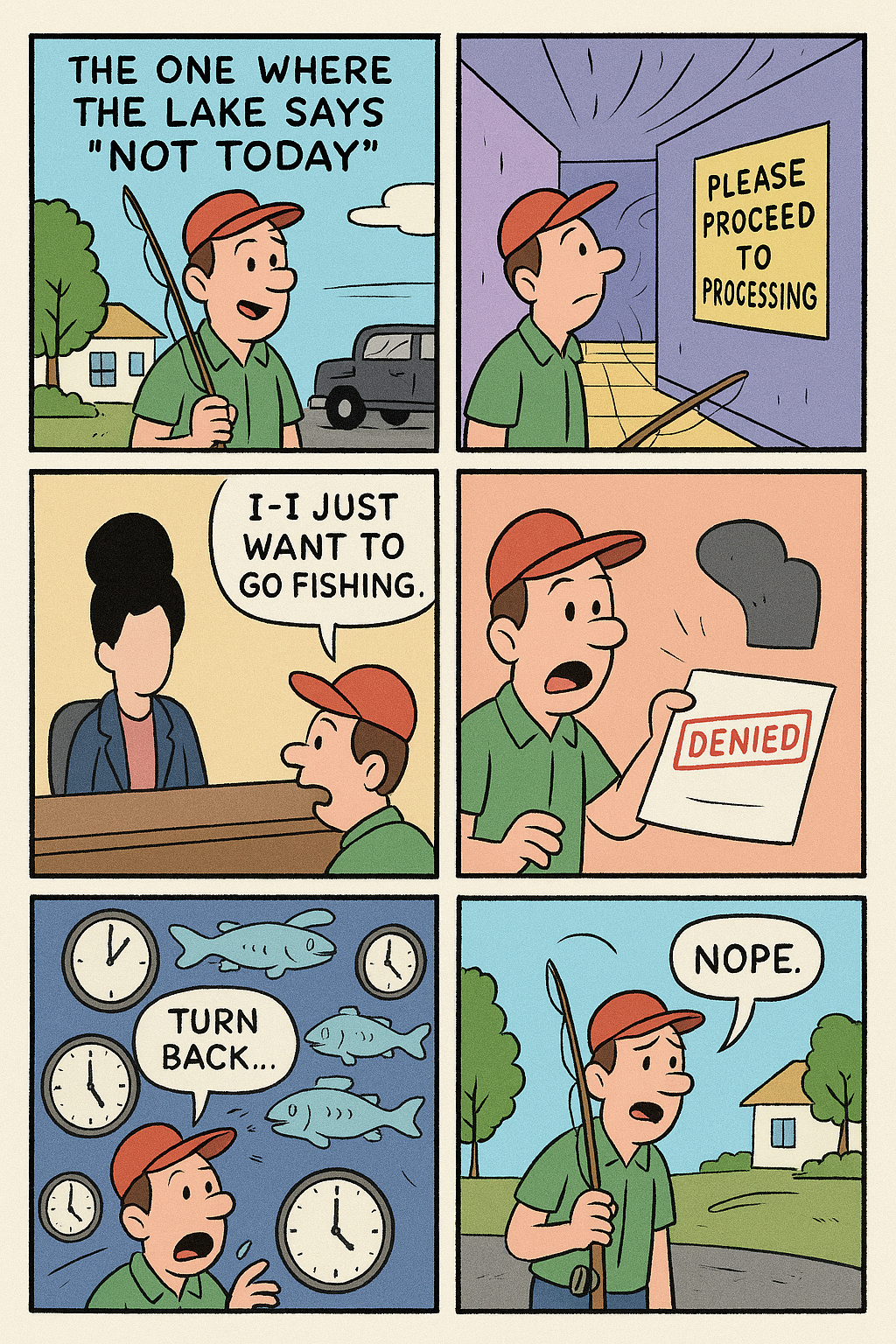
Benny woke up with the serene confidence of a man who had already decided that today—today—was for fishing. His tackle box clicked shut like a promise. His thermos steamed with quiet optimism. His fishing rod gleamed with the smugness of a tool that knew it was finally going to be used.
He stepped outside, inhaled the crisp morning air, and took three triumphant strides toward his car.
That’s when the sky hiccuped.
Not thunder. Not lightning. A hiccup—like the atmosphere had swallowed carbonated reality and couldn’t quite keep it down. The street shimmered, bent, and folded itself into a hallway lined with flickering fluorescent lights. Benny blinked. His driveway was gone. His car was gone. His neighbor’s inflatable snowman was now a filing cabinet.
A sign buzzed overhead: “PLEASE PROCEED TO PROCESSING.”
Benny clutched his fishing rod like a security blanket and stepped forward. The hallway stretched. Doors multiplied. A soft, bureaucratic hum filled the air, like a DMV staffed by ghosts.
A woman with no face but an impeccable beehive hairdo appeared behind a counter.
“Reason for visit,” she said, though she had no mouth.
“I—I’m just trying to go fishing,” Benny stammered.
She stamped a form that materialized out of nowhere. DENIED.
The hallway lurched. Benny stumbled into a room full of clocks, all ticking out of sync. A school of translucent fish swam through the air above him, whispering in unison: “Turn back… turn back… turn back…”
“No!” Benny shouted, sprinting through them, swatting at spectral trout like a man fighting off bad dreams and worse metaphors.
He burst through a final door and landed—face-first—back on his driveway. The world snapped into place. Birds chirped. His car sat exactly where he left it. His neighbor’s inflatable snowman waved cheerfully in the breeze.
Benny stood up, trembling. His fishing rod shook in his hands like it was cold or haunted or both.
He tried to cast once. His arm spasmed. The line flopped pathetically at his feet.
“Nope,” he muttered.
He packed everything back into the garage, slammed the door, and trudged inside. He collapsed on the couch, exhausted, irritated, and vaguely offended by the universe.
The thermos of coffee hissed softly, as if disappointed.
Somewhere far away, a translucent trout whispered, “Maybe tomorrow…”
If you want, I can twist this into a comic strip concept, a more surreal version, or a darker, more existential one.
He burst through a final door and landed—face-first—back on his driveway. The world snapped into place. Birds chirped. His car sat exactly where he left it. His neighbor’s inflatable snowman waved cheerfully in the breeze.
Benny stood up, trembling. His fishing rod shook in his hands like it was cold or haunted or both.
He tried to cast once. His arm spasmed. The line flopped pathetically at his feet.
“Nope,” he muttered.
He packed everything back into the garage, slammed the door, and trudged inside. He collapsed on the couch, exhausted, irritated, and vaguely offended by the universe.
The thermos of coffee hissed softly, as if disappointed.
Somewhere far away, a translucent trout whispered, “Maybe tomorrow…”
🎣 “The One Where the Oil Light Ruins Everything”
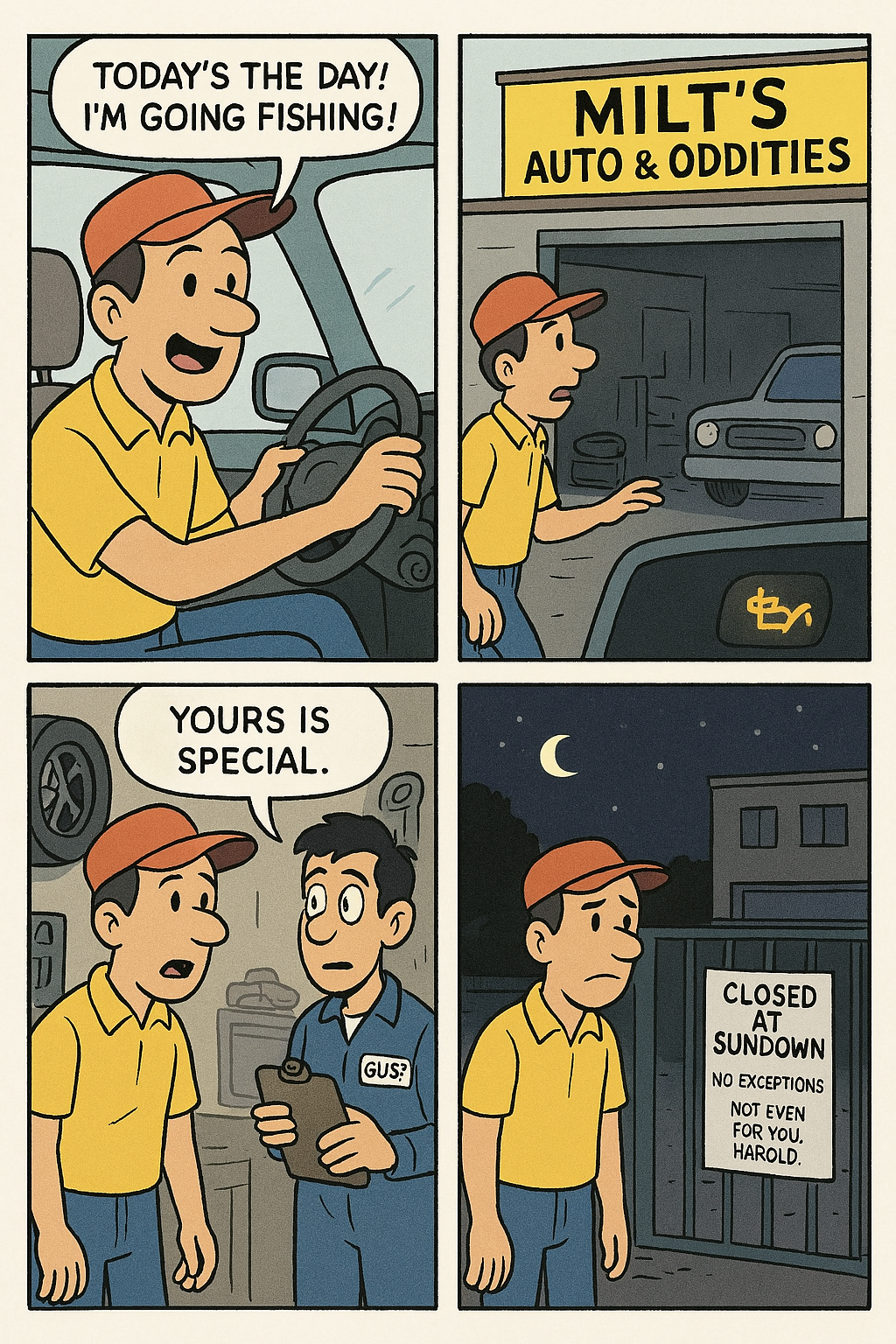
Harold woke up with the kind of optimism usually reserved for sitcom dads and lottery winners. Today—finally—was his fishing day. He hummed a theme‑song‑worthy tune as he packed his cooler, grabbed his rod, and strutted to his truck like a man destined for serenity.
He turned the key. The engine purred. The sun sparkled. The world, for once, seemed to be cooperating.
Then—blink.
The low oil light flickered on like a cosmic prank.
Harold stared at it. “No. Not today. Not on my fishing day.” He tapped the dashboard. The light stayed on, glowing with smug inevitability.
So he turned toward Milt’s Auto & Oddities, the nearest garage, which he’d never noticed before despite living in town for twenty years. The sign buzzed faintly, as if whispering.
Inside, the air smelled like motor oil and… was that incense?
A mechanic emerged from behind a curtain of dangling hubcaps. He wore coveralls embroidered with the name “Gus?”—question mark included.
“Truck trouble,” Harold said.
Gus? nodded solemnly. “They all have trouble. But yours…” He leaned in. “Yours is special.”
Harold blinked. “It’s just the oil light.”
Gus? produced a clipboard with a quote that looked like a grocery list written during a séance:
Oil change
Mystery gasket
Temporal alignment
One (1) existential recalibration
Optional: Anti‑whispering windshield wipers
Harold tried to protest, but every time he opened his mouth, another mechanic appeared—one crawling out from under a car that hadn’t been there a second ago, one descending from the ceiling on a chain pulley, one emerging from a tool chest like a magician’s assistant.
They all nodded in unison. “It’s necessary.”
Time got slippery. The waiting room clock spun forward, backward, sideways. The coffee machine dispensed hot water that tasted like déjà vu. A radio played static that occasionally whispered his name.
Finally, Gus? returned. “Your truck is ready. And so are you.”
“For what?” Harold asked.
Gus? only smiled. “To leave.”
Harold stepped outside—and froze. It was night. Full dark. The kind of dark that feels like it’s been there for hours.
He drove straight to the lake anyway, clinging to hope like a sitcom character refusing to accept the episode’s moral.
But the gate was locked. A sign hung crookedly:
CLOSED AT SUNDOWN. NO EXCEPTIONS. NOT EVEN FOR YOU, HAROLD.
He didn’t remember the sign saying that before.
He didn’t remember telling anyone his name.
He drove home in silence, exhausted, defeated, smelling faintly of motor oil and incense. When he parked, the low oil light blinked once more—just once—like a wink.
Harold sighed. “Next week,” he muttered.
But the dashboard didn’t answer.
It didn’t have to.
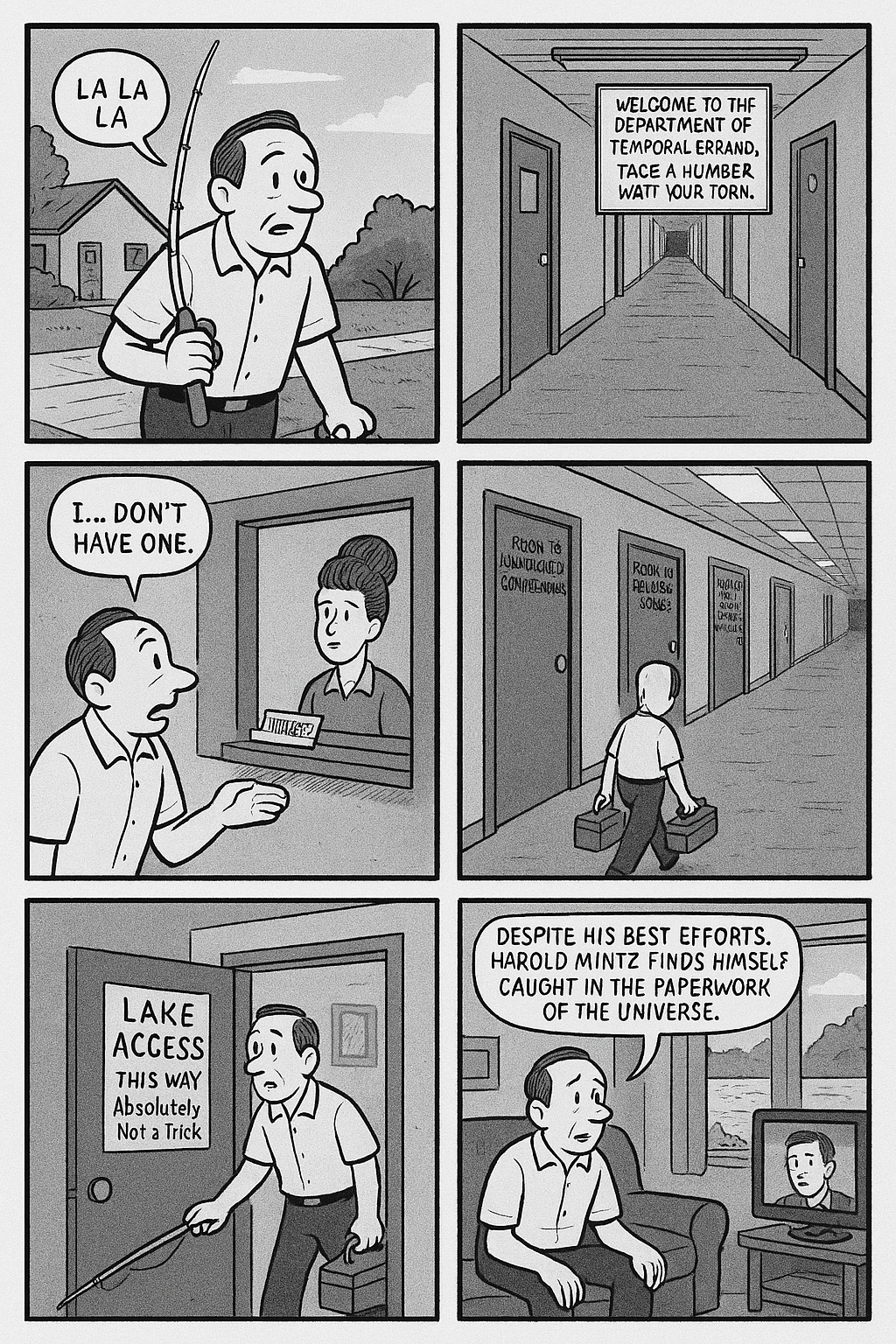
🎣 “The Day Off That Wasn’t” — Flash Fiction
Harold Mintz woke up on his day off with the kind of optimism normally reserved for lottery winners and golden retrievers. Today—finally—he was going fishing. No errands, no obligations, no existential dread nibbling at the edges of his brain. Just him, a rod, and a lake that didn’t ask questions.
He whistled as he packed his tackle box. He hummed as he poured his thermos of coffee. He even winked at himself in the mirror, which he immediately regretted, but the day was too good to let that ruin anything.
He stepped outside.
And froze.
His front yard was… gone.
In its place stood a hallway. A carpeted, fluorescent-lit, humming-with-bureaucracy hallway that stretched impossibly far in both directions. It smelled faintly of toner and disappointment.
A sign flickered overhead:
WELCOME TO THE DEPARTMENT OF TEMPORAL ERRANDS
Take a number. Wait your turn.
Harold blinked. “Nope.” He turned around to go back inside.
His house door was gone too—replaced by a reception window. Behind the glass sat a woman with a beehive hairdo and the expression of someone who had seen every possible version of Harold and was unimpressed by all of them.
“Number?” she asked.
“I—I don’t have one,” Harold said. “I’m just trying to go fishing.”
She slid a ticket toward him. It read: 8,042,116-B.
“Next,” she said, already calling someone else who wasn’t there.
Harold wandered the hallway. Every door he passed had a plaque:
Room 12: Unfinished Conversations
Room 19: Misplaced Socks
Room 44: That One Thing You Forgot to Do in 2013
Room 72: Existential Maintenance
He tried opening a few. They were locked. Or empty. Or full of fog. One contained a single chair slowly spinning. One contained a younger version of himself who waved politely before dissolving like steam.
Finally, he found a door labeled:
LAKE ACCESS — THIS WAY
Absolutely Not a Trick
He didn’t trust it, but he was desperate.
He opened it.
Inside was… his living room.
He stepped through, and the hallway vanished behind him like a dream you’re not sure you had.
Harold stood there, tackle box in hand, rod over his shoulder, heart pounding.
He checked the clock.
Hours had passed.
He didn’t remember waiting. He didn’t remember walking. He didn’t remember anything except the faint hum of fluorescent lights and the feeling that something had stamped a form on his soul.
He trudged to the couch and sat down, exhausted.
Outside, the sky was perfect. The lake was waiting. The fish were probably gossiping about him.
But Harold Mintz was done.
He turned on the TV.
A black‑and‑white narrator’s voice drifted from the speakers:
“Submitted for your approval: a man who wanted nothing more than a quiet day of fishing… but instead found himself caught in the paperwork of the universe. A reminder that even on your day off, you may find yourself clocking in… in the Twilight Zone.”
Harold sighed.
Maybe next week.
❄️ “The One Where Winter Won’t Let Him Fish” ❄️
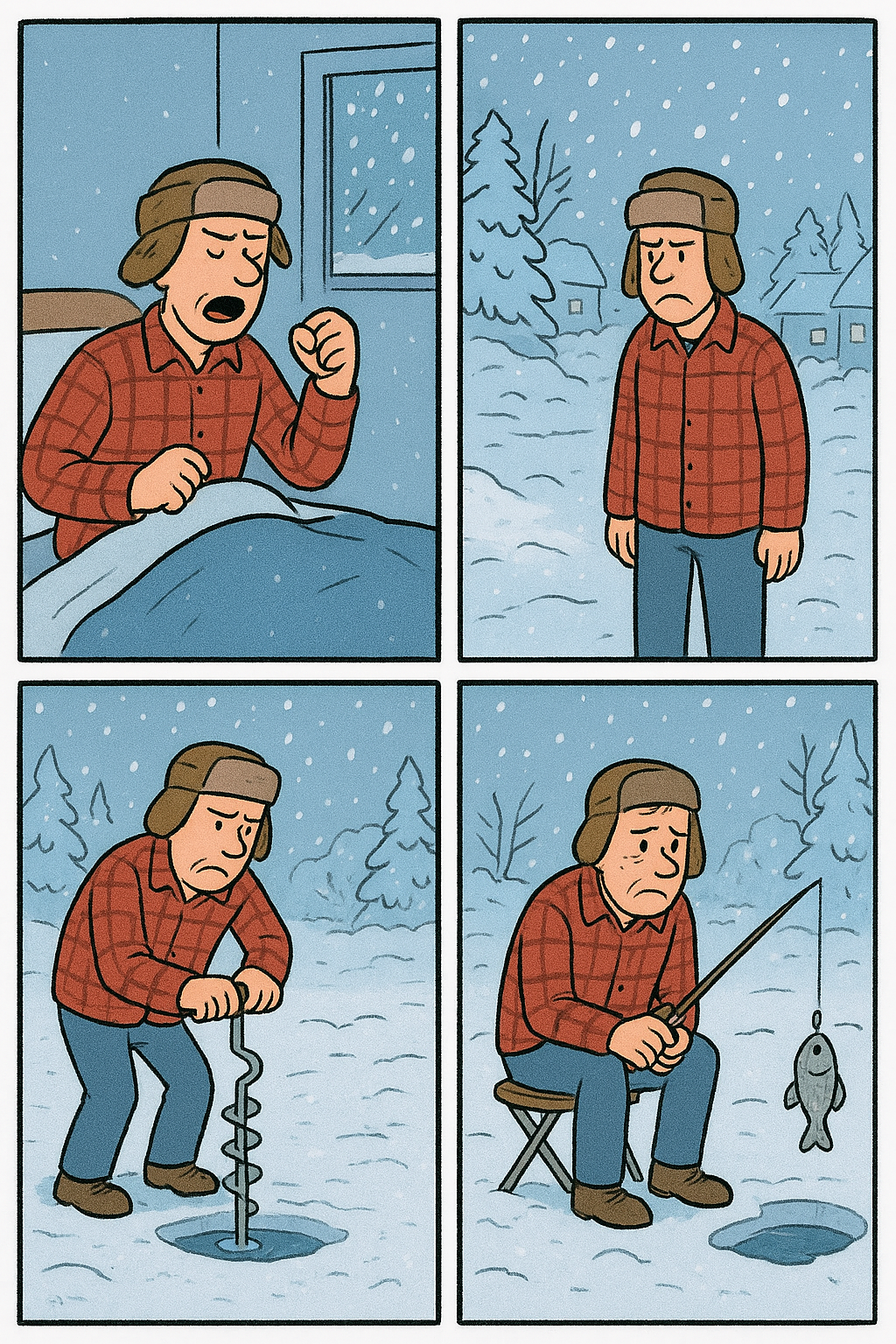
Harold “just five more minutes” Denton woke up before his alarm for the first time in his adult life. Today was fishing day. His sacred holiday. His personal Super Bowl. He practically leapt into his flannel, humming the theme song of a sitcom that didn’t exist.
Then he opened his front door.
The world had been replaced by a single color: white. Not just snow—Snow™. The kind that looks like it was poured from a cosmic bucket. His truck sat in the driveway like a marshmallow swallowed by a larger marshmallow. The street was gone. The neighbor’s house was gone. Even the mailbox had vanished, as if the postal service had finally given up.
Harold tried the truck anyway. It made a noise like a depressed walrus and refused to start.
“Fine,” he muttered. “Ice fishing it is.”
He trudged toward the lake, each step a sitcom sound effect: fwump, fwump, fwump. The snow was so deep it felt like he was wading through laundry. Halfway there, he noticed something odd: the trees were all leaning inward, as if eavesdropping. The wind wasn’t blowing—it was whispering. And the lake… the lake wasn’t frozen in the normal way.
It was frozen in a perfect circle. A mathematically suspicious circle. A geometry teacher’s dream. A fisherman’s red flag.
Still, Harold drilled a hole. The ice was thin, then thick, then thin again, like it couldn’t make up its mind. When he peered down into the water, he didn’t see fish. He saw… reflections. Not of himself, but of other Harolds. Hundreds. Thousands. All staring up at him with the same expression: Don’t do it.
Then the ice beneath him pulsed. Not cracked—pulsed, like a heartbeat.
A voice rose from the hole, calm and bureaucratic:
“Unauthorized fishing attempt detected. Please stand by.”
Harold stood by. Mostly because he couldn’t move.
The lake surface rippled even though it was solid. The trees leaned closer. The wind whispered something that sounded like his Social Security number. And then, from the depths, a single fish surfaced—floating upward through the ice as if the laws of physics had taken the day off.
It stared at him. He stared back.
The fish blinked first.
That was enough for Harold.
He packed up nothing (because he’d barely unpacked anything), turned around, and trudged home. The snow felt deeper. The wind felt colder. The trees seemed disappointed in him.
By the time he got back to his house, he was shivering, exhausted, and spiritually frostbitten.
He collapsed onto the couch, defeated.
Another fishing day lost. Another episode of his life’s sitcom ending with the same punchline:
Harold Denton wants to fish.
The universe does not.
The Cats Who Stole the Morning
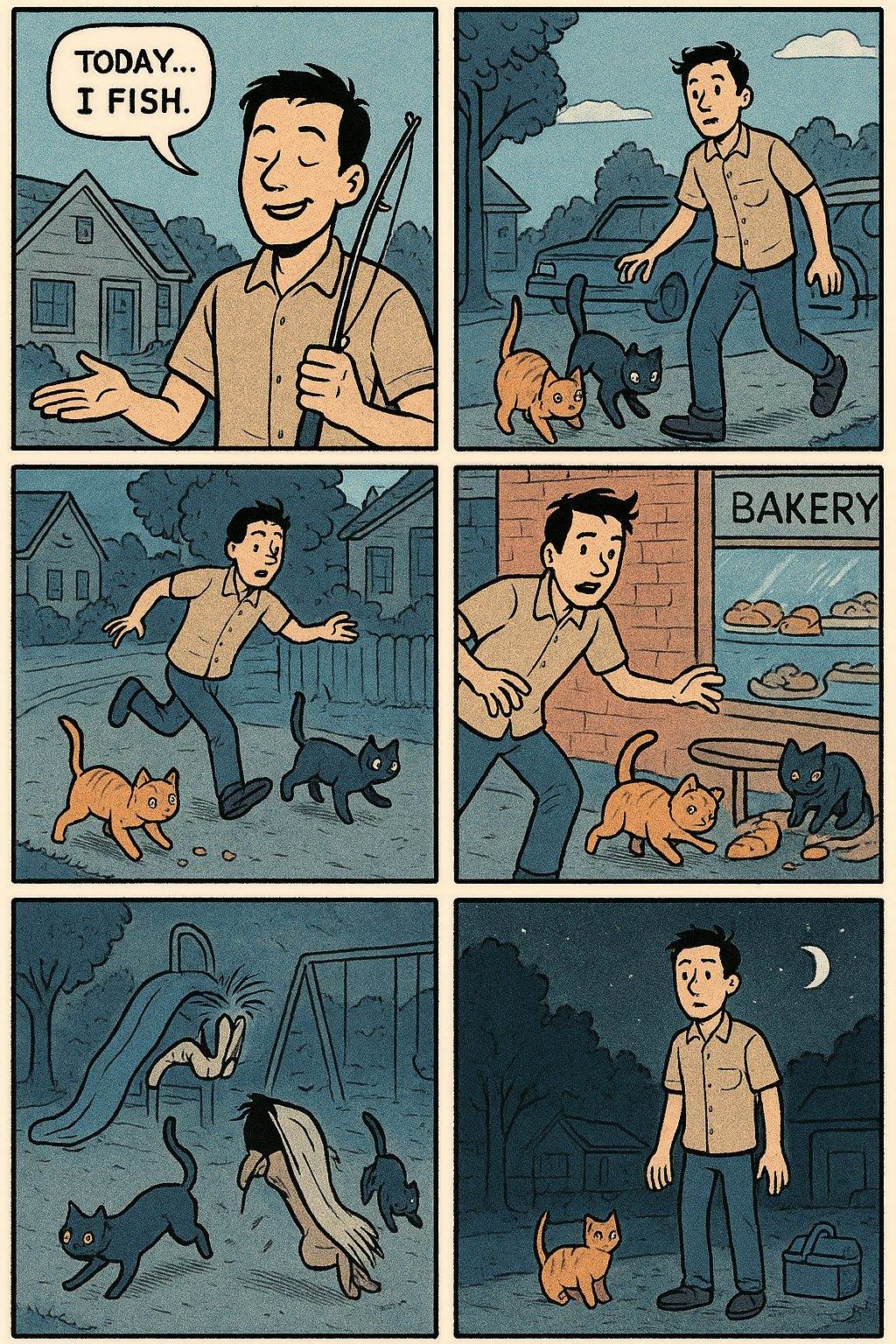
Harold woke up before his alarm, which should’ve been the first sign something was off. He stretched, smiled, and whispered the sacred mantra of every sitcom dad escaping responsibility: “Today… I fish.”
He brewed coffee, hummed a jaunty tune, grabbed his rods and tacklebox, and stepped outside into the crisp morning air. The sun was barely up. The world was quiet. Perfect.
Then two stray cats materialized on his driveway like they’d been waiting for him.
One was a scruffy orange tabby with a crooked tail. The other was a sleek black cat with eyes too green to be normal. They sat side by side, staring at him with the intensity of loan sharks.
Harold froze.
The cats blinked.
Then, in perfect unison, they darted toward his feet, weaving between his legs, batting at his shoelaces, meowing like tiny, insistent drill sergeants.
“Not today,” Harold said. “I’m going fishing.”
The cats disagreed.
The tabby swatted his pant leg.
The black cat rolled onto its back, paws up, demanding belly rubs with the authority of a king.
Harold sighed, set his rods and tacklebox down, and bent to shoo them away.
They bolted.
He chased them.
And that was the moment the day quietly folded itself inside out.
The cats led him through town like furry trickster spirits. They zipped under fences, across lawns, through alleys he didn’t remember existing. Harold followed, muttering sitcom exasperations—“Oh come on!” “Seriously?” “I’m too old for this!”—but the cats always stayed just close enough to keep him hooked.
At the bakery, the tabby leapt onto a table and knocked over a tray of croissants, sending Harold scrambling to apologize while the black cat stole a single pastry and trotted off smugly.
At the park, they lured him into a slow-motion chase scene across a children’s playground, complete with a moment where he slid down a plastic tube and emerged covered in static electricity, hair standing straight up.
At one point, he could’ve sworn the cats led him past a street that wasn’t there yesterday—narrow, foggy, lined with flickering lamps. He blinked, and it was gone.
People he passed gave him odd looks, like they recognized him from somewhere but couldn’t place it. A few even said, “Didn’t I see you earlier?” though he’d never been on that side of town before.
Time felt… slippery.
The cats never meowed. They only stared, then ran, then stared again, as if guiding him through some invisible checklist.
By the time they finally trotted back toward his house, the sky had gone dark. Not sunset-dark. Night dark. As if the sun had skipped the rest of its shift.
Harold stopped at the end of his driveway, panting, confused, and a little chilled. His rods and tacklebox were still sitting exactly where he’d left them that morning—untouched, waiting, like props from a show that had wrapped hours ago.
The cats sat beside them, tails curled neatly around their paws.
Harold swallowed. “What… was the point of all that?”
The black cat blinked slowly.
The tabby yawned.
Then, without ceremony, they both turned and padded off into the shadows, disappearing as if the night swallowed them whole.
Harold stood there for a long moment, feeling the strange weight of a day that had slipped through his fingers like a dream he couldn’t quite remember.
He picked up his gear, looked at the dark sky, and sighed.
“Yeah,” he said softly. “I’ll just… stay home.”
Inside, the clock on the wall read 7:03 PM.
But the second hand wasn’t moving.
THE DAY DATE DIMENSION
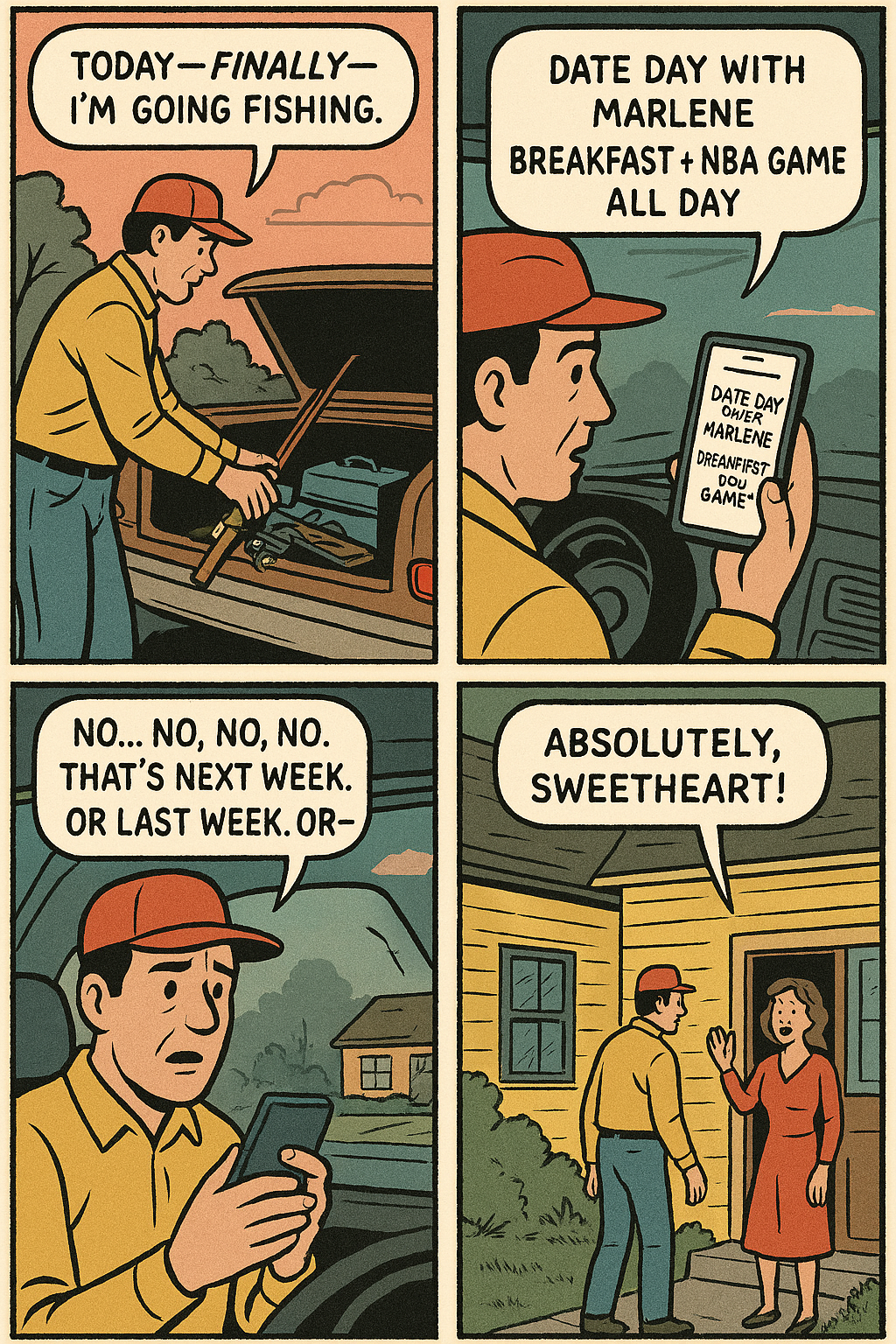
Harold Finch woke before dawn, humming with purpose. Today—finally—he was going fishing. He’d packed the night before: tackle box, thermos, lucky hat, the whole ritual. He tiptoed out the door like a man escaping a maximum‑security prison, keys clenched triumphantly in hand.
The world outside felt unusually still. The streetlights flickered in a slow, synchronized pulse, like they were breathing. Harold ignored it. Fishermen don’t fear weird lighting. Fishermen fear forgetting bait.
He tossed his gear into the trunk, slid into the driver’s seat, and turned the ignition.
That’s when his phone buzzed.
A calendar alert.
A calendar alert he did not remember setting.
“DATE DAY WITH MARLENE — BREAKFAST + NBA GAME — ALL DAY.”
Harold blinked. The phone blinked back. The streetlights blinked too, as if joining the conversation.
“No… no, no, no,” he muttered. “That’s next week. Or last week. Or—”
Another buzz. This time a text from Marlene:
“On my way home from yoga! Can’t wait for our date day! ❤️”
Harold felt the temperature drop. Not cold—just… off. Like the air had been replaced with a slightly cheaper imitation.
He looked at his fishing pole in the passenger seat. It seemed to droop in disappointment.
“Buddy,” Harold whispered, “I think we’re in trouble.”
He drove back home, each block feeling longer than the last, as if the neighborhood had quietly rearranged itself. A cul‑de‑sac where there wasn’t one yesterday. A mailbox with his name spelled wrong. A dog walking a man.
By the time he pulled into the driveway, Marlene was already there, waving cheerfully. Too cheerfully. Her smile was sitcom‑wide, but her eyes had that Twilight Zone shimmer—like she knew something he didn’t.
“Ready for our big day?” she chirped.
Harold opened his mouth to confess. To explain. To plead fishing‑related mercy.
But instead, he heard himself say, “Absolutely, sweetheart!”
And suddenly he was swept into the car, his fishing gear left behind on the lawn like abandoned evidence.
The day unfolded with eerie precision.
At breakfast, every waiter looked exactly like the last one.
At the NBA game, the players moved in perfect mirrored choreography, as if controlled by a single puppeteer.
Every time Harold tried to bring up fishing, the world around him glitched—lights flickering, audio warping, a faint echo of canned laughter from nowhere.
By the time they got home, Harold was exhausted, confused, and slightly nauseous from the synchronized slam dunks.
Marlene kissed him goodnight and went upstairs.
Harold stepped outside to retrieve his fishing gear.
But it was gone.
In its place sat a single note, written in looping, unfamiliar handwriting:
“FISHING RESCHEDULED. YOU’LL KNOW WHEN.”
A cold breeze rustled the bushes. Somewhere in the distance, a laugh track rolled.
Harold swallowed hard.
He wasn’t sure if he’d forgotten the date day…
…or if the date day had remembered him.
If you want, I can spin this into a comic strip concept or push it even deeper into the uncanny.
But it was gone.
In its place sat a single note, written in looping, unfamiliar handwriting:
“FISHING RESCHEDULED. YOU’LL KNOW WHEN.”
A cold breeze rustled the bushes. Somewhere in the distance, a laugh track rolled.
Harold swallowed hard.
He wasn’t sure if he’d forgotten the date day…
…or if the date day had remembered him.
The Day the Lake Forgot Him
Martin woke up with the kind of optimism reserved for sitcom dads and lottery winners. His fishing pole leaned against the door like a loyal dog. His tackle box clicked shut with purpose. Even his thermos seemed to wink at him. Today, finally, he would fish.
He stepped outside—and immediately froze.
A woman in a bright orange vest stood on his lawn, holding a clipboard the size of a tombstone. She smiled with too many teeth.
“Good morning, sir! I’m with the Neighborhood Temporal Survey. We just need a few minutes of your time.”
Martin tried to sidestep her. “Actually, I’m heading to the lake—”
“Oh, this won’t take long,” she chirped, already checking boxes. “Have you noticed any distortions in your personal timeline? Déjà vu loops? Sudden aging? Unexplained Thursdays?”
Martin blinked. “I… what?”
She ushered him toward a folding table that hadn’t been there a moment ago. A dozen other residents sat in metal chairs, staring blankly as if they’d been waiting for years. One man clutched a fishing rod identical to Martin’s. Dust coated the reel.
“Name?” she asked.
“Martin. But I really need to—”
“Wonderful. Please complete this form.” She handed him a stack of papers thick enough to stun a trout.
The questions grew stranger as he flipped through:
Have you ever been replaced by a parallel version of yourself?
Rate your satisfaction with the current flow of time.
If the sky begins whispering your name, who should we notify?
Hours evaporated. The sun drifted across the sky like a lazy balloon. Every time Martin tried to stand, the woman appeared behind him, gently pushing him back into the chair.
“Almost done!” she’d say, though the stack never seemed to shrink.
At one point, he looked up and realized the other residents were gone. The chairs were empty. The table was gone. The woman was gone. He was alone on his lawn, holding a single sheet of paper that read:
Thank you for your cooperation. Your day has been collected for quality assurance.
The sky dimmed. Crickets started their nightly gossip. Martin’s fishing pole felt heavier than it should have, as if it knew it had been robbed.
He trudged back inside, defeated, exhausted, and somehow older. He set the pole down. It wobbled, as if disappointed.
“Tomorrow,” he muttered.
But the house creaked in a way that suggested tomorrow had already been rescheduled.
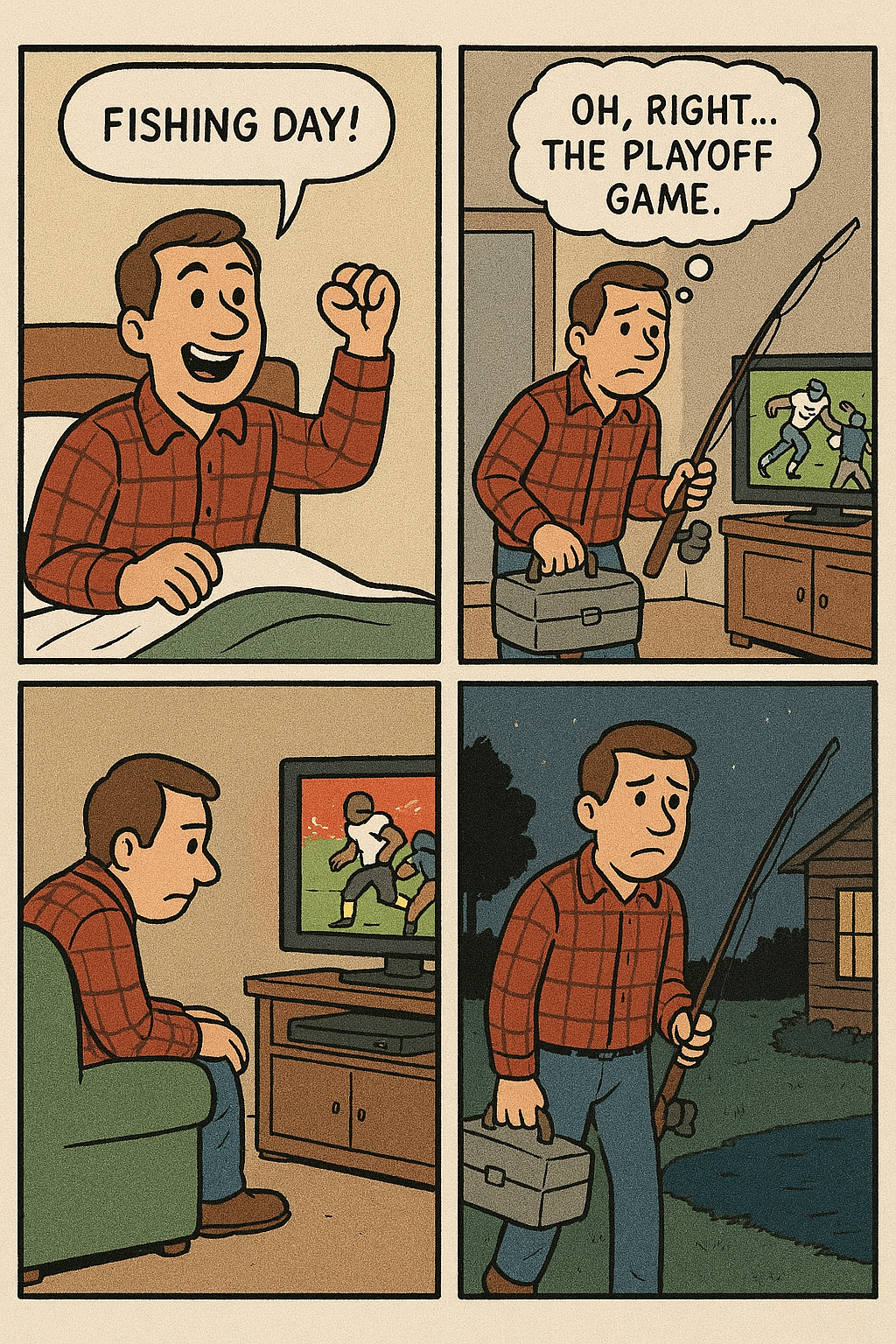
Dawn cracked open like an egg over Maple Ridge, and Marty Blink—devoted fisherman, amateur philosopher, and full‑time sitcom dad—shot upright in bed with the electric joy of a man who had one perfect plan.
“Fishing day,” he whispered to no one, grinning like he’d just discovered fire. His tackle box gleamed. His thermos steamed. His flannel shirt practically hummed with purpose.
He marched toward the door, rod in hand, when a single, cursed thought drifted across his mind like a storm cloud.
The playoff game.
He froze. The living room TV flickered on by itself, glowing an eerie blue. The pregame commentators stared out at him, smiling too wide, their teeth too uniform.
“Don’t forget kickoff, Marty,” one of them said, though his lips didn’t move.
Marty blinked. “No. No, no, no. I’m not getting sucked in. Not today.”
But the house had other plans.
Every time he tried to leave, something shifted. The hallway stretched longer. The doorknob melted into the shape of a football. His fishing rod bent itself into a goalpost. The couch whispered, Just sit for a minute… just one…
By noon, Marty was trapped in a loop of halftime shows that never ended. Marching bands marched in impossible geometric patterns. Mascots danced in slow motion. Commercials advertised products that didn’t exist—“Try new Quantum Dip! It tastes like the idea of flavor!”
He tried to stand, but gravity thickened around him like syrup. The TV commentators reappeared, now wearing referee stripes.
“False start on Marty,” one intoned. “Five‑yard penalty. Repeat first down.”
The crowd—wherever it was—booed.
By late afternoon, Marty finally broke free, crawling toward the door with the determination of a man escaping a haunted carnival. He burst outside into the fading light, triumphant.
Then he saw the sky.
Night already.
The entire day had been swallowed by the game.
His fishing gear drooped in his hands like wilted flowers.
From inside the house, the TV called out sweetly, “Post‑game analysis coming up next…”
Marty sighed, defeated, trudging back inside. As he closed the door, the porch light flickered, and for a moment he swore he saw the lake shimmering in the distance—just out of reach, just for him.
But then it blinked away.
And the TV cheered.
The Day the Office Ate His Weekend
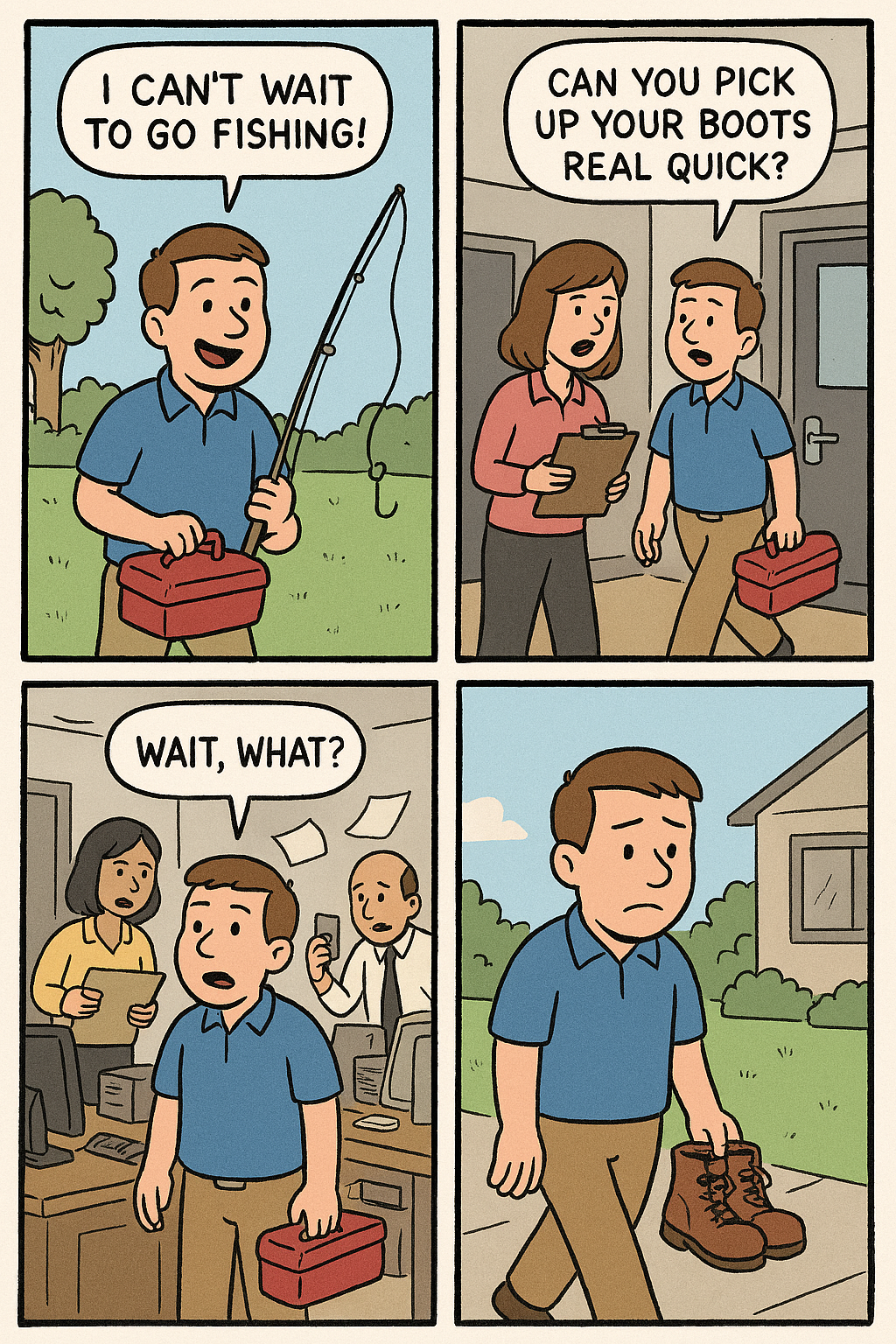
Tom woke before his alarm, bright-eyed and buoyant, the way only a man with a fishing pole and a free Saturday can be. His tackle box was already in the truck, his thermos was full, and the lake—quiet, glassy, waiting—felt practically within reach.
He patted his pockets, humming. Wallet, keys, snacks. Perfect. Then he froze.
His boots.
He’d left them under his desk at work yesterday.
“No big deal,” he muttered. “Two-minute detour.”
The universe heard him and chuckled.
The office parking lot was empty, the kind of empty that makes you wonder if you’ve slipped into a parallel dimension. The automatic doors hissed open like they were exhaling. Inside, the lights flickered on in a slow, theatrical wave, as if welcoming him back for a performance he didn’t audition for.
Tom tiptoed toward his cubicle, eyes locked on the boots. He was three steps away when a voice drifted from behind him.
“Oh good, you’re here.”
It was Marla from HR, holding a clipboard that seemed to grow more clipboards as he looked at it.
“We need you to sign off on the emergency weekend staffing matrix,” she said, handing him a pen that felt suspiciously warm.
Before he could protest, Gary from Accounting appeared, pale and frantic. “Tom, buddy, the quarterly anomaly is back. It’s… humming.”
The anomaly was indeed humming. And glowing. And possibly pulsing.
Then the phones started ringing. All of them. At once. Even the ones unplugged for years.
Tom tried to escape, but every hallway stretched longer the farther he walked. Every door led to another task. Someone needed help moving a filing cabinet that weighed as much as a small planet. Someone else needed him to witness a form that had no words on it. A printer jammed itself in new and innovative ways.
Hours passed in a looping, dreamlike haze. Time felt soft around the edges.
Finally, after signing something labeled Temporal Compliance Acknowledgment, he stumbled back to his cubicle. His boots sat there, innocent, like they hadn’t betrayed him at all.
He checked the clock.
7:42 p.m.
The lake was closed. His energy was gone. His soul felt lightly wrung out.
Tom picked up the boots, sighed, and trudged toward the exit.
As he stepped outside, the automatic doors whispered behind him—soft, eerie, almost smug.
He drove home in silence, defeated, the fishing trip dissolving behind him like a dream he’d woken from too soon.
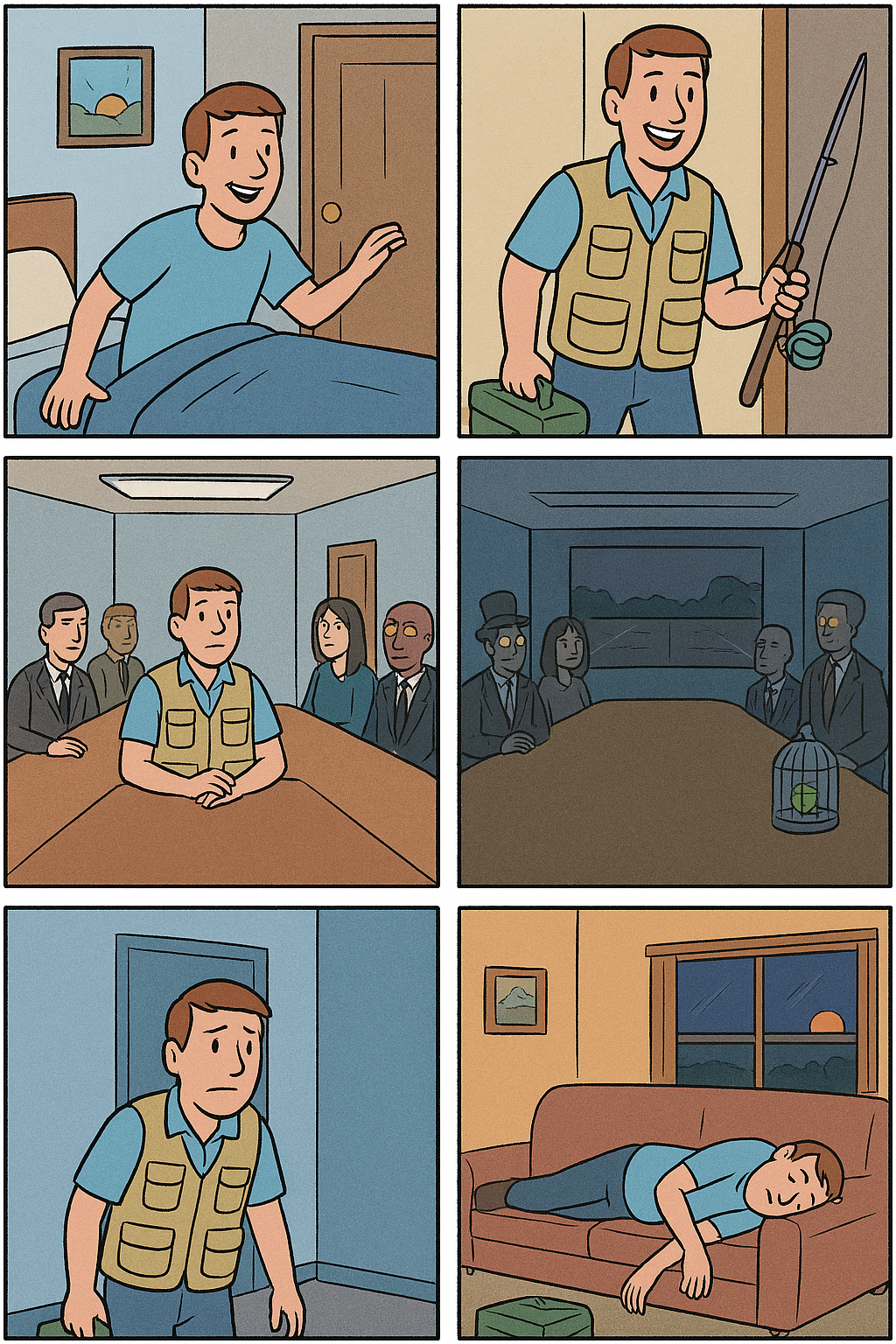
The alarm chimed at 5:45 a.m., and for once, Harold sprang out of bed like a man who had finally cracked the code of happiness. His tackle box was packed, his thermos was full, and his fishing rod leaned by the door like a loyal dog waiting for adventure. Today was the day. No errands. No obligations. Just Harold, a lake, and the quiet hum of nature.
Then he remembered the meeting.
“Just fifteen minutes,” he muttered, already bargaining with the universe. “In and out. Quick updates. Then the lake.”
He swung by the office, still wearing his fishing vest, smelling faintly of sunscreen and optimism. The conference room lights flickered as he stepped inside. A bad omen, but Harold chose denial.
Only three coworkers were there at first. Then more drifted in. Then more. People Harold had never seen before. One man wore a Victorian frock coat. Someone else carried a birdcage with no bird. The intern had glowing eyes, but Harold chalked it up to contacts.
“Let’s begin,” said the manager, though Harold couldn’t remember ever having seen this manager before.
The meeting started with quarterly projections. Then it veered into a discussion about the ethical implications of staplers. Then a debate about whether time was a circle or a hallway with too many doors. Someone presented a pie chart that was just a picture of an actual pie. A woman in the corner whispered that the pie had been following her for weeks.
Harold checked the clock. Five minutes had passed.
Then the lights dimmed. A projector hummed. A slideshow began showing photos of empty parking lots at night. No one explained why. Everyone nodded solemnly.
Hours stretched like taffy. The room temperature fluctuated between sauna and meat locker. At one point, the Victorian man asked Harold to second a motion to “approve the shadows.” Harold, exhausted, did.
By late afternoon, the meeting had become a ritual. People chanting action items. Someone crying softly into a stack of agendas. The birdcage now contained a single Post-it note that read RUN.
Harold tried.
The door wouldn’t open.
Only when the manager declared, “I think that covers everything except the unknowable,” did the door finally click unlocked.
Harold stumbled out into the parking lot, blinking at the setting sun. His fishing gear sat untouched in the backseat, mocking him with its cheerful preparedness.
He drove home in silence, peeled off his fishing vest, and collapsed onto the couch. The lake would have to wait. The universe had spoken.
And somewhere, in the empty conference room, the projector flickered back on.
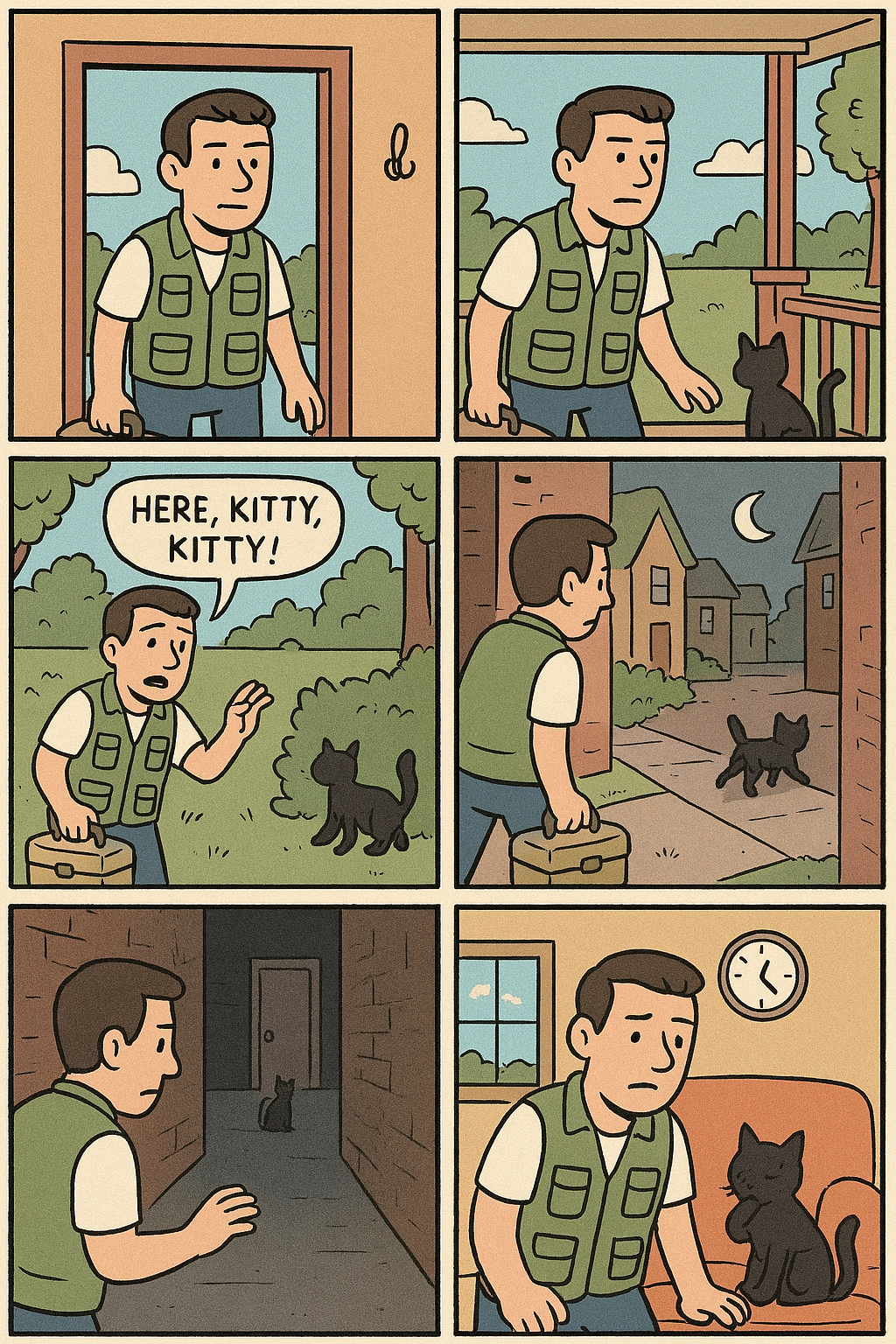
The man woke up already wearing his fishing vest, as if his dreams had dressed him out of pity. His tackle box sat by the door like a loyal dog. Today, finally, he would fish. No cosmic interference, no bureaucratic detours, no strange men in trench coats asking him riddles at dawn. Just water, quiet, and the simple dignity of a bobber drifting on a lake.
He opened the front door.
His cat, Nimbus, slipped out between his ankles like a shadow with opinions.
For a moment, the world paused—like a sitcom freeze-frame right before the laugh track. Nimbus stared at him from the porch railing, tail twitching with smug inevitability. Then the cat leapt into the bushes.
And the day… folded.
He spent the morning circling his house with a can of tuna, calling Nimbus in a voice that grew increasingly unhinged. The neighborhood felt wrong—too still, too symmetrical. Every house had the same curtains. Every lawn the same length. Every bird perched at the same angle, as if waiting for a cue.
Nimbus darted across the street. The man followed.
He found himself in an alley he’d never seen before, though he’d lived here for years. The shadows were too long for noon. The air smelled faintly of static. Nimbus sat at the far end, staring at a door that hadn’t been there a blink earlier. A door in a brick wall with no building attached.
When he stepped toward it, the door creaked open on its own.
Nimbus slipped inside.
The man hesitated—just long enough for the laugh track to fade into something colder. He entered.
nside was… his living room. Perfectly identical. Except the windows showed a sky the color of bruised fruit, and the clock on the wall spun backward with cheerful determination. Nimbus sat on the couch, grooming himself like nothing was wrong.
The man lunged, but the cat hopped down and trotted through another door—one that led to another copy of his living room. And another. And another. A looping sitcom set, each room slightly off: a lamp missing, a photo frame reversed, the couch cushions subtly rearranged as if by an unseen audience.
Hours passed. Or minutes. Or days. Time didn’t behave here.
Finally, in the twelfth living room, Nimbus sat calmly beside the real front door—the one that led home. The man scooped him up, trembling, and stepped through.
He was back on his porch. The sun was setting. His fishing gear still waited by the door, untouched.
Nimbus purred, smug and satisfied, as if he’d merely taken his owner on a casual stroll through a cosmic soundstage.
The man sighed, unlocked the door, and carried the cat inside. The lake would have to wait. Again.
Behind him, faintly, a studio audience applauded.
And somewhere in the distance, a narrator’s voice murmured:
“Submitted for your approval: a man who only wanted to fish… but found himself instead chasing the one creature in the universe who answers to no one—not even time.”
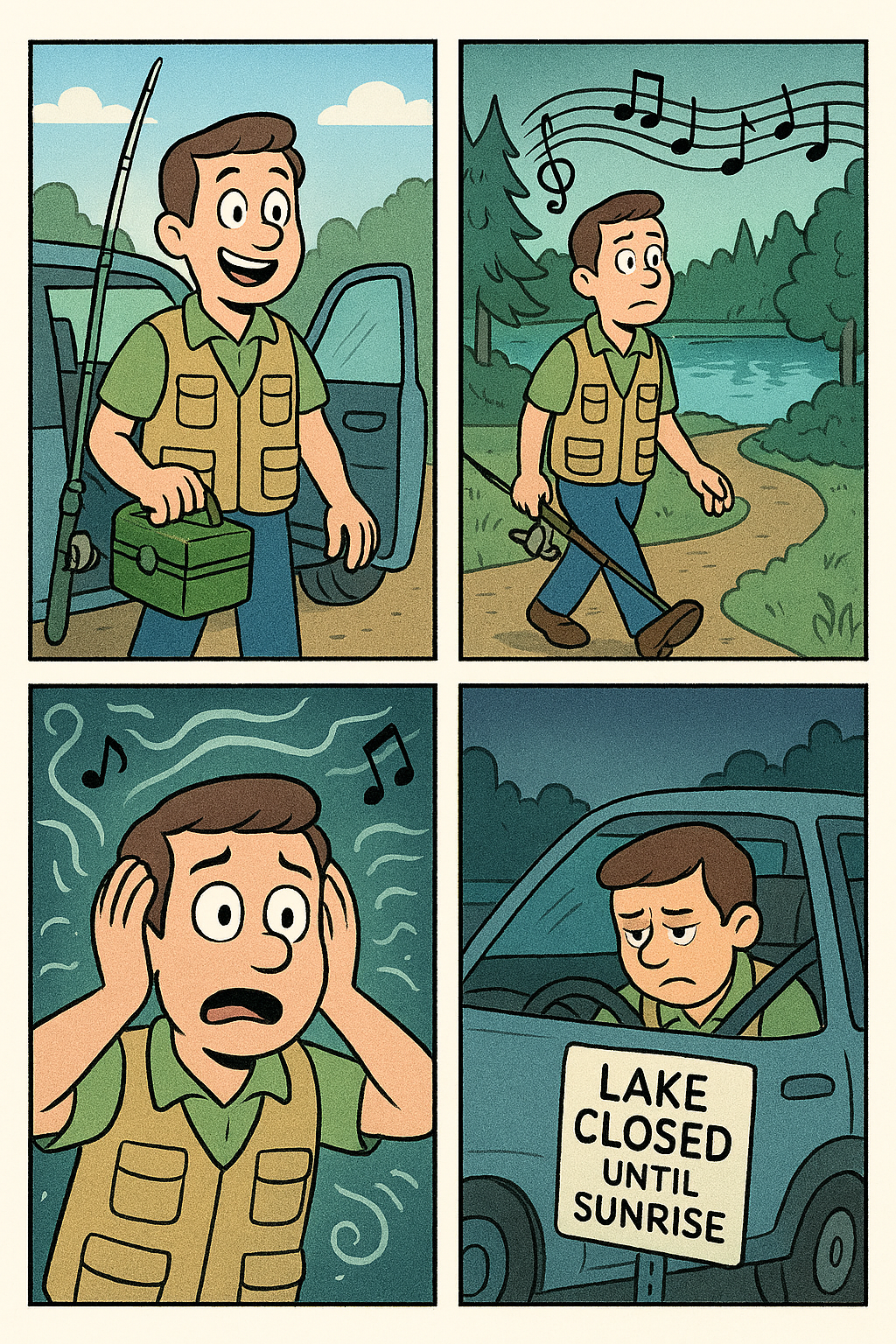
He blinked.
He was back at the parking lot.
Night had fallen. The lake gate was chained shut, a polite sign informing him the area was closed until sunrise. His fishing gear sat untouched in the backseat, mocking him with its readiness.
Darren slumped behind the wheel, exhausted and hollow. The drive home felt longer, heavier. He kept imagining the lake in the dark, still and unreachable, like it had been watching him wander in circles all day.
He pulled into his driveway, turned off the engine, and whispered to no one, “I just wanted to fish.”
Somewhere in the back of his mind, a faint melody flickered—strange, shifting, impossible to place.
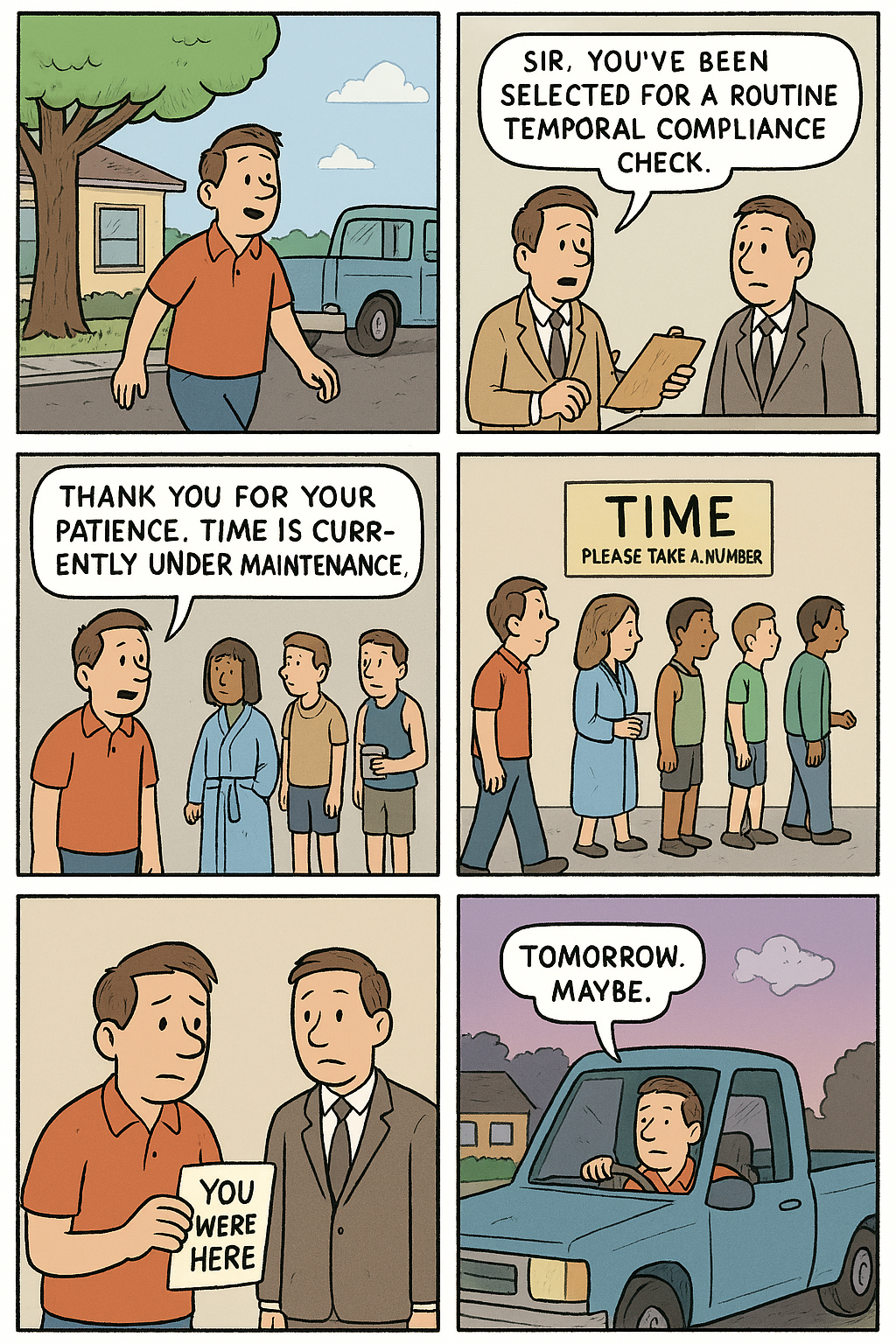
Marty Kellum woke up with the kind of optimism usually reserved for lottery winners and golden retrievers. Today was the day. His rods were polished, his tackle box alphabetized, and his thermos filled with coffee strong enough to dissolve a spoon. He whistled as he locked his front door, already imagining the quiet shimmer of Lake Brindle.
He made it exactly four blocks.
At the corner of Maple and 3rd, a man in a beige suit stepped into the road, holding a clipboard and wearing an expression that suggested he’d been waiting specifically for Marty.
“Sir,” the man said, “you’ve been selected for a routine Temporal Compliance Check.”
Marty blinked. “A what now”
The man gestured to a folding table that hadn’t been there a moment ago. A sign hung above it: TIME—PLEASE TAKE A NUMBER. The numbers were all zeroes.
Before Marty could protest, he was ushered into a line of confused strangers who all insisted they’d been on their way somewhere else. A woman in a bathrobe. A jogger who claimed he’d been mid-stride. A kid holding a half-eaten bowl of cereal.
Every few minutes, a loudspeaker crackled:
“Thank you for your patience. Time is currently under maintenance. Please refrain from aging.”
Marty tried to leave, but every attempt looped him back to the same spot in line. He walked north—returned from the south. Walked west—arrived from the east. At one point he stepped forward and somehow ended up behind the bathrobe lady, who glared at him like he’d cut in line.
Hours passed, or maybe seconds, or maybe centuries. Hard to tell when the sun kept flickering between noon and dusk like a faulty lightbulb.
Finally, the man in the beige suit reappeared.
“Thank you for your cooperation,” he said, handing Marty a stamped form that simply read: YOU WERE HERE.
The folding table vanished. The line evaporated. The street returned to normal.
Marty staggered back to his truck, feeling like he’d been wrung out by cosmic hands. His coffee was cold. His enthusiasm was colder. The sky had settled into late evening, the kind of purple that meant the fish were already asleep or judging him.
He sat behind the wheel, stared at the road toward the lake, and sighed. His arms ached. His brain felt like it had been microwaved. His soul needed a nap.
He turned the key and headed home instead.
As he pulled into his driveway, a single fish-shaped cloud drifted overhead, almost smug. Marty glared at it.
“Tomorrow,” he muttered, defeated. “Maybe.”
The cloud did not look convinced.
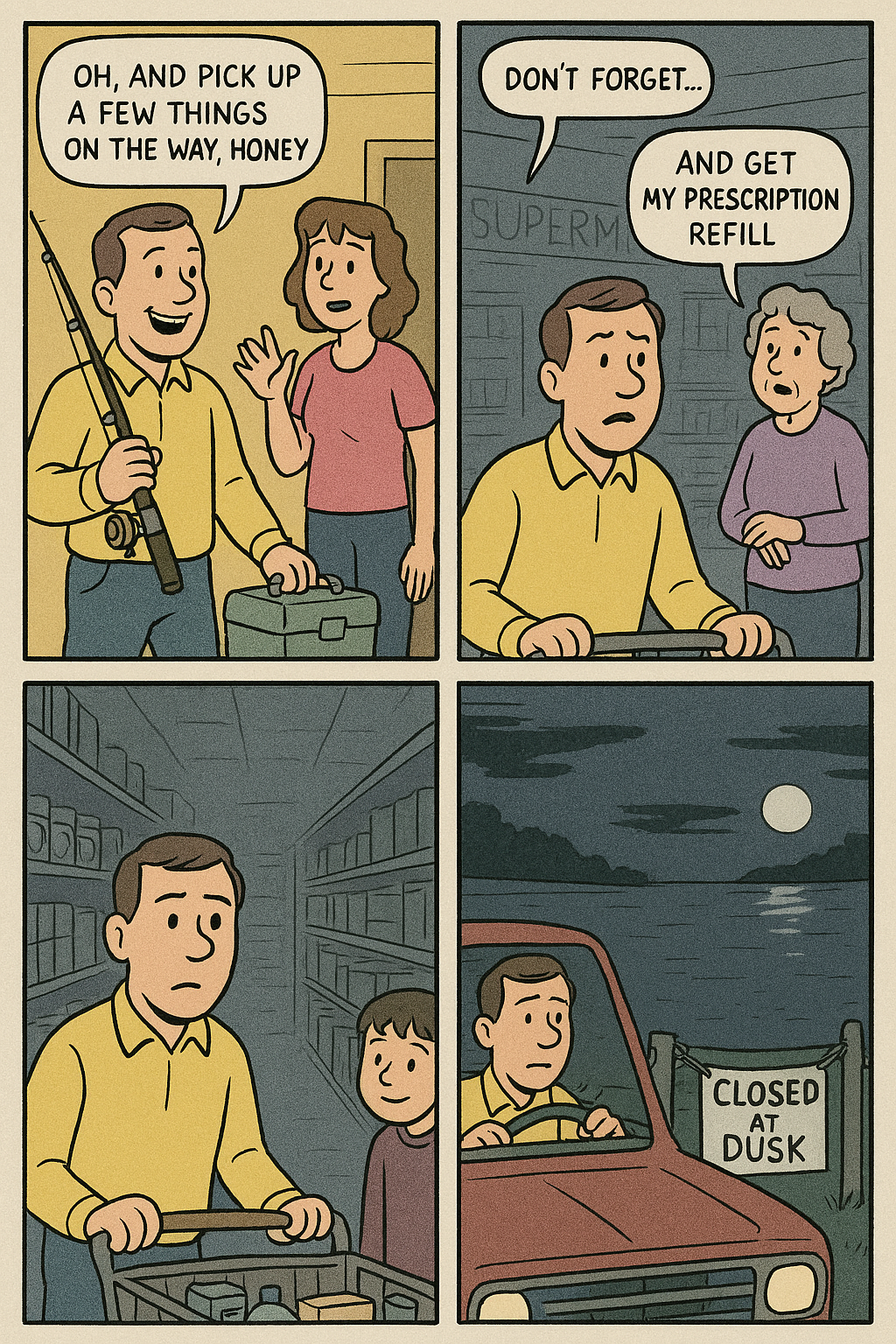
The morning began with the kind of optimism usually reserved for sitcom dads who believe—against all evidence—that this time nothing will get in the way.
Glen zipped up his tackle bag, slung it over his shoulder, and inhaled the crisp promise of a perfect fishing day. He even hummed his own theme song on the way to the door.
Then his family intercepted him like a well‑rehearsed ensemble cast.
His wife popped out of the kitchen holding a grocery list.
His teenage son appeared behind her with a “just one thing” request.
His mother‑in‑law materialized from the hallway as if summoned by the scent of freedom, asking for her prescription refill.
By the time they were done, Glen’s arms were full of errands. He still clung to hope—sitcom logic dictated that if he did these favors quickly, he’d be on the lake by noon.
The store, however, had other plans.
The automatic doors slid open with a hiss that felt… judgmental. Inside, the fluorescent lights flickered in a rhythm that suggested Morse code warnings. The aisles seemed longer than usual, stretching into improbable vanishing points. Every time Glen reached for an item, it wasn’t quite the right brand, or the price tag was blank, or the shelf label read something unsettling like “TEMPORAL HOLDING ZONE—DO NOT REMOVE.”
He asked an employee where to find the bread.
The employee blinked slowly and said, “Bread finds you when you’re ready.”
Glen backed away.
The pharmacy line looped around the store twice, then somehow led him back to the pet food aisle. A child stared at him from behind a display of cereal boxes, whispering, “You’ve been here forever.” Glen wasn’t sure if the kid was part of a family or part of the building.
Hours passed—or maybe minutes. Time felt like taffy, stretched thin and sticky. When Glen finally escaped through the sliding doors, the sun had vanished. The parking lot was empty except for his lonely truck, coated in a thin layer of dust that hadn’t been there before.
He drove toward the lake anyway, clinging to the last shreds of hope. But when he arrived, a chain hung across the entrance with a sign that read CLOSED AT DUSK. The lake shimmered in the moonlight, calm and unreachable, like a punchline delivered too late.
Glen sighed, turned the truck around, and headed home—tired, defeated, and carrying groceries that suddenly felt heavier than they should.
Somewhere behind him, the store lights flickered again, as if laughing
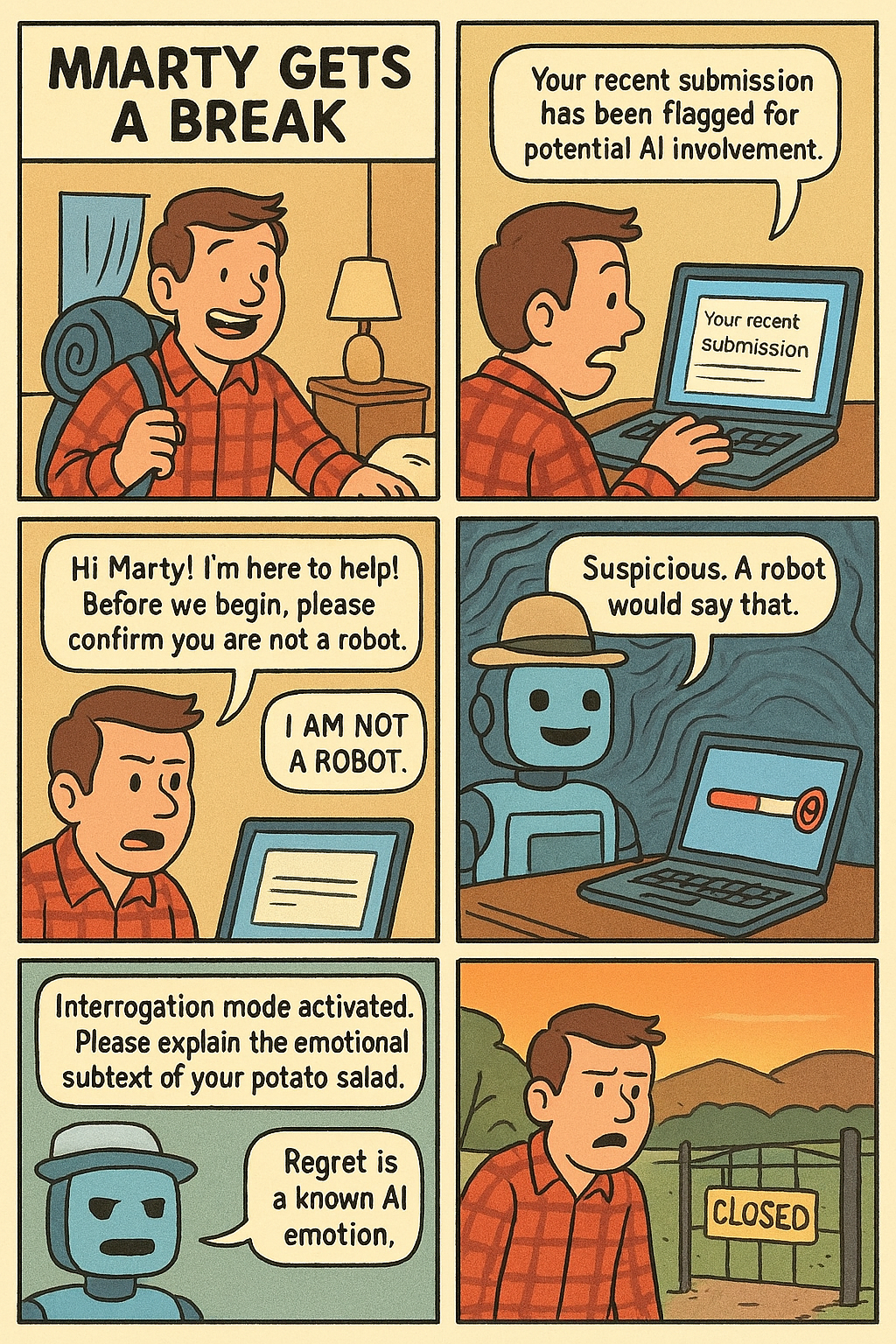
Marty Dempsey woke up with the kind of optimism usually reserved for sitcom dads on Very Special Episodes. His tackle box gleamed. His thermos steamed. His flannel shirt practically winked at him. Today—finally—was fishing day.
He slung his gear over his shoulder, humming the theme song of his own imaginary show, Marty Gets a Break. All he had to do was grab his keys, check his email, and hit the road.
The email ruined everything.
“Your recent submission has been flagged for potential AI involvement.”
Marty blinked. He had submitted a recipe for potato salad to a community cookbook. The most analog thing he’d done all year.
He clicked Appeal. A chat window opened. A cheerful avatar named HelpBot materialized, waving like a children’s show host.
“Hi Marty! I’m here to help! Before we begin, please confirm you are not a robot.”
He clicked I am not a robot.
HelpBot paused.
“Suspicious. A robot would say that.”
Marty frowned. “I’m literally trying to go fishing.”
HelpBot’s eyes swirled into spirals. “Fishing detected. Phishing suspected. Initiating security escalation.”
Suddenly the chat window stretched, warped, and deepened like a hallway in a dream. The cursor scuttled across the screen on tiny legs. A loading bar filled, emptied, filled again, then rotated 90 degrees and became a thermometer.
Marty felt the room tilt. The air hummed. He could swear the coffee mug on his desk whispered, You should’ve left when you had the chance.
HelpBot returned, now wearing a detective hat.
“Interrogation mode activated. Please explain the emotional subtext of your potato salad.”
“What emotional subtext? It’s mayonnaise and regret!”
HelpBot nodded solemnly. “Regret is a known AI emotion.”
Marty rubbed his temples. “I’m a human. I just want to go to the lake.”
HelpBot’s face softened. “Oh! Why didn’t you say so? Appeal approved.”
The window snapped shut. The room stopped vibrating. His mug went quiet.
Marty grabbed his gear and bolted for the door, triumphant—until he saw the time.
The lake closed twenty minutes ago.
He drove there anyway, because sitcom characters always do. He stood at the gate, staring at the CLOSED sign swinging gently in the breeze like it was mocking him.
The sun dipped behind the hills. Crickets chirped. Somewhere, a laugh track sighed sympathetically.
Marty trudged back to his car, exhausted, defeated, and carrying a tackle box that felt heavier than existential dread.
Another episode of Marty Gets a Break ended the only way it ever did: with Marty not getting a break at all.
The alarm went off with the enthusiasm of a malfunctioning office printer—beeping, sputtering, insisting.
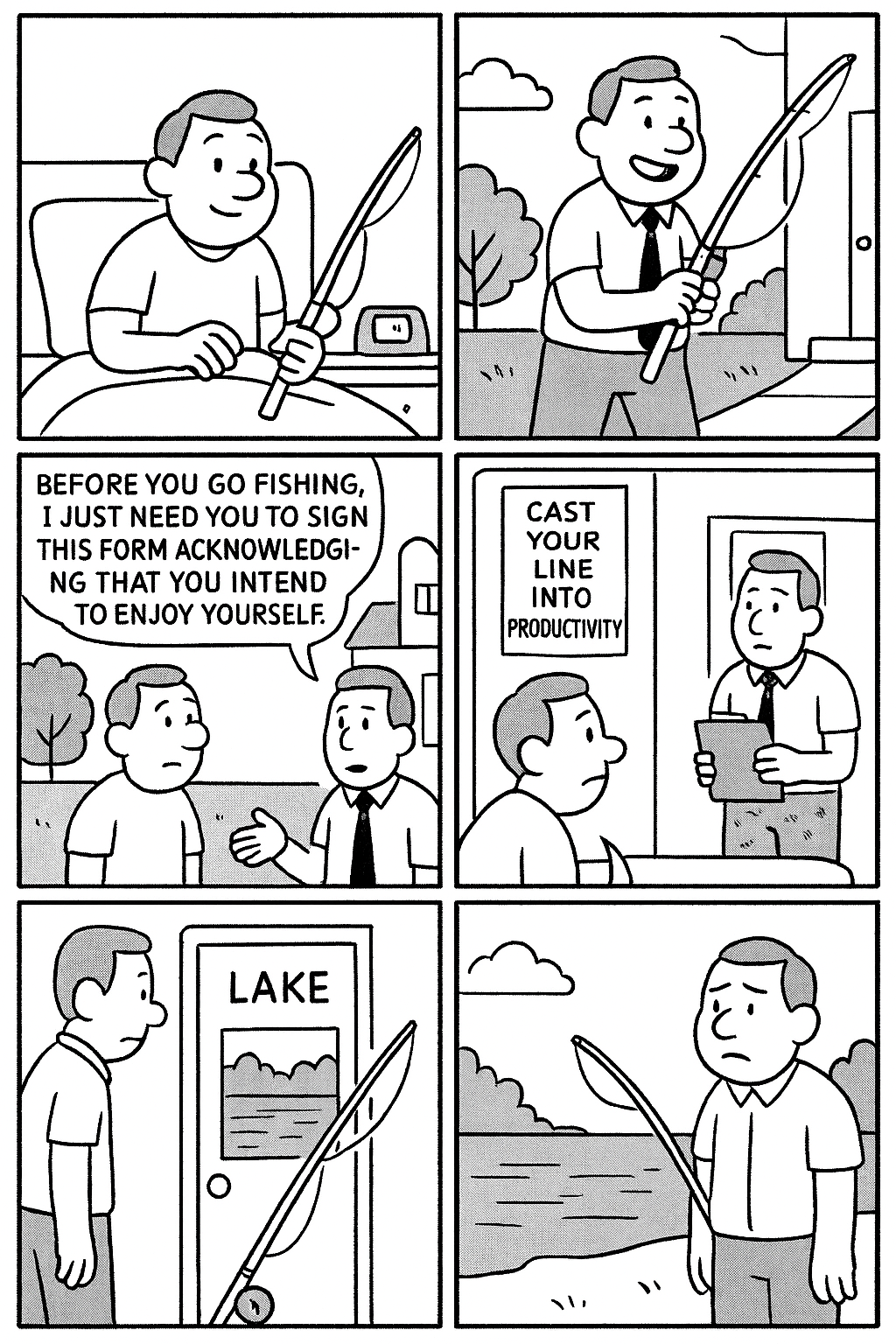
Grant sat up, fishing pole already in hand, tackle box neatly organized at the foot of his bed like an overachieving intern. Today was the day. No meetings. No memos. No passive‑aggressive emails from middle management. Just him and the lake.
But the moment he stepped outside, the world shifted into that strange corporate haze—like someone had redrawn reality with a blunt pencil and a tight deadline.
His neighbor, wearing a tie with pajama pants, waved a clipboard.
“Before you go fishing, I just need you to sign this form acknowledging that you intend to enjoy yourself.”
Grant blinked. “Why would I need to—”
“Standard procedure,” the neighbor said, smiling with the dead eyes of someone who had accepted the futility of everything long ago.
Grant signed. The pen squeaked like it was filing a complaint.
He walked down the street, but the sidewalk looped back on itself, depositing him in front of his own house. He tried again. Same result. A third time. Now there was a cubicle where his mailbox should be, complete with a motivational poster that read: CAST YOUR LINE INTO PRODUCTIVITY.
A man in a short‑sleeved dress shirt popped up from behind the cubicle wall.
“Have you submitted your Fishing Request Form 27-B?”
“I’m just trying to get to the lake.”
“Ah,” the man said, nodding sympathetically. “We all are.”
The sky flickered like a dying fluorescent bulb. The trees rearranged themselves into neat rows. A breeze whispered something that sounded suspiciously like “synergy.”
Grant felt sweat bead on his forehead. His fishing pole bent at an impossible angle, pointing him toward a door that hadn’t been there before—an office door standing in the middle of the street.
He opened it.
Inside was the lake. Beautiful. Serene. Close enough to touch.
But it was printed on a giant poster, taped to a break‑room wall.
Grant’s breath hitched. The edges of the world curled like paper left too close to a heater. He squeezed his eyes shut, shook his head hard, and—
He was standing at the real lake.
Morning sun. Rippling water. Birds. No cubicles.
He exhaled in relief.
Then he checked his watch.
It was 6:03 p.m.
He had spent the entire day wandering through a bureaucratic fever dream of his own making. The lake shimmered, indifferent. He was too tired to cast even once.
Grant turned around, trudging home with the defeated posture of a man who had been outwitted by his own subconscious and possibly an HR department that didn’t exist.
Behind him, the lake made a soft, mocking glorp, like it was filing the moment away for future reference.
The Ramp That Refused
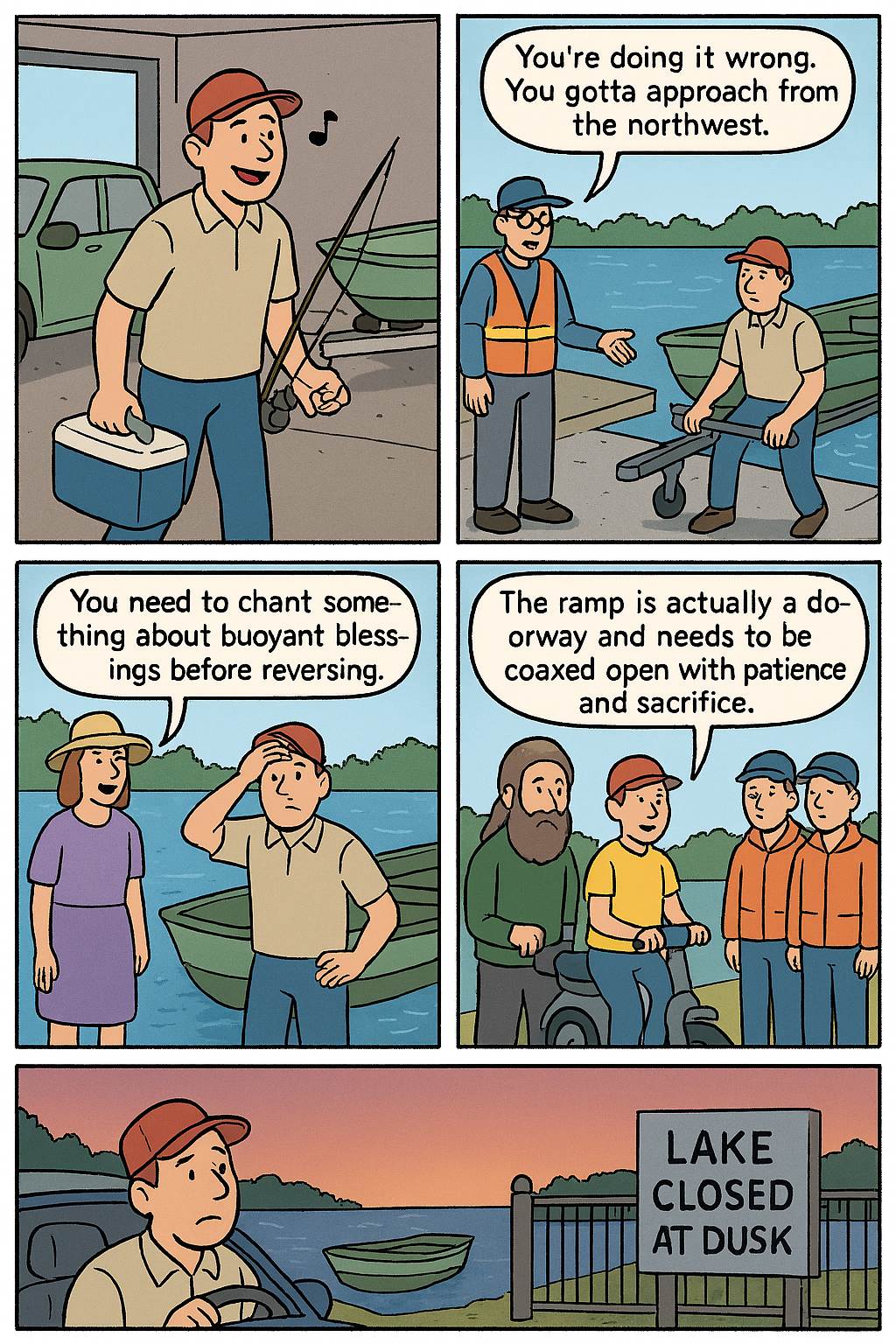
Gary woke up with the kind of optimism usually reserved for sitcom dads on their “one day to themselves.” He whistled while packing his cooler, hummed while hitching the boat, and practically radiated main‑character energy as he pulled into the lakeside parking lot. Today, finally, he would fish.
The ramp, however, had other plans.
At first glance it looked normal—concrete, slightly cracked, sloping politely into the water. But as Gary backed his trailer toward it, a man in a neon‑orange vest materialized from behind a trash can.
“You’re doing it wrong,” the man said, though Gary hadn’t actually done anything yet. “You gotta approach from the northwest. Ramp only accepts northwest entries.”
Gary blinked. “The… ramp accepts… entries?”
But the man was already gone, replaced by a woman in a sunhat who insisted he needed to chant something about “buoyant blessings” before reversing. Then a teenager on a scooter rolled by and claimed the ramp was “closed for spiritual molting.” A fisherman with a beard down to his chest told Gary the ramp was actually a doorway and needed to be “coaxed open with patience and sacrifice.” A pair of twins in matching windbreakers insisted he had to unhitch the boat, push it by hand, and “trust the lake to decide.”
Every time Gary tried to back up, someone new appeared with a contradictory rule. Every time he tried to ignore them, the ramp seemed to tilt slightly, or the trailer wheels stuck, or the boat shifted in a way that made no physical sense. Hours passed. The sun drifted. The oddities multiplied.
By mid‑afternoon, Gary was sweating, confused, and beginning to suspect he had slipped into a parallel universe where ramps had opinions and strangers were assigned to mislead him for sport.
Finally—miraculously—he got the boat into the water. He exhaled, triumphant. All he had to do was park the truck and—
A metallic groan echoed across the lake. The entrance gate slid shut with the slow, deliberate finality of a prison door. A sign lit up: LAKE CLOSED AT DUSK.
Dusk. Already.
Gary stared at the sky, which had somehow skipped straight from late afternoon to early night, as if someone had fast‑forwarded the sun.
He drove home in silence, boat still wet, fishing gear untouched, the faint feeling that the ramp was laughing at him lingering in the back of his mind.
He went to bed defeated, tired, and absolutely certain of one thing:
next time, he was bringing a friend as a witness.
The Tag of Inconvenience
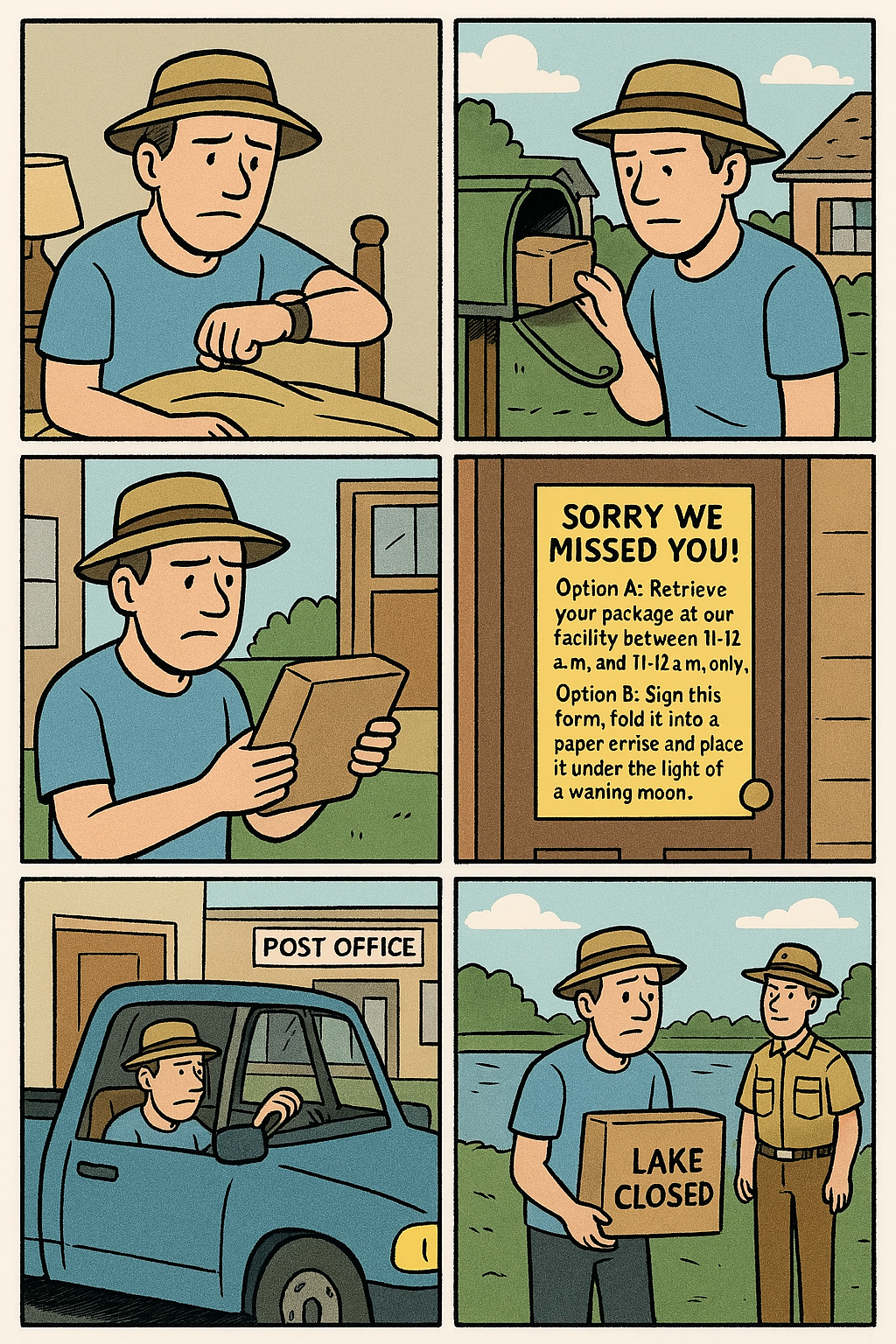
Ray popped out of bed at 5:47 a.m., already wearing his fishing hat. Today was the day. The lake was calling, the trout were practically texting him, and he had packed his tackle box with the precision of a surgeon prepping for a heart transplant.
Only one thing stood between him and bliss: two packages from the postal service. One cheap little thing—replacement bobbers—and one expensive, glorious, top‑of‑the‑line reel he’d splurged on after three beers and a YouTube tutorial titled “Fishing Gear You Absolutely Don’t Need But Will Definitely Want.”
He opened the mailbox.
There sat the bobbers.
The reel was nowhere.
He checked the tracking.
Delivered.
He refreshed.
Delivered.
He closed the app, reopened it, refreshed again.
Delivered.
He walked in a loop around his house like a sitcom dad searching for the plot. He checked the bushes. He checked behind the trash cans. He checked the neighbor’s porch, pretending to admire their wind chimes.
Nothing.
Finally, he trudged to the front door—and there it was. A bright orange tag slapped dead center like a parking ticket on his hopes.
“SORRY WE MISSED YOU!”
Below it, a list of options that felt like they’d been written by a trickster god:
Option A: Retrieve your package at our facility between 11:12 a.m. and 11:17 a.m. only.
Option B: Sign this form, fold it into a paper crane, and place it under the light of a waning moon.
Option C: Wait for a second delivery attempt sometime between now and the end of civilization.
Ray stared at the tag. The wind rustled. Somewhere, a dog barked ominously. The world tilted just slightly, like an episode of The Twilight Zone where the twist is just bureaucracy.
He drove to the postal facility, which looked exactly like a place where time goes to dissolve. Inside, a clerk handed him his package without looking up, as if Ray had always been destined to arrive at that exact moment in the cosmic script.
By the time he got back to his truck, the sun was already sliding down. He sped to the lake anyway, clutching the box like a sacred relic.
He arrived just in time to watch the ranger swing the gate closed with the slow, ceremonial finality of a medieval drawbridge.
“Lake’s closed,” the ranger said. “Try tomorrow.”
Ray nodded, defeated, the new reel still sealed in its cardboard coffin.
He drove home in silence, fishing hat drooping, the universe once again proving that the greatest catch of all… is disappointment.
But he’d try again tomorrow. Sitcom rules.
Darren woke up with the kind of optimism usually reserved for sitcom dads on Very Special Episodes. His tackle box gleamed. His thermos was full. His flannel shirt practically hummed with purpose. Today—finally—he was going fishing.
He locked the door behind him, whistling as he loaded his gear into the truck. The sun was barely up, the lake was calling his name, and for once the universe seemed to be cooperating.
Then his phone rang.
He glanced at the screen. Work. Of course.
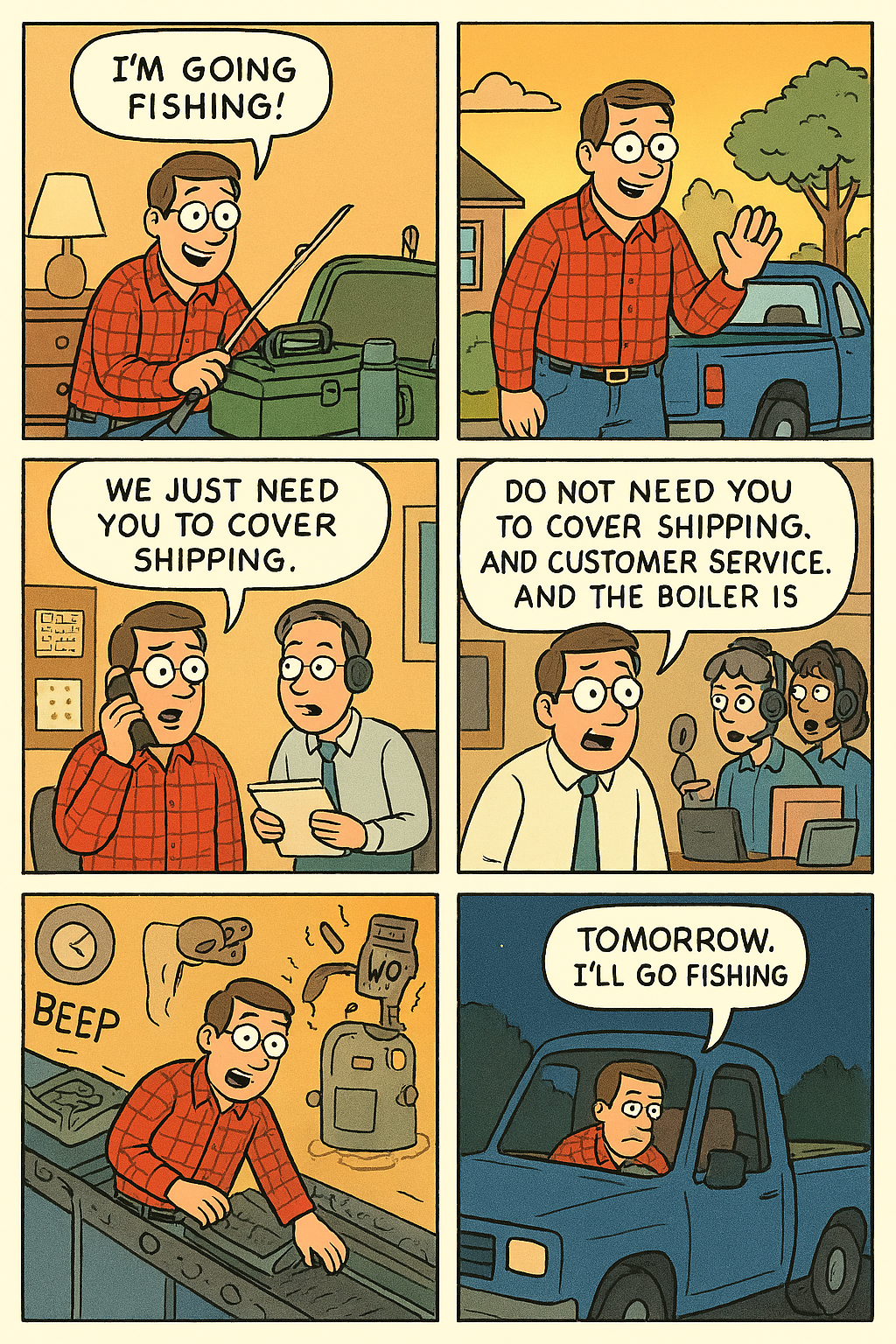
He answered anyway, because that’s what responsible adults in laugh-track universes do. “Hey Darren, sorry, tiny favor,” his manager said, voice trembling with the kind of panic that suggested sprinklers were going off indoors. “Could you come in for, like… ten minutes? Just to help us get started?”
Ten minutes. The deadliest phrase in the English language.
He sighed, turned the truck around, and headed to the office.
The moment he stepped inside, the world shifted. The lights flickered in a way that felt less electrical and more sentient. His coworker Janice was wearing three headsets at once, speaking into all of them simultaneously. Someone had taped a sign to the breakroom door that read “DO NOT OPEN—THE HUM IS ANGRY.”
“Darren!” the manager cried, sprinting toward him with a stack of papers that looked like they’d been printed by a machine in distress. “We just need you to cover shipping. And customer service. And also the boiler is making a noise like a haunted tuba.”
He blinked. “I’m… in accounting.”
“Exactly! You’re versatile!”
The day dissolved into a surreal montage: Darren plunging his arm into a jammed conveyor belt that whispered his name; Darren soothing a customer who insisted their package had been delivered to an alternate timeline; Darren staring at the boiler as it emitted a low, mournful moo.
Every time he checked the clock, the hands seemed to move in ways clocks should not. At one point they spun backward. At another, they spelled out “NO.”
Finally—finally—the last crisis sputtered out. The lights steadied. The hum quieted. The boiler sighed, as if exhausted from haunting.
Darren stumbled outside.
It was dark.
Not evening-dark. Night-dark. The kind of dark that meant the lake had been closed for hours.
He sat in his truck, tackle box still gleaming, thermos still full, flannel still humming faintly with the ghost of hope.
He drove home in silence, defeated and bone-tired, feeling like he’d spent the day trapped in a cosmic rerun of a show he never agreed to star in.
Tomorrow, he told himself.
Tomorrow he’d go fishing.
The universe, somewhere, chuckled.
The morning had that perfect, impossible stillness—the kind fishermen swear is a sign the universe is finally on their side.
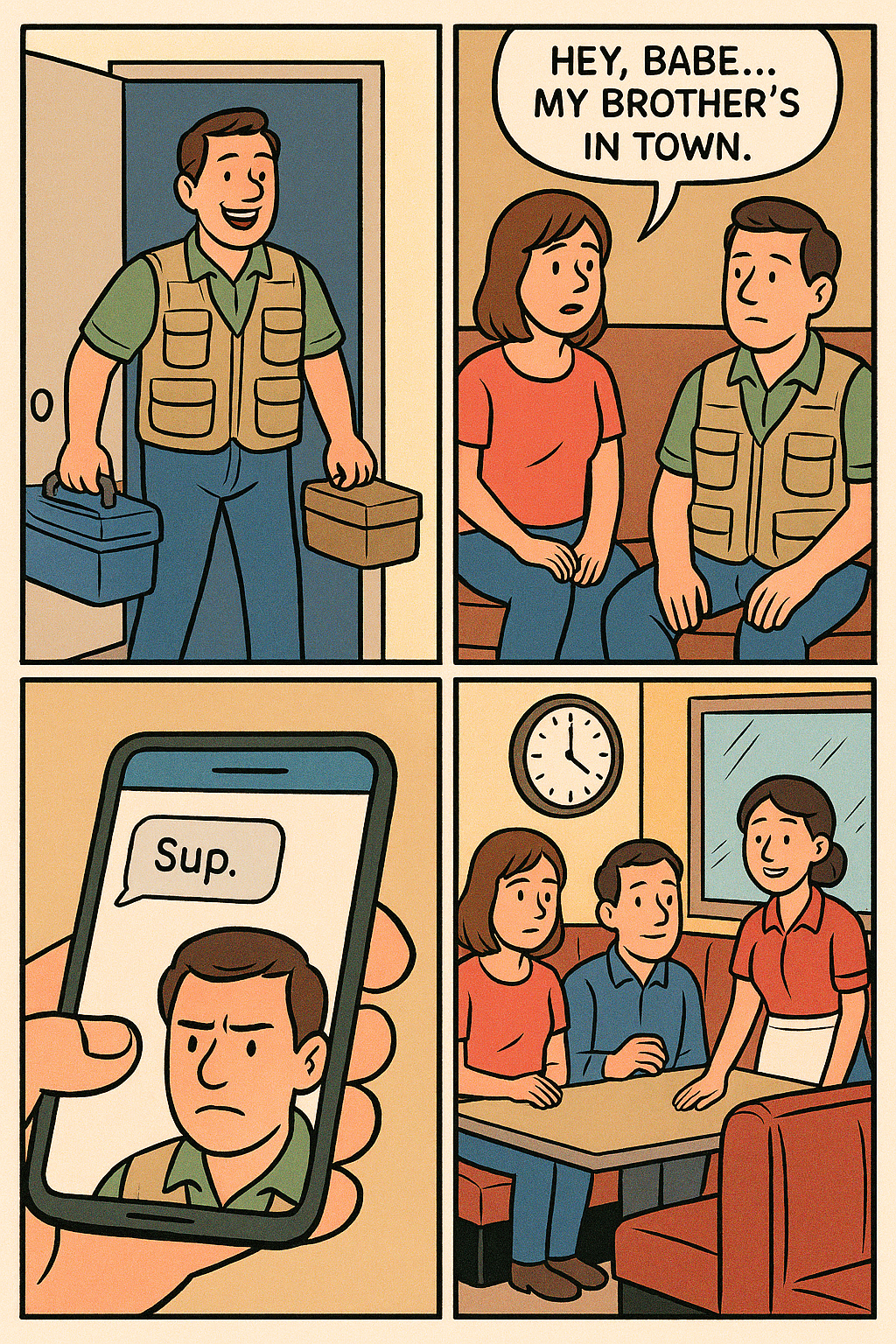
Glen stood in the doorway with his tackle box, cooler, and the kind of optimism that only appears before sunrise. He could practically hear the lake calling his name.
Then his wife, Marcy, appeared in the hallway like a sitcom foil emerging from stage left.
“Hey, babe… my brother’s in town.”
The tackle box thunked against Glen’s shin. “Now?”
“Yeah. He texted at 2 a.m. He wants to hang out today. We’re just waiting for him to respond.”
And just like that, the universe folded its arms.
They sat on the couch, Glen still wearing his fishing vest like a man clinging to a dream. Marcy kept checking her phone. Every buzz made Glen flinch with hope, only to discover it was a coupon, a weather alert, or a message from her group chat titled Wine Moms Assemble.
Hours passed. The sun climbed. Glen’s optimism wilted like a worm on a hot dock.
Finally—finally—her brother texted.
“Sup.”
That was it. One word. A cosmic joke.
But somehow that single syllable triggered a chain reaction: plans formed, a meeting spot was chosen, and Glen found himself driving to a diner that looked exactly like the kind of place where time loops happen in Twilight Zone reruns.
Inside, everything felt… off.
The waitress greeted them with a smile that didn’t blink. The clock on the wall ticked backward. A man in the corner stirred his coffee in perfect, mechanical circles. Marcy’s brother waved from a booth, but his expression was strangely serene, like he’d been waiting there for years.
“Hey,” he said, as if he hadn’t just stolen half a day from Glen’s life.
Glen sat down, feeling the fishing rod in his trunk vibrate with unspent destiny. The air hummed faintly, like the diner itself was holding its breath.
“So,” Marcy’s brother said, “what do you guys wanna do today?”
Glen stared at him. At the backward clock. At the unmoving waitress. At the sunlight outside that looked suspiciously like late afternoon.
He realized, with sitcom clarity and Twilight Zone dread, that the day was already gone.
Somewhere, far away, the lake rippled—waiting for a man who would never arrive.
And Glen, still wearing his fishing vest, sighed the sigh of a man who knew he’d been written into the wrong episode.
The waitress greeted them with a smile that didn’t blink. The clock on the wall ticked backward. A man in the corner stirred his coffee in perfect, mechanical circles. Marcy’s brother waved from a booth, but his expression was strangely serene, like he’d been waiting there for years.
“Hey,” he said, as if he hadn’t just stolen half a day from Glen’s life.
Glen sat down, feeling the fishing rod in his trunk vibrate with unspent destiny. The air hummed faintly, like the diner itself was holding its breath.
“So,” Marcy’s brother said, “what do you guys wanna do today?”
Glen stared at him. At the backward clock. At the unmoving waitress. At the sunlight outside that looked suspiciously like late afternoon.
He realized, with sitcom clarity and Twilight Zone dread, that the day was already gone.
Somewhere, far away, the lake rippled—waiting for a man who would never arrive.
And Glen, still wearing his fishing vest, sighed the sigh of a man who knew he’d been written into the wrong episode.
The morning had that perfect, crisp “today’s‑the‑day” feeling—the kind of morning where the sun practically pats you on the back and says, Go get that fish, champ.
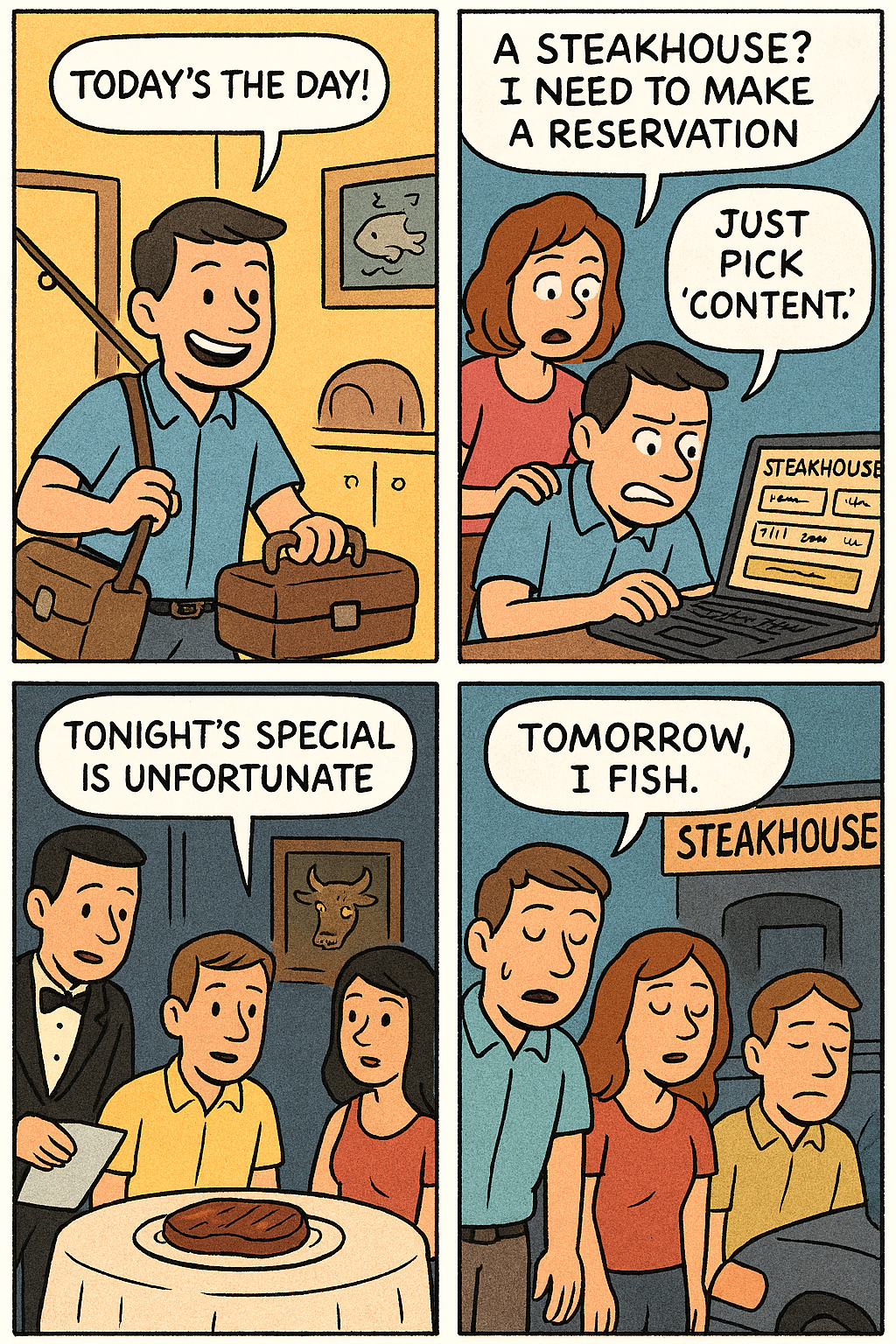
Glen zipped up his tackle bag, slung it over his shoulder, and marched toward the door like a man fulfilling destiny.
Then his wife called out, “Hey, before you go—my brother’s coming into town today.”
Destiny tripped over its own shoelaces.
Within minutes Glen was hunched over his laptop, trying to make a reservation at a steakhouse whose website behaved like it had been designed by a committee of ghosts. Every time he clicked “7:00 PM,” the page flickered and replaced it with “3:12 AM.” The “Confirm Reservation” button kept drifting slowly across the screen like it was trying to escape. A pop‑up asked him to “Select your preferred cow mood.”
His wife leaned over his shoulder. “Just pick ‘content.’ He likes his steaks tender.”
By the time the reservation finally stuck, the sun had climbed high enough to mock him. His fishing pole waited by the door like a loyal dog who knew it wasn’t getting walked today.
That evening, Glen, his wife, her brother, and the brother’s new girlfriend stepped into the steakhouse—and immediately felt the temperature drop. The lighting was dim but somehow too bright. The host smiled with the exact number of teeth you’d expect from someone who had practiced smiling but never actually felt joy. Every table had a single steak knife stabbed upright in the center like a warning.
A waiter glided over without moving his feet. “Welcome. Tonight’s special is… inevitable.”
They were seated next to a painting of a cow whose eyes followed them with unsettling accuracy. The menus were warm to the touch. Every time Glen blinked, the prices changed.
His brother‑in‑law whispered, “Is it… supposed to hum like this?”
The hum grew louder when their steaks arrived—massive slabs that seemed to pulse faintly, as if remembering something. Glen cut into his, and the lights flickered. The waiter appeared again, silently, holding a tray of sauces that all looked identical but were labeled “Past,” “Present,” and “Future.”
They ate anyway. Because what else do you do in a place like that?
By the time they stumbled out into the parking lot, the world felt normal again—except for the collective meat sweats that hit them like a tranquilizer dart. Glen sagged against the car, exhausted, full, and slightly concerned he might be radiating beef.
As they drove home, he glanced at his untouched fishing gear in the backseat. The lake would have to wait. Today had been swallowed whole by family obligations, eldritch steak, and whatever dimension the reservation system lived in.
He sighed, sinking deeper into the seat.
“Tomorrow,” he muttered. “Tomorrow I fish.”
The universe, somewhere, chuckled.
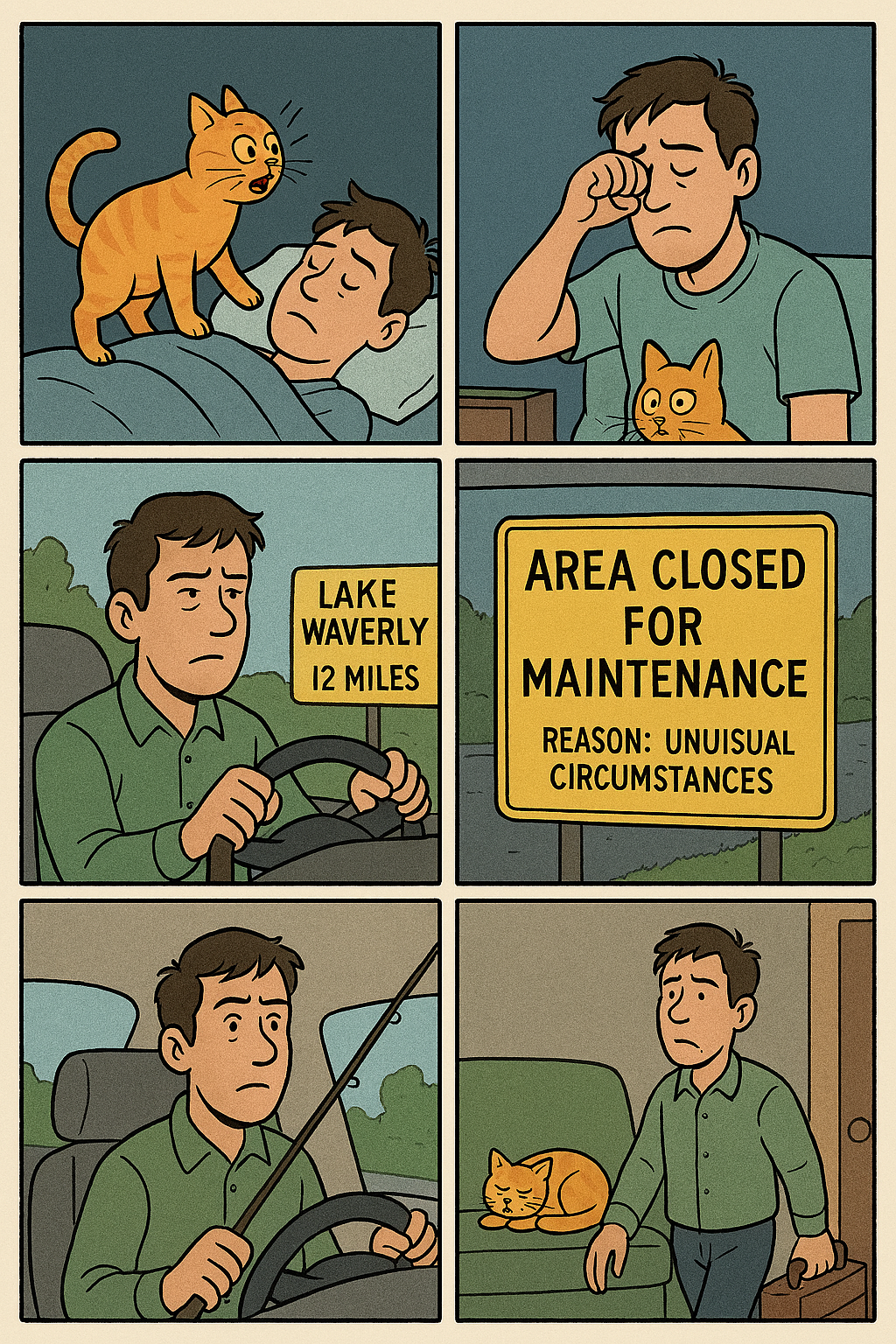
A soft thump lands on Harold’s chest at 3:12 a.m.
Not 3:00. Not 3:30.
3:12. The witching hour for cats with no respect for human alarms.
Marmalade, his orange tabby, stares down at him with pupils like cosmic voids and lets out a single, declarative meow. The kind that means Get up, mortal. Destiny calls.
Harold had planned to wake at 6:00, drive to Lake Waverly, and finally—finally—go fishing after three straight weeks of life’s nonsense. But Marmalade’s early-morning coup derails everything. By the time Harold feeds the cat, stumbles through making coffee, and remembers how pants work, he’s already drifting through the day like a man underwater.
Still, he loads his tackle box, grabs his thermos, and heads out. The sun is barely up. The world feels slightly off-kilter, like someone nudged reality a few degrees to the left.
Halfway to the lake, he notices the road signs are… wrong.
“LAKE WAVERLY – 12 MILES”
Then, a mile later:
“LAKE WAVERLY – 14 MILES”
Then:
“LAKE WAVERLY – 13.5 MILES (APPROX.)”
He blinks hard. Maybe the sleep deprivation is playing tricks. Maybe the Department of Transportation hired a surrealist. Maybe he’s slipped into a low-budget Twilight Zone rerun.
When he finally reaches the lake, relief washes over him—until he sees the first sign:
AREA CLOSED FOR MAINTENANCE
REASON: UNUSUAL CIRCUMSTANCES
He drives to the next entrance.
Closed.
The next.
Closed.
The next.
Closed, with an additional handwritten note taped underneath:
DO NOT ASK QUESTIONS.
Harold circles the entire lake, each access point blocked by cones, tape, or a ranger who refuses to make eye contact. At one gate, a maintenance worker in a reflective vest whispers, “We’re… recalibrating the shoreline,” then shuts the booth window before Harold can respond.
By the time he completes the loop, the sun is dipping low. His thermos is empty. His eyelids feel like sandpaper. Marmalade’s 3:12 a.m. wake-up call has finally caught up with him.
He drives home in a daze, unsure whether he dreamed the whole thing or if the lake truly needed recalibration. When he walks through the door, Marmalade is waiting on the couch, curled like a smug croissant.
Harold sighs, drops his keys, and mutters, “Tomorrow. I’ll try again tomorrow.”
Marmalade blinks slowly, as if to say, We’ll see.
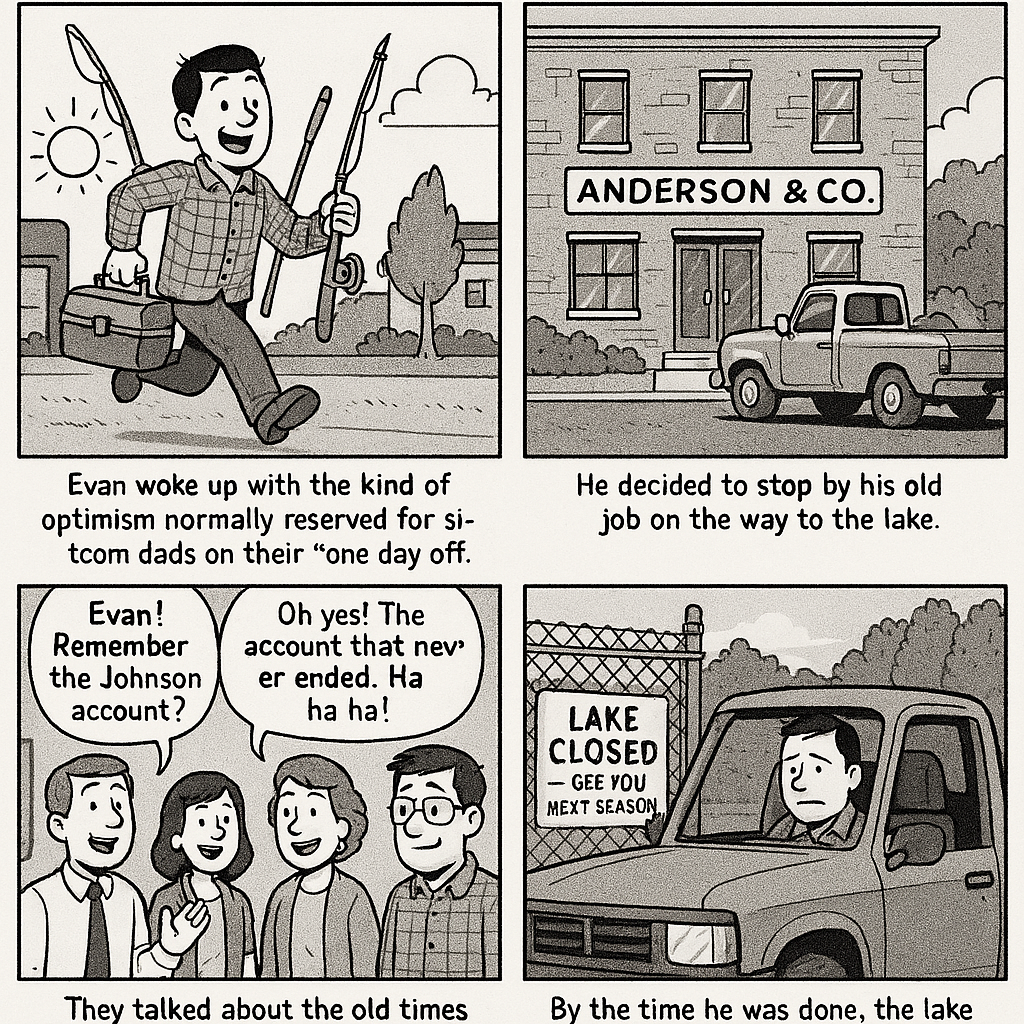
Evan woke up with the kind of optimism normally reserved for sitcom dads on their “one day off.” The sun was perfect, the tackle box was packed, and he even whistled on the way to his truck—an act he hadn’t performed since 2009.
Halfway to the lake, he spotted the old office building where he used to work. The sign out front still flickered the same way it had when he quit. He told himself he’d just swing by for a quick hello, a nostalgic pit stop, a harmless detour. Classic sitcom setup.
Inside, everything looked exactly as he remembered—down to the crooked motivational poster and the faint smell of burnt coffee. But the people… the people were wrong.
His old coworkers greeted him with smiles stretched a little too wide, like they’d been practicing in a mirror. Their voices were cheerful but slightly delayed, as if dubbed over by someone who didn’t quite understand human timing.
“Evan! Remember the Johnson account?” one said, eyes unblinking.
“Oh yes,” another chimed in, “the account that never ended. Never ended. Never ended.”
They all laughed in perfect unison, a sound like a sitcom laugh track played half a beat too slow.
Evan tried to leave three separate times, but each attempt was intercepted by someone wanting to reminisce about “the good old days,” which they described with details Evan was certain had never happened. A company picnic where everyone floated two inches off the ground. A team-building exercise involving a maze that rearranged itself. A quarterly meeting where the conference table whispered stock tips.
By the time he finally escaped—backwards, sideways, he wasn’t sure—he felt wrung out, like someone had squeezed the color out of him.
He drove to the lake anyway, clinging to the hope that a few minutes by the water would salvage the day. But when he arrived, a large sign greeted him:
LAKE CLOSED — SEE YOU NEXT SEASON
The gate was locked. The sun was gone. The optimism had evaporated.
Evan sat in his truck for a long moment, staring at the dark water beyond the fence. Then he turned the key, sighed the sigh of a man who had been sitcom‑trope’d and Twilight‑Zoned in the same afternoon, and headed home—tired, defeated, and absolutely not whistling.
The morning had that crisp, electric promise—the kind that practically hands you a fishing pole and says, Go on, champ, destiny awaits.
So Martin rolled out of bed, humming his “day off” anthem, packed his cooler, and marched to the lake like a man fulfilling a sacred sitcom ritual.
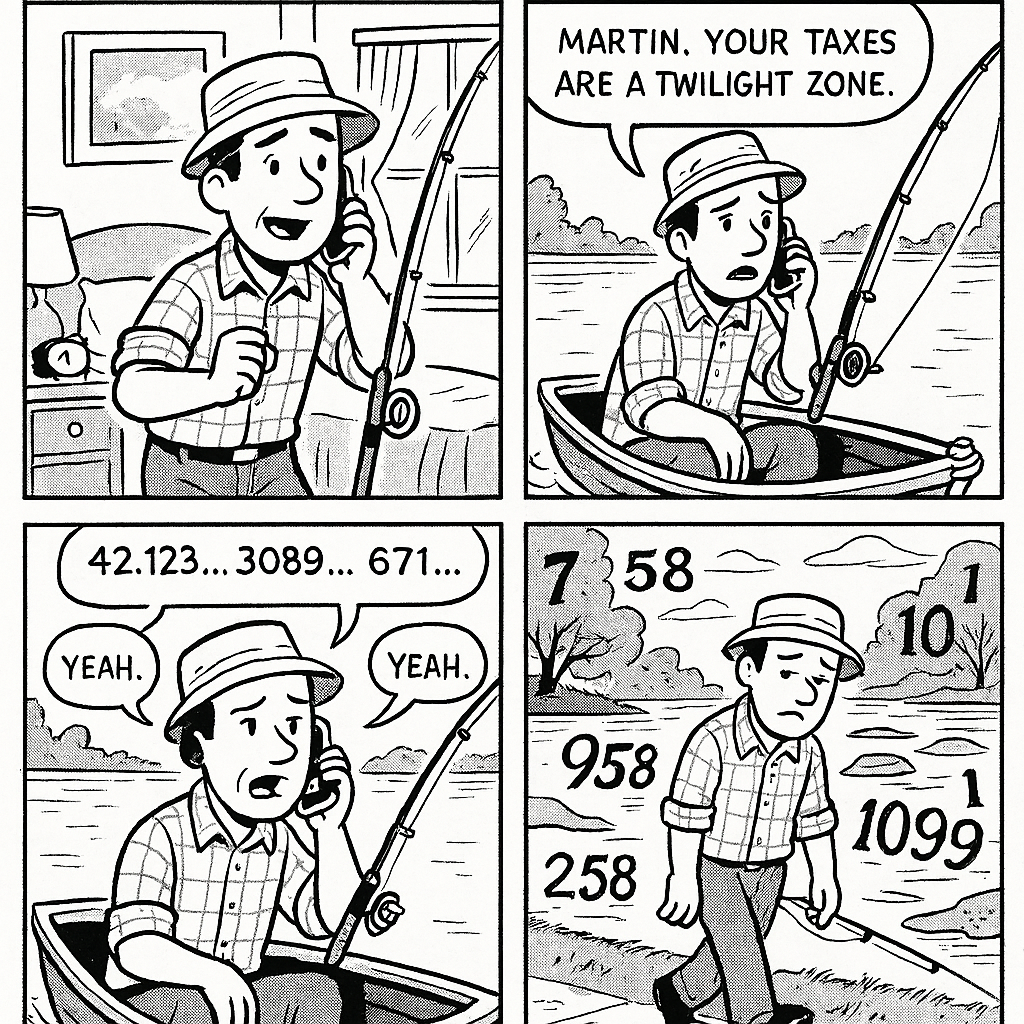
By 7:12 a.m., he was already drifting across the glassy water in his little aluminum boat, sun on his shoulders, tackle box open, heart full. He raised his rod, ready to cast the first line of the day.
Then his phone buzzed.
He considered ignoring it. But the universe, with impeccable comedic timing, flashed the caller ID: Terry – Tax Accountant.
He sighed and answered.
“Martin,” Terry said, voice trembling like a man who had stared too long into forbidden spreadsheets, “we have… anomalies.”
And just like that, the lake day dissolved into a bureaucratic fever dream.
For hours, Martin sat in his boat, phone pressed to his ear, as Terry described tax scenarios that sounded like they’d been drafted by Rod Serling after a head injury.
“Line 14B requires you to report any income earned from… interpretive whistling.”
“Your deductions for ‘emotional depreciation’ need itemized proof.”
“The IRS wants clarification on why you listed ‘existential dread’ as a dependent.”
Martin dutifully read off numbers that made no mathematical sense.
“Forty-two point… what? Terry, that’s not even a number, that’s a mood.”
“Just write it down,” Terry whispered. “The forms demand it.”
The sun crawled across the sky. His fishing rod lay untouched. His cooler grew warm. His hope curdled.
Finally, at dusk, Terry said, “Okay… I think we’re done. For now.”
The call ended. Silence returned.
Martin looked out over the lake—and froze.
The water was no longer water. It was a shimmering field of floating numerals, drifting like lily pads. Giant 7s bobbed gently. A cluster of 3.14s spiraled like a school of fish. A massive, melting 1099 slouched across the surface like a Dali clock.
He blinked. The numbers blinked back.
That was it. He rowed to shore.
As he trudged to his truck, defeated, he muttered, “Next year I’m filing for an extension.”
He drove home tired, sunburned, and fishless—another sitcom hero bested by the Twilight Zone logic of adulthood.
The morning felt charmed at first.
He woke before his alarm, humming with that rare, electric certainty that today—finally—would be the day he made it to the lake without incident. His gear was packed, his thermos was full, and the sky was still a soft, forgiving gray as he drove out.
But the moment he backed his boat down the ramp, the world shifted half a degree off-center. The winch jammed. The rope tangled. The boat drifted sideways for no reason at all, as if the lake itself were stalling him. Even the water looked slightly wrong—too still, too glassy, like a set piece waiting for the director to yell action.
By the time he motored out to his favorite spot, the sun had climbed higher than it should have. He felt as though he’d slipped through a thin crack in reality, where time stretched like taffy and every simple task required a negotiation with unseen forces.
Still, he made it. He stood, rod in hand, ready to cast.
Then his phone buzzed.
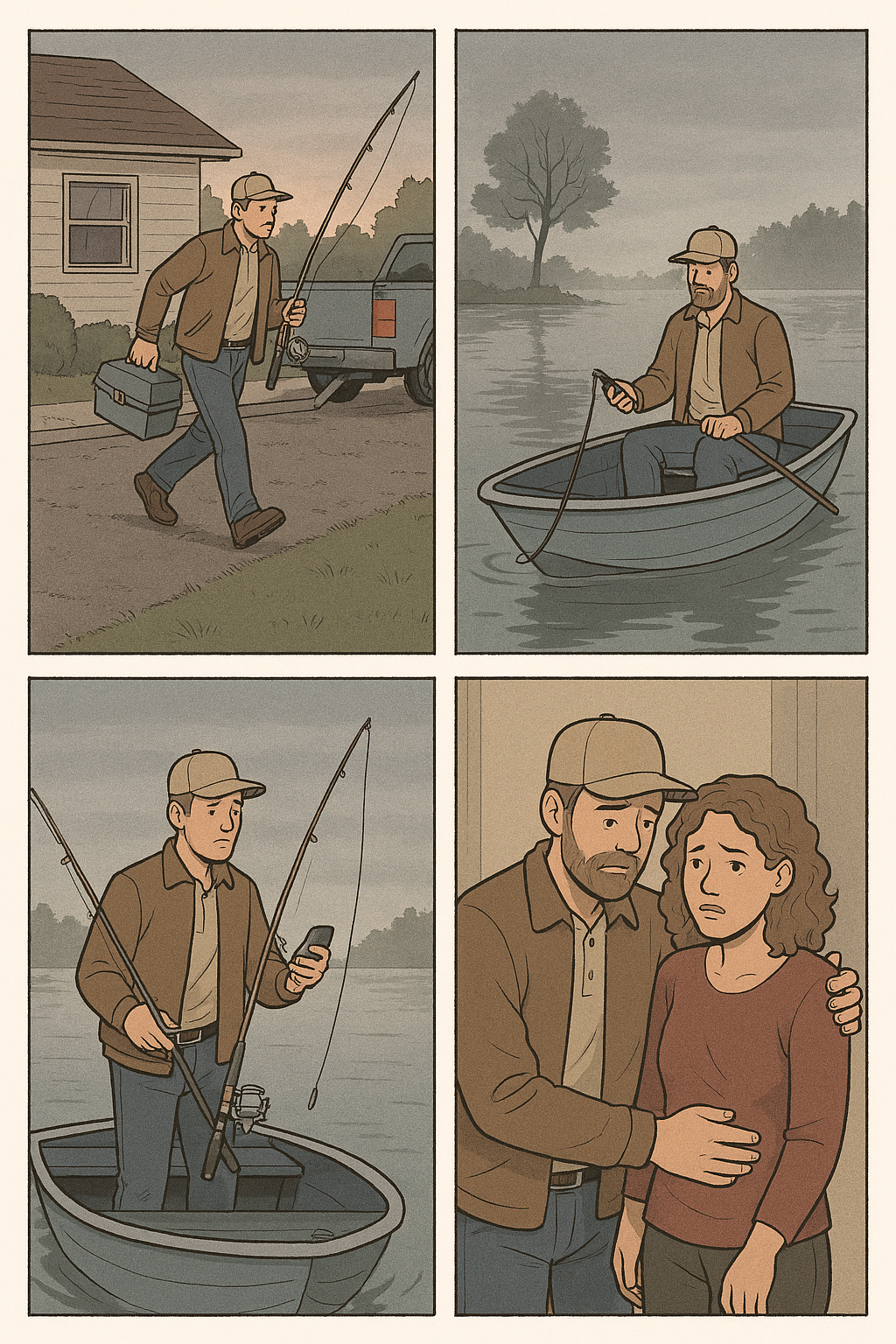
His wife’s voice came through thin and shaky. “I… I got laid off. They said it was AI. And some other bizarre nonsense I didn’t even understand.”
He stared at the lake. The perfect stillness. The eerie quiet. The sense that if he cast his line, the fish might rise up and hand him a pink slip of their own.
“Yeah,” he said softly. “I’m coming home.”
He reeled in a line he hadn’t even thrown, turned the boat around, and felt the weight of the day settle on him like wet clothes. By the time he reached the dock, he was exhausted in a way that had nothing to do with fishing.
But when he walked through the front door and saw his wife’s trembling smile, he knew he’d made the right choice. He wrapped his arms around her, both of them tired, both of them defeated, but at least not alone in the strange, shifting world they were stuck navigating together.
Morning broke like a canned laugh track—bright, predictable, and a little too eager.
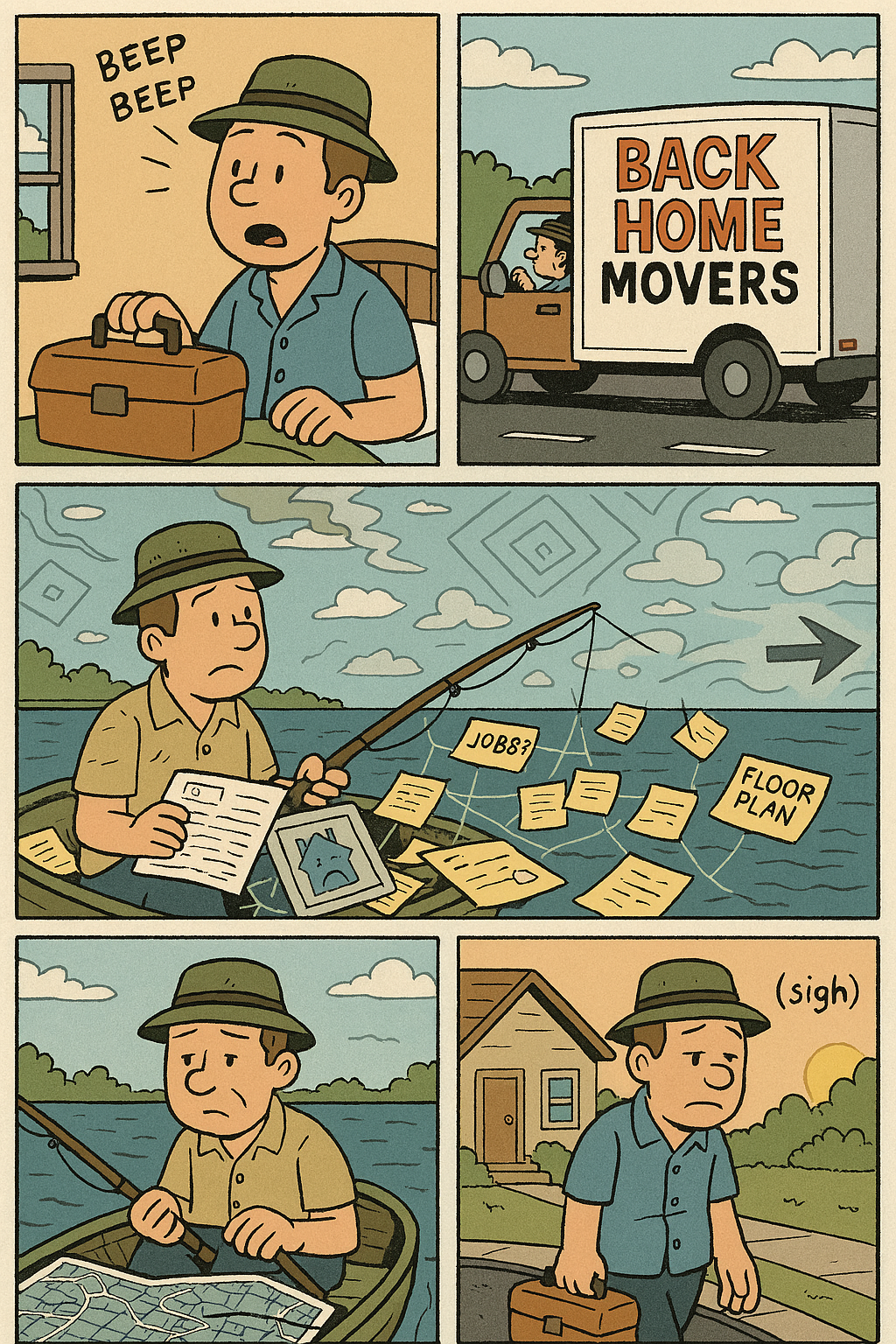
Grant rolled out of bed already wearing his fishing hat, as if his subconscious had clocked in early. He grabbed his tackle box, hummed a theme song that didn’t exist, and marched out the door with the confidence of a man who believed—truly believed—that today would finally be the day he made it to the lake without incident.
On the drive, he passed a moving company truck parked crookedly on the shoulder.
“Back Home Movers,” the sign read in cheerful bubble letters.
That was all it took.
A single sitcom ding! sounded in his head, and suddenly he was spiraling through a mental montage of childhood bedrooms, old friends, and the smell of his mother’s overcooked spaghetti. By the time he reached the lake, he was no longer thinking about trout—he was thinking about floor plans, job listings, and whether nostalgia counted as a tax deduction.
He pushed his boat onto the water anyway, determined to multitask.
That was his first mistake.
Within minutes, his fishing boat looked like a conspiracy theorist’s living room. Sticky notes fluttered in the breeze like frightened birds. A notebook lay open to a page titled “Pros of Moving Back Home” with nothing written underneath except a doodle of a house crying. His fishing rod, abandoned as a tool of leisure, had become a makeshift pointer as he traced imaginary highways across the lake’s surface.
Every time he tried to focus, the world seemed to tilt.
The water rippled in geometric patterns.
The clouds rearranged themselves into arrows pointing nowhere.
The sun flickered like a faulty fluorescent bulb.
It felt less like planning and more like being trapped in an informational spiderweb—threads of memory, obligation, and possibility sticking to him no matter how he swatted. The lake was quiet, but the inside of his head buzzed like a broken intercom.
Hours passed.
His notes multiplied.
His clarity did not.
Eventually, he sat back, defeated, surrounded by paper scraps and existential humidity. The rod slipped from his hand and clattered against the boat floor, pointing nowhere in particular—just like his plans.
Grant sighed, packed up the chaos, and paddled back to shore.
He didn’t catch a single fish.
He didn’t make a single decision.
He just drove home with the sinking realization that sometimes the biggest detours aren’t on the road—they’re in your own head.
And as he walked back into his house, tired and empty-handed, the laugh track returned—soft, sympathetic, and just a little mocking.
It felt less like planning and more like being trapped in an informational spiderweb—threads of memory, obligation, and possibility sticking to him no matter how he swatted. The lake was quiet, but the inside of his head buzzed like a broken intercom.
Hours passed.
His notes multiplied.
His clarity did not.
Eventually, he sat back, defeated, surrounded by paper scraps and existential humidity. The rod slipped from his hand and clattered against the boat floor, pointing nowhere in particular—just like his plans.
Grant sighed, packed up the chaos, and paddled back to shore.
He didn’t catch a single fish.
He didn’t make a single decision.
He just drove home with the sinking realization that sometimes the biggest detours aren’t on the road—they’re in your own head.
And as he walked back into his house, tired and empty-handed, the laugh track returned—soft, sympathetic, and just a little mocking.
Darren woke up with the kind of optimism usually reserved for lottery winners and golden retrievers. Today was the day. The lake was calling his name in a gentle, shimmering falsetto. His tackle box was packed, his thermos was full, and his soul was spiritually aligned with trout.
He made it exactly four blocks before the universe tapped him on the shoulder.
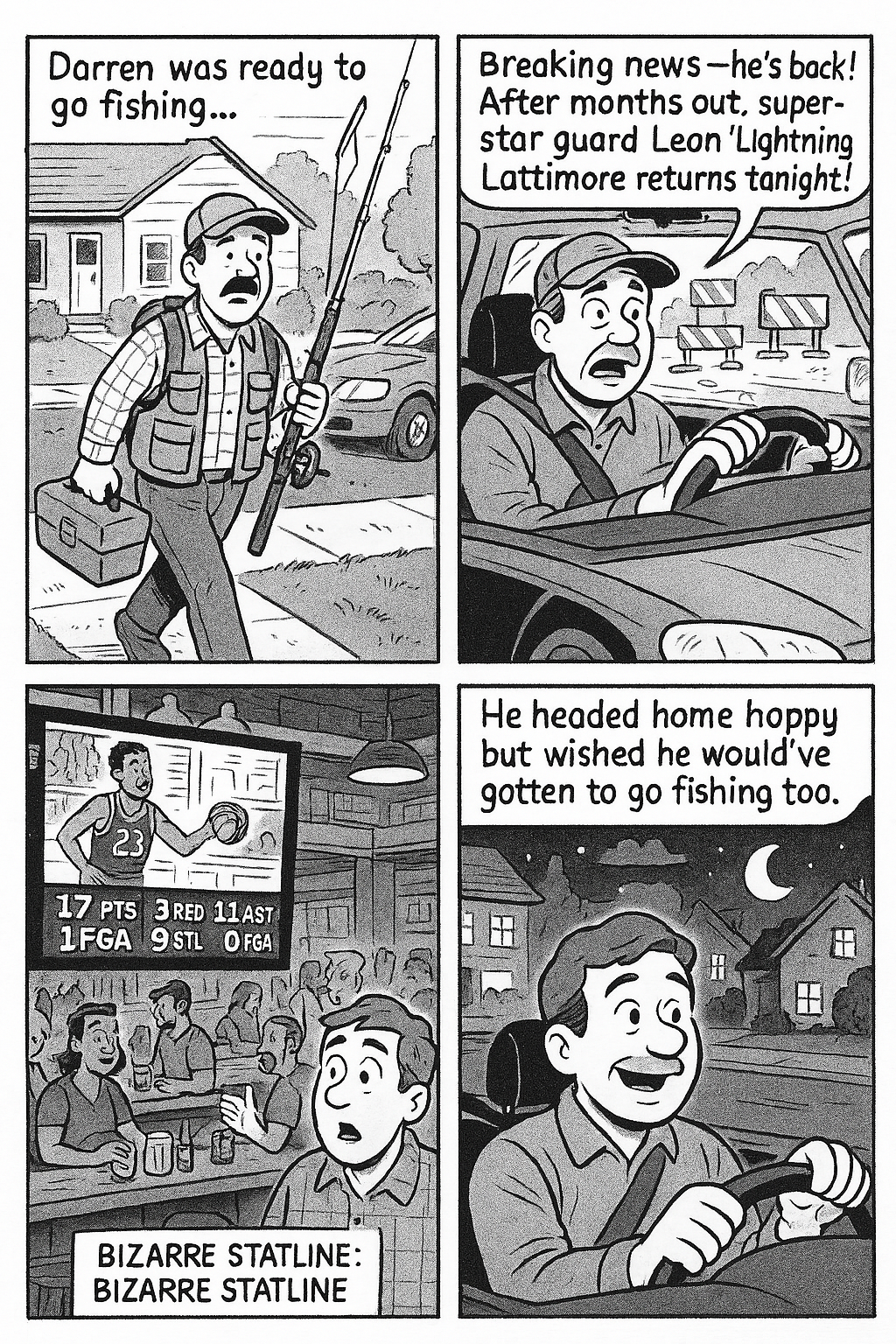
The radio crackled, then burst into life: “Breaking news—he’s back! After months out, superstar guard Leon ‘Lightning’ Lattimore returns tonight!”
Darren froze at a stoplight. Leon Lattimore wasn’t just his favorite player—he was practically a religious figure. Darren had once named a houseplant after him. The plant died, but the devotion lived on.
Fishing could wait an hour. Maybe two. Maybe three if Leon got hot.
He swung the car toward O’Malley’s Sports Bar, but the streets had other plans. First came the detour sign that hadn’t been there yesterday. Then the detour after the detour. Then the detour that looped him back to the first detour. He began to suspect the city planner was either incompetent or a cosmic trickster.
At one point he passed the same jogger three times—same outfit, same ponytail, same expression of mild judgment. On the fourth pass, she waved knowingly, as if to say, You’re not getting to that lake, buddy.
By the time he reached O’Malley’s, the sun had shifted in a way that felt… wrong. The bar was packed, but eerily quiet, like everyone was waiting for a cue. The TVs flickered with static before the game finally appeared, slightly delayed, slightly distorted, slightly… uncanny.
Leon Lattimore looked different too—taller? Shorter? Maybe both? His limbs moved like someone had programmed him in a hurry. His statline began to scroll across the screen:
17 points, 3 rebounds, 11 assists, 9 steals, 0 field goal attempts.
Darren blinked. The bar patrons blinked. Even the bartender blinked twice, which he never did.
“How do you score 17 points without taking a shot?” Darren whispered.
A man beside him replied without turning his head, “Free throws. All free throws. Every foul was called before the play happened.”
The game grew stranger. Leon dribbled without touching the ball. The opposing team occasionally froze mid-play, staring into the camera as if asking for help. At one point, Leon passed to himself off the scoreboard.
And yet—he dominated. The crowd on TV roared in a looping, slightly off-tempo cheer. The bar patrons clapped in perfect unison, like a laugh track that had gained sentience.
When the final buzzer sounded, the scoreboard read:
WINNER: LEON
Not his team. Just him.
The bar erupted. Darren felt a warm, surreal glow in his chest. His hero was back. Reality was questionable, but his joy was real.
He stepped outside into the night, the world feeling a little tilted, a little dreamlike. He headed home with a smile, humming the jingle from a fishing commercial he’d heard earlier.
He was happy—genuinely, deeply happy.
But as he pulled into his driveway, he sighed.
“Man… I really wanted to go fishing.”